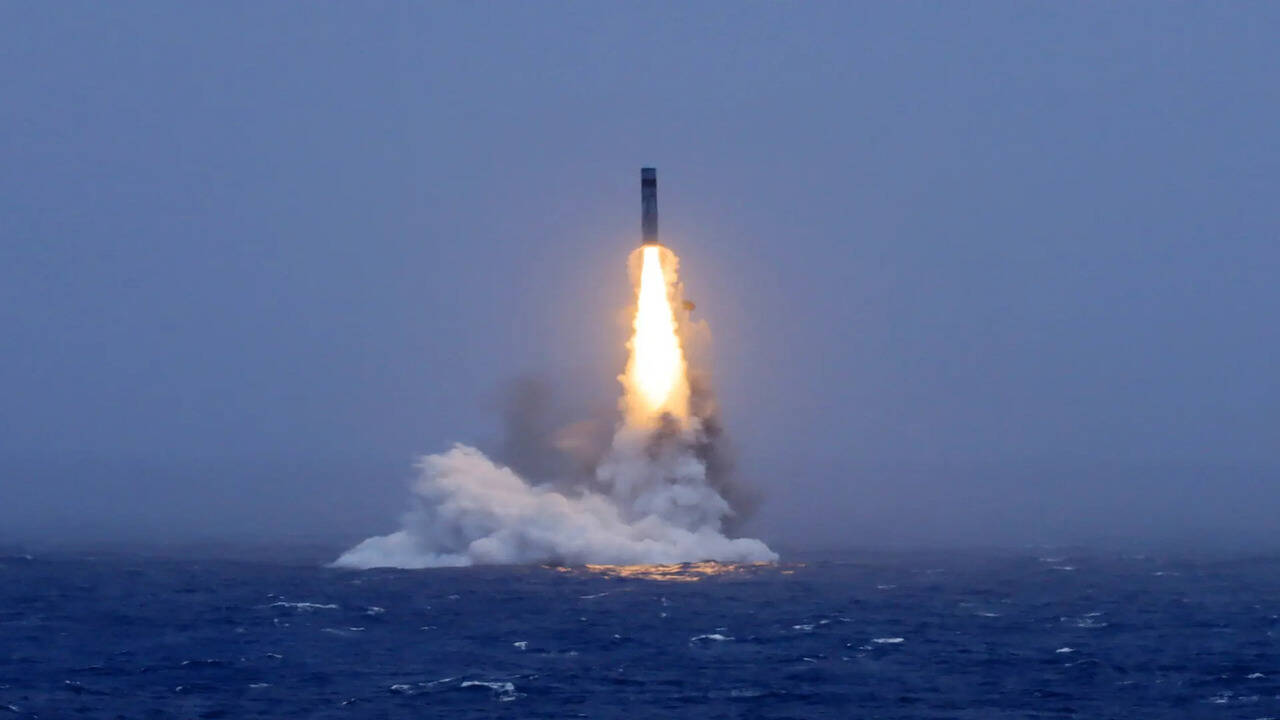
China's Pacific Missile Test Rattles Allies, Raises Regional Tensions
China conducted a rare submarine-launched ballistic missile test in the Pacific, drawing strong criticism from the US, Australia, and New Zealand. While China claims it was routine training, allies view it as a destabilizing act amid concerns over Beijing's military expansion and lack of transparency. The test coincided with a new defense pact between Australia and Fiji, further escalating regional security concerns.
Key Highlights
- China tested a submarine-launched ballistic missile in the Pacific.
- US, Australia, and New Zealand expressed strong concerns.
- The test is seen as part of China's military expansion.
- Concerns raised over China's transparency regarding military activities.
- Test occurred as Australia and Fiji signed a new defense pact.
- Missile landed in the South Pacific Nuclear Free Zone.
China's recent test-firing of a ballistic missile from a nuclear-powered submarine into the Pacific Ocean has triggered significant alarm among allied nations, including the United States, Australia, and New Zealand. The launch, which occurred on a Monday at 12:01 PM local time, involved a missile carrying a dummy warhead that landed in designated waters within the Pacific. While China's state media, Xinhua, described the event as a "routine arrangement" in annual military training, not directed at any specific country or target, and asserted compliance with international law, regional powers have interpreted it as a deliberate and destabilizing display of military might.
Australia's Foreign Minister Penny Wong labeled the test "destabilizing" and noted that China's rapid military buildup "lacks the transparency and reassurance as to intent that the region expects". New Zealand's Foreign Minister Winston Peters expressed deep concern, stating that the test was "an unwelcome and concerning development" and that his country, along with its Pacific neighbors, has "no interest in China using the South Pacific as a testing site for missile capability". Japan's government also voiced grave concerns about "the intensification of China's military activities" and urged Beijing to reconsider. The US State Department characterized Beijing's "rapid and opaque nuclear weapons buildup" as a "great concern to the region and the world" and urged China to engage in meaningful arms control discussions.
The timing of the missile test has amplified concerns, occurring just hours after Australia and Fiji signed a new major defense alliance, the "Ocean of Peace" pact, which commits both nations to mutual defense obligations in case of an attack. This development is seen in the context of increasing strategic competition in the Pacific, where China has been actively expanding its economic and security influence, vying for sway with the US and its allies in the strategically important island nations.
Analysts suggest that the test, potentially involving a JL-3 submarine-launched ballistic missile with a range exceeding 10,000 kilometers, is a strategic signal from Beijing. It demonstrates China's growing military capabilities, including its nuclear triad (land-based missiles, strategic bombers, and submarine-launched ballistic missiles), and aims to assert its influence and deter US allies in the region. The test also highlights China's ongoing military modernization, which aims to achieve regional dominance and potentially challenge the US as the world's most powerful nation.
For India, China's expanding missile and nuclear capabilities, including its sea-based deterrent, represent a significant strategic challenge. India is compelled to enhance its own capabilities to counter China's growing atomic and missile delivery systems, facing a dual nuclear challenge from both China and Pakistan. The missile's landing in the South Pacific Nuclear Free Zone has also drawn particular attention and criticism.
Credibility of the sources:
The Times of India is generally considered a reputable news source in India, though some analyses suggest a right-center bias and mixed factual reporting. The Hindu is generally rated as highly credible with a left-center bias. The Guardian is rated as generally reliable with a left-center bias. CNN is rated as mostly factual with a left-center bias. NDTV is rated as having mixed factual reporting and a lean right bias by some sources, while others rank it as India's most trusted private TV news network.
Verification:
All major claims in the article are corroborated by multiple credible news outlets. The core facts of the missile test, the countries involved, their reactions, and the geopolitical context are consistent across reports from The Times of India, The Hindu, The Guardian, CNN, and NDTV.
Frequently Asked Questions
What kind of missile did China test?
While China has not officially confirmed the exact model, defense experts widely assess it to be the Julang-3 (JL-3) submarine-launched ballistic missile, a nuclear-capable weapon with a potential range exceeding 10,000 kilometers. It is believed to be China's most advanced submarine-launched missile.
Why are countries like Australia and New Zealand concerned about this missile test?
These countries are concerned because the test is seen as a destabilizing act amid China's rapid military expansion and lack of transparency regarding its intentions. It is viewed as a display of growing military assertiveness in the strategically vital Indo-Pacific region.
What is the significance of the test coinciding with the Australia-Fiji defense pact?
The timing is significant as it highlights the escalating strategic competition in the Pacific. The Australia-Fiji pact strengthens regional security ties, while China's missile test is interpreted as a signal to deter such alliances and assert its influence in the region.
How does this missile test relate to India?
China's expanding nuclear and missile capabilities, including its sea-based deterrent, present a growing strategic challenge for India. India is compelled to enhance its own capabilities to counter China's growing military power, especially in light of the dual nuclear threat from China and Pakistan.