US-Iran MoU's Article 5 Sparks Renewed Hostilities in Strait of Hormuz
A fragile US-Iran Memorandum of Understanding, signed on June 17, 2026, aimed at de-escalation, is under severe strain due to conflicting interpretations of its Article 5. This crucial clause, governing commercial navigation in the Strait of Hormuz, has directly triggered a new wave of military strikes, with both nations accusing the other of violations.
Key Highlights
- US-Iran MoU signed June 17, 2026, to end hostilities and de-escalate.
- Article 5 of MoU focuses on safe commercial navigation in Strait of Hormuz.
- Conflicting interpretations of Article 5 sparked recent US-Iran strikes.
- Iran claims authority over Strait's northern corridor; US seeks international routes.
- Strikes threaten global energy markets and regional stability.
- Interim agreement is a framework, not a final peace treaty, with 60-day negotiation period.
A fragile Memorandum of Understanding (MoU) signed between the United States and Iran on June 17, 2026, intended to end hostilities and establish a framework for a broader peace agreement, has quickly become the flashpoint for renewed military strikes in the Middle East. The core of the recent escalation lies in deeply conflicting interpretations of Article 5 (also referred to as Paragraph 5 or Section 5) of this interim agreement, which specifically addresses the critical issue of commercial navigation through the Strait of Hormuz.
This MoU, signed by U.S. President Donald Trump and Iranian President Masoud Pezeshkian, marked a significant diplomatic development aimed at de-escalation, lifting of naval blockades, and addressing sanctions relief. However, it was viewed by many as a temporary pause or a 'mirage of an agreement' rather than a lasting peace treaty, due to its broadly worded and vague language on critical issues, including Iran's nuclear program and regional proxies.
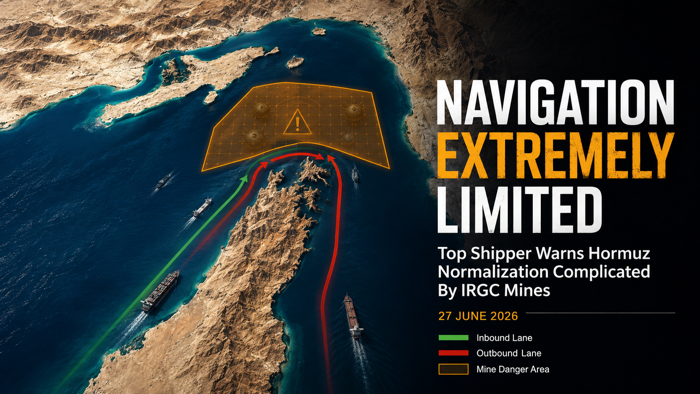
Article 5 of the MoU explicitly outlines commitments regarding the Strait of Hormuz, one of the world's most vital maritime chokepoints, through which approximately one-fifth of global oil supplies pass. It states that Iran will "make arrangements using its best efforts for the safe passage of commercial vessels with no charge for 60 days only, from the Persian Gulf to the Sea of Oman, and vice versa." Furthermore, it mandates Iran to remove technical and military obstacles, including carrying out demining operations within 30 days. Another crucial provision of Article 5 requires Iran to engage in dialogue with Oman and other Persian Gulf littoral states to define the future administration and maritime services in the Strait, in line with international law and the sovereign rights of coastal states.
The current crisis stems from starkly opposing views on how these provisions should be implemented. The United States asserts that freedom of navigation requires internationally coordinated shipping routes, implicitly favoring safer passages, possibly closer to Omani territorial waters. Conversely, Iran vehemently insists that Article 5 recognizes its sovereign authority over the Strait of Hormuz and grants it the right to manage navigation, advocating for the use of a northern shipping corridor within its own territorial waters. Iranian Foreign Minister Abbas Araghchi has publicly stated that the Strait remains under Iran's total oversight for an initial 30 days, emphasizing Iran's sole responsibility for its management and warning against any unilateral actions or interventions that could exacerbate tensions.
This fundamental disagreement over maritime control swiftly led to a fresh cycle of military confrontations. Reports indicate that the US military conducted strikes against Iranian targets, including missile and drone storage locations, coastal radar systems, and other military infrastructure, following alleged Iranian drone attacks on commercial vessels in the Strait of Hormuz. These US strikes were described as a "powerful response" to "unwarranted aggression" and aimed at degrading capabilities used to threaten maritime traffic. In retaliation, Iran launched its own missiles and drones, reportedly targeting US military facilities in the region, including air bases in Kuwait (Ali Al Salem Air Base) and the headquarters of the US Fifth Fleet in Bahrain. President Trump has accused Iran of repeatedly violating the ceasefire memorandum, while Iran has countered, describing US strikes as a breach of the UN Charter and Paragraph 1 of the MoU.
The re-escalation underscores the volatility of the situation despite the signed MoU. Mediators are attempting to bring both sides back to technical talks, with a potential meeting in Qatar to resume negotiations. However, the ongoing dispute over the Strait of Hormuz and the interpretation of Article 5 remains the primary obstacle to preserving the fragile truce and moving towards a comprehensive final agreement. The broader implications of this instability include heightened risks to global energy markets, international shipping, and regional security, with countries like India closely monitoring developments due to their reliance on crude oil transit through the Strait.
This situation is a continuation of long-standing tensions between the US and Iran, rooted in historical mistrust, Iran's nuclear program, ballistic missiles, and regional influence, which also saw a
Frequently Asked Questions
What is the US-Iran Memorandum of Understanding (MoU)?
The US-Iran MoU, signed on June 17, 2026, is an interim agreement aimed at immediately ending military hostilities between the United States and Iran and establishing a framework for negotiating a comprehensive, lasting peace deal within 60 days.
What does Article 5 of the US-Iran MoU specifically address?
Article 5 of the MoU specifically addresses the restoration of safe commercial navigation through the Strait of Hormuz. It requires Iran to facilitate commercial vessel passage without charge for 60 days, remove military obstacles, conduct demining operations, and engage with Gulf states and Oman on the Strait's future administration.
Why has Article 5 led to renewed US-Iran strikes?
Article 5 has led to renewed strikes due to conflicting interpretations. The US advocates for internationally coordinated shipping routes for freedom of navigation, while Iran asserts that Article 5 recognizes its authority to manage navigation through a northern corridor within its territorial waters. This disagreement over control and management of the Strait has directly triggered retaliatory military actions from both sides.
What are the broader implications of this dispute?
The dispute has significant broader implications for global energy security, as the Strait of Hormuz is a critical chokepoint for oil transit. It also threatens regional stability in the Middle East, impacting international shipping, and highlights the fragile nature of the current de-escalation efforts between the US and Iran.
Is this MoU a final peace agreement?
No, the MoU is explicitly an interim agreement and a framework for negotiations, not a final peace treaty. It sets out initial commitments and a 60-day period for both sides to negotiate a comprehensive final deal that would address more complex issues like sanctions, Iran's nuclear program, and regional influence.