China's Chang'e-7 Mission to Survey Lunar South Pole for Resources
China is set to launch its Chang'e-7 lunar mission in the second half of 2026, targeting the Moon's south pole. This robotic mission will conduct extensive environmental and resource surveys, specifically searching for water ice and assessing the region's suitability for a future research base, marking a significant step in China's ambitious lunar exploration program.
Key Highlights
- Chang'e-7 mission targets Moon's south pole for resource surveys.
- Mission aims to detect water ice and volatiles in shadowed craters.
- Comprises an orbiter, lander, rover, and a unique hopping probe.
- Scheduled for launch in the second half of 2026, preparations are underway.
- Forms a crucial part of China's plan for a future lunar research station.
- Highlights growing international competition and collaboration in lunar exploration.
China is pressing ahead with its ambitious lunar exploration program, announcing that its Chang'e-7 mission is scheduled for launch in the second half of 2026. This robotic mission is specifically designed to target the Moon's south pole to conduct comprehensive environmental and resource surveys. The primary objective is to search for water ice and other volatile compounds within the permanently shadowed regions, as well as to assess the overall suitability of the area for establishing a future lunar research base.
The Chang'e-7 mission represents a significant advancement in China's Chang'e lunar exploration program, which has already achieved several milestones, including the world's first soft landing on the far side of the Moon with Chang'e-4 and the first lunar sample return in over 40 years with Chang'e-5. Most recently, the Chang'e-6 mission successfully collected and returned samples from the Moon's unexplored far side in 2024.
The mission's complex architecture includes an orbiter, a lander, a rover, and a small, innovative hopping spacecraft. The orbiter will provide crucial remote sensing data, while the lander will perform a high-precision touchdown near the rim of the Shackleton crater, a preferred landing site. The rover will then explore the surface, and the hopping probe is uniquely designed to venture into the dark, cold, permanently shadowed craters, where water ice is most likely to be preserved. This hopping capability allows it to explore areas inaccessible to traditional rovers.
Detecting water ice is a critical aspect of the mission, as water is considered a vital resource for sustained human presence on the Moon. It could be used for drinking, producing breathable oxygen, and even as rocket fuel through in-situ resource utilization (ISRU). The Chang'e-7 mission's data will directly contribute to understanding the distribution and accessibility of these crucial resources, paving the way for future lunar habitation.
Preparations for the Chang'e-7 launch are well underway, with the lunar probe having been delivered to the Wenchang Space Launch Site in Hainan province in April 2026. All related work is reported to be progressing steadily as planned.
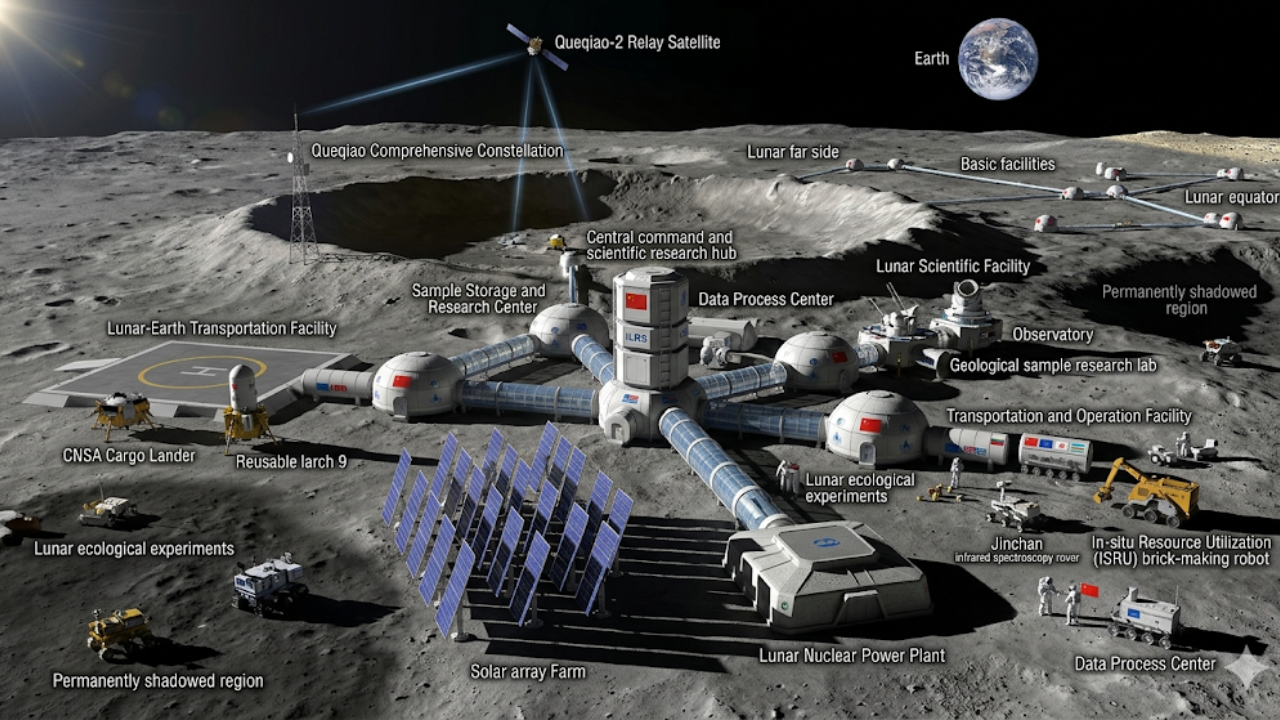
This mission is also a foundational step in China's broader strategy to establish the International Lunar Research Station (ILRS) at the Moon's south pole, planned to begin construction from 2031. The ILRS is a collaborative effort, with China inviting international partners to participate, demonstrating a growing emphasis on global cooperation in its lunar ambitions. Already, Chang'e-7 is set to carry international payloads from several countries, including Egypt, Bahrain, Italy, Russia, Switzerland, and Thailand, along with the International Lunar Observatory Association.
The race to the lunar south pole is intensifying globally. India made history in 2023 by becoming the first country to successfully land near the Moon's little-explored south pole region with its Chandrayaan-3 mission. This achievement underscores the region's strategic importance for future lunar exploration, making China's Chang'e-7 mission particularly relevant in the context of global space competition and collaboration.
Beyond Chang'e-7, China plans the Chang'e-8 mission around 2028, which will further test in-situ resource utilization technologies, including 3D-printing with lunar soil. China also aims for a crewed lunar landing by around 2030, integrating its manned and unmanned lunar exploration efforts into a unified project. These missions collectively lay the groundwork for China's long-term vision of a permanent human presence on the Moon and the establishment of the ILRS.
The success of Chang'e-7 will not only provide invaluable scientific data about the Moon's south pole environment and resources but also showcase China's advanced capabilities in robotic lunar exploration and contribute significantly to the ongoing international efforts to understand and eventually utilize lunar resources. The mission's focus on identifying and characterizing water ice is particularly crucial for enabling sustainable long-duration missions and habitats on the lunar surface, a goal shared by many spacefaring nations, including those collaborating on the Artemis Accords.
From an Indian audience perspective, this news is highly relevant as India has its own successful lunar south pole mission, Chandrayaan-3. The ongoing developments by China, a major Asian space power, directly impact the broader geopolitical and scientific landscape of space exploration, fostering both competition and potential avenues for future cooperation in the scientific community. The advancements made by China in this domain continue to shape the global narrative of space exploration and its future trajectory.
Frequently Asked Questions
What is the primary goal of China's Chang'e-7 mission?
The primary goal of China's Chang'e-7 mission is to conduct comprehensive environmental and resource surveys of the Moon's south pole, with a specific focus on searching for water ice and other volatile compounds in permanently shadowed regions, and assessing the area for a future lunar research base.
When is the Chang'e-7 mission scheduled to launch?
The Chang'e-7 mission is scheduled for launch in the second half of 2026. The probe was delivered to the Wenchang Space Launch Site in Hainan province in April 2026 for pre-launch preparations.
What unique components does the Chang'e-7 mission include?
The Chang'e-7 mission will consist of an orbiter, a lander, a rover, and a small, innovative hopping spacecraft. The hopping probe is particularly unique, designed to explore permanently shadowed craters for water ice, areas that are otherwise difficult for traditional rovers to access.
How does Chang'e-7 fit into China's broader lunar exploration plans?
Chang'e-7 is a crucial step in China's long-term lunar exploration program, which aims to establish the International Lunar Research Station (ILRS) at the Moon's south pole from 2031 and achieve a crewed lunar landing by 2030. The mission's findings on water ice and resources are vital for future sustainable human presence on the Moon.
What is the significance of the Moon's south pole for space exploration?
The Moon's south pole is considered strategically important due to the presence of permanently shadowed regions that are believed to harbor significant deposits of water ice. This water ice could be a crucial resource for future lunar missions, providing drinking water, breathable oxygen, and even rocket fuel.