Epstein Files: What Investigations Reveal So Far | Quick Digest
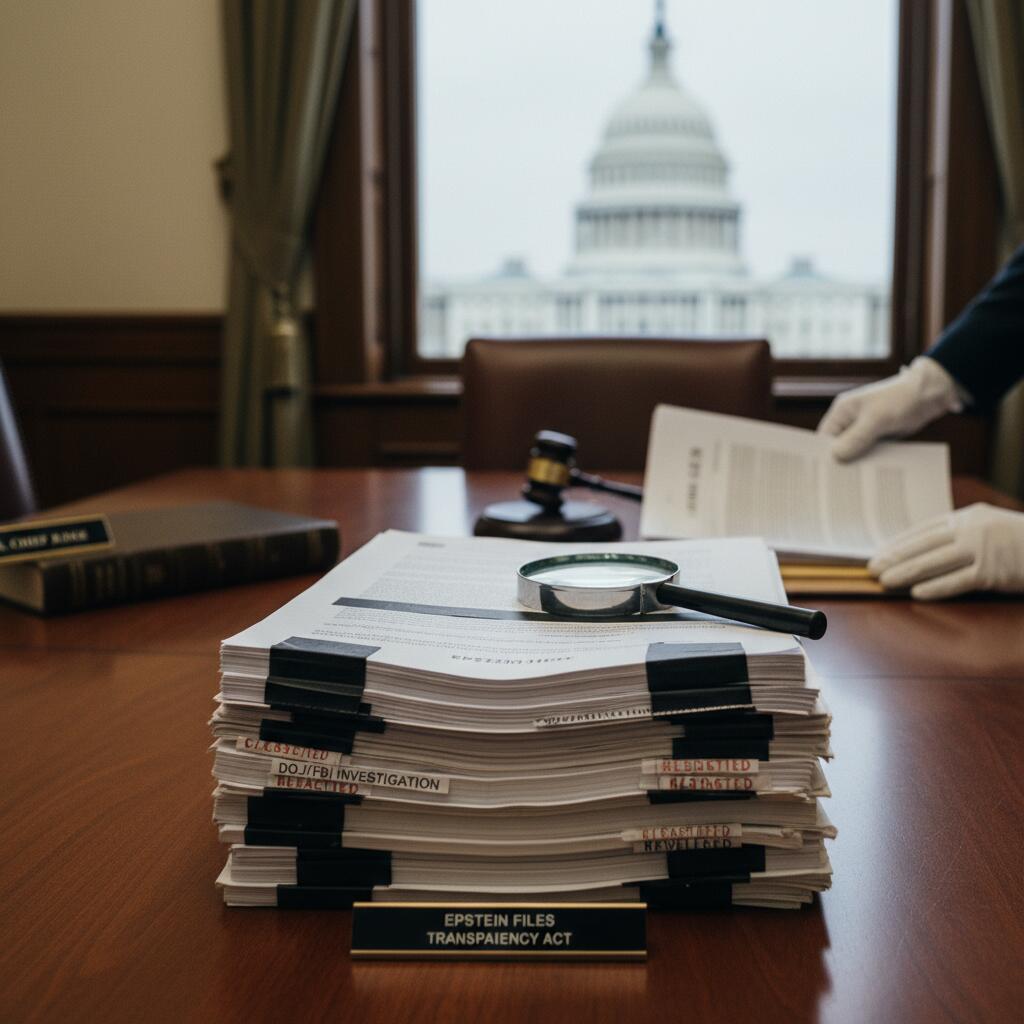
This topic covers the so‑called Epstein files: a large collection of Justice Department and FBI records on Jeffrey Epstein’s sex‑trafficking crimes, his network, finances, travel, and death in custody. It explains what has been released under recent transparency laws, what remains redacted, and why these documents matter for public accountability.
Less than 1% of the DOJ’s Epstein records have been released, with over two million documents still under review.
Early FBI tips about Epstein, including a 1996 report from survivor Maria Farmer, were not properly pursued.
The Inspector General found negligence and misconduct around Epstein’s 2019 jail death, deepening concerns about institutional failures.
The Epstein Files Transparency Act has triggered a showdown between Congress, the DOJ, and oversight bodies over transparency and accountability.
The "Epstein files" – millions of pages of law-enforcement, court, and government records tied to Jeffrey Epstein – are slowly being released under a new federal transparency law. Less than **1%** of what the government holds is public, but even that small slice already reveals failures by authorities, powerful connections, and new questions about accountability.
This article explains what we know so far, what is still hidden, and what to watch next.
## What Are the Epstein Files?
When people talk about the "Epstein files," they usually mean three overlapping sets of records:
- **Federal law-enforcement files** held by the U.S. Department of Justice (DOJ) and FBI about Epstein’s crimes, associates, and financial network.
- **Court and investigative records** from cases in Florida, New York and elsewhere, including those involving Ghislaine Maxwell and civil suits brought by survivors.
- **Oversight and internal-review files**, including reports on how agencies handled complaints, plea deals, and Epstein’s 2019 jail death.
Under the **Epstein Files Transparency Act**, Congress ordered the DOJ to release *all unclassified Epstein-related records* by December 19, 2025, with redactions only for limited reasons such as victim privacy and some national security issues.
The DOJ has created a public "Epstein Library" website to host released documents. But as of early 2026, only a fraction is online.
## How Much Has Been Released – and Why So Little?
### A legal deadline, mostly missed
Congress passed the **Epstein Files Transparency Act** with near-unanimous support, and the law was signed by President Donald Trump. It gave the DOJ **30 days** to process the documents for release, with the key deadline of **December 19, 2025**.
Yet more than two weeks after that date, the DOJ told a federal judge it had:
- Published only **12,285 documents**
- Still had **more than 2 million documents** in "various phases of review and redaction"
That means **less than 1%** of DOJ’s Epstein records have been made public.
The DOJ has assigned **over 400 lawyers** to the review effort, acknowledging that the process is resource-intensive and ongoing.
### DOJ’s explanation – and critics’ response
The DOJ says it needs more time primarily to:
- Redact victim-identifying information
- Remove sensitive personal data of uncharged individuals
- Process duplicates and newly discovered material that may also fall under the law
Officials also say they recently identified **over a million additional documents** potentially related to Epstein that were not in the initial review batch, and these now must be processed and de-duplicated.
However, lawmakers, survivors, and watchdog groups argue that:
- The law did **not** allow the DOJ to delay beyond the deadline
- The department has offered limited, sometimes shifting explanations for why it fell so far behind
- The partial releases appear selective and may be shaped by political concerns
A bipartisan group in Congress has warned that the DOJ has already **proven itself incapable** of meeting the law’s requirements, and some members have urged a court to appoint a **special master** to oversee and accelerate the process.
## What the Released Files Show So Far
Even with only a small share released, the files and related oversight documents have already surfaced important facts.
### Early warnings that went nowhere
One of the clearest findings so far: **federal authorities were warned about Epstein years before he was finally prosecuted on serious federal charges.**
- Files show that in **1996**, survivor Maria Farmer gave the FBI a detailed tip about Epstein’s behavior.
- Her lawyer says this tip was not properly pursued and that this failure should now be a key focus of oversight.
- Advocates are calling for the Inspector General to examine why such an early warning was effectively ignored.
This fits a broader pattern: Epstein was the subject of **repeated complaints and civil suits** over many years, yet he maintained his social status and freedom, including a controversial plea deal in Florida in 2008.
### Failures around Epstein’s 2019 jail death
In 2019, Epstein died by suicide in federal custody in New York. An Inspector General (IG) investigation in 2023 found:
- **Negligence, misconduct, and performance failures** by Federal Bureau of Prisons staff
- Problems with supervision, cell checks, staffing, and procedures that should have reduced suicide risk
While the IG did not conclude that foul play was involved, the report bolstered public distrust in how the government handled such a high-profile inmate.
### DOJ handling and possible political sensitivity
Some of the reporting and commentary around the files highlights how politically charged the release has become:
- Epstein had social ties to multiple powerful figures, including Donald Trump, Bill Clinton, and others in business, politics, and media.
- Advocates and some lawmakers say the DOJ appears to be **"playing defense" for Trump** in how it manages the timing and content of releases, pointing to things like the quick correction of Trump-related images and language in posted files and preemptive statements distancing him from Epstein’s crimes.
- Emails from Epstein’s estate, released by the House Oversight Committee, reportedly show Epstein believed Trump knew about his abuses, though Trump has denied any knowledge or involvement.
The transparency law requires the DOJ not only to release documents, but also to give Congress:
- A **report explaining why redactions were made**, and
- A **list of "all government officials and politically exposed individuals" named in the files**.
The DOJ has already missed the January 3, 2026 deadline for that report and list, offering no public explanation.
## Survivors’ Perspective: Why Full Disclosure Matters
Survivors of Epstein’s crimes are among the strongest voices demanding full release of the files.
Their goals are not just historical. They want:
- **Accountability** for officials who failed to act on early complaints
- **Transparency** about who enabled, financed, or benefited from Epstein’s operations
- **Control and protection** over what information about them is released
Attorneys for survivors have told reporters that:
- An IG review should examine whether *all* Epstein-related files have been produced and whether redactions are appropriate and protective of victims.
- Survivors want a chance to speak with the federal government about what they do and do not want disclosed.
Florida-based attorney Spencer Kuvin, who represents multiple survivors, has emphasized that victims want **"full transparency"** but also a say in how their privacy is safeguarded.
## Political and Legal Fallout
### Congress vs. the DOJ
Two of the law’s co-sponsors, Reps. Ro Khanna (D-Calif.) and Thomas Massie (R-Ky.), have sharply criticized the DOJ’s delay.
They and other lawmakers have:
- Floated **contempt or impeachment proceedings** against Attorney General Pam Bondi and other senior officials if they continue to defy the statute.
- Asked the DOJ’s **Inspector General** to audit compliance with the law and assess whether redactions and delays are being used for improper reasons.
- Pressed a federal judge to consider appointing a **special master** to oversee and speed up document review.
Senate leaders have publicly questioned what the DOJ might be trying to hide, pointing to the lack of required reports and the slow trickle of documents.
### Inspector General under pressure
The DOJ’s Office of Inspector General has already investigated Epstein’s death and, according to its semiannual reporting, is handling thousands of tips and complaints in a typical six-month window, with only a small percentage leading to full investigations.
Now, the IG’s office faces:
- Formal requests from survivors’ lawyers, advocacy groups, and members of Congress to investigate whether the DOJ is mishandling the Epstein files.
- Specific questions about whether redactions are being misused, whether some files are being withheld altogether, and whether partisan motives are shaping what is released when.
The IG typically does not confirm or deny new investigations, so the status of any inquiry into the files remains unclear.
## What We Still Don’t Know
The biggest story about the Epstein files is the **scale of what remains hidden**.
Key unknowns include:
- The full list of **government officials, corporate leaders, and other prominent figures** named across millions of pages
- The complete history of **tips, complaints, and internal memos** about Epstein before major prosecutions
- Details of any **missed investigations, declined charges, or internal disagreements** within agencies
- The extent of Epstein’s **financial network**, shell companies, and transactions that may point to money laundering or broader criminal schemes
Because more than 99% of the records are still under review, any narrative about the full picture is necessarily incomplete and provisional. That makes it important to distinguish:
- What is firmly documented in releases and oversight reports
- What is based on leaks or interviews
- What remains speculation
## Why the Epstein Files Matter Beyond One Man
The Epstein story is not just about one high-profile sex offender. It is a case study in how power, wealth, and weak oversight can interact.
Here are some of the **most important emerging insights** from the files and related investigations:
- **Systemic failures allowed Epstein to operate for decades**, despite early warnings and credible complaints.
- **Institutions often protected reputations over victims**, from lenient plea deals to slow responses to tips.
- **Transparency laws can force reluctant agencies to open their files**, but deadlines alone are not enough without real enforcement.
- **Survivor voices are critical for shaping how sensitive records are released**, balancing truth-telling with privacy and safety.
These lessons extend to other abuse and trafficking cases. The Epstein files are becoming a test case for how serious the U.S. is about confronting elite-enabled exploitation.
## How to Read the Files Critically (When They Arrive)
As more documents are released, they will be messy, technical, and often incomplete. For journalists, advocates, and ordinary readers, a few practical guidelines can help:
### 1. Look at patterns, not just names
The public is understandably focused on **who** appears in the files. But some of the most important information will be about **how systems worked or failed**:
- Repeated references to ignored tips or downgraded complaints
- Internal emails showing concerns about optics or political fallout
- Patterns in how certain associates were treated differently from others
### 2. Separate allegation from evidence
Many documents will record **claims, tips, or raw intelligence** that were never proven in court.
To read them responsibly:
- Note how a claim is labeled (tip, allegation, sworn statement, investigative finding).
- Check whether later documents confirm, dispute, or drop that claim.
- Remember that being mentioned in the same file as Epstein does not automatically imply criminal conduct.
### 3. Pay attention to what is missing
Redactions and gaps can be telling. Under the law, the DOJ must eventually explain its redaction choices to Congress.
Redactions may mean:
- Protection of a victim’s identity or sensitive personal details
- Ongoing investigations or national-security issues
- Overreach, where officials hide more than the law allows (something the IG may need to examine)
If certain topics consistently disappear under black ink while others remain visible, that pattern is itself newsworthy.
### 4. Cross-check with court records and prior reporting
Many civil suits, settlement agreements, and criminal cases involving Epstein and his associates are already public. Their filings, testimony, and exhibits can be used to:
- Verify or challenge claims in newly released government documents
- Fill in timelines and understand who knew what, when
- Spot contradictions between what officials said publicly and what internal files show
## What Comes Next
The fight over the Epstein files is entering a new phase, with several likely developments ahead:
- **More document batches**: The DOJ’s Epstein Library is expected to continue posting files in tranches as reviews finish.
- **Possible court intervention**: A judge could appoint a special master or issue stricter orders if the DOJ continues missing deadlines or appears to defy the law’s intent.
- **Oversight and investigations**: Congress and the DOJ Inspector General may launch or expand probes into how the files have been handled and why previous opportunities to stop Epstein were missed.
- **Renewed scrutiny of enablers**: As more names and communications surface, attention will likely shift to the roles of institutions, associates, and officials who may have facilitated or ignored abuse.
For now, the public has only the barest outline of what the Epstein files contain. But the combination of a legal mandate, political pressure, and survivors’ persistence means the story is still unfolding – and far from over.
## How Individuals and Institutions Can Use These Lessons
Even before the full release, the Epstein files point to some practical steps for preventing similar failures elsewhere:
- **Strengthen early-warning systems**: Organizations should ensure that serious complaints – especially involving minors – are escalated quickly and independently reviewed.
- **Build survivor-centered processes**: Give survivors clear options for reporting, control over their information, and access to legal and psychological support.
- **Create real transparency obligations**: Internal investigations and settlements in abuse cases should be subject to independent oversight where possible, not buried.
- **Invest in oversight bodies**: Inspectors general, ethics offices, and external watchdogs need resources and independence to challenge powerful interests.
These are the kinds of reforms that can turn the grim lessons of the Epstein case into concrete protections for future victims.
As more files come out, the public record on Epstein will grow more complicated – but also more complete. The challenge will be to use that information not just to satisfy curiosity about the powerful, but to strengthen systems meant to protect the vulnerable.
Read the full story on Quick Digest