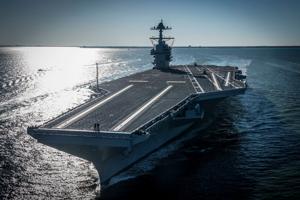
US Prepares for Extended Iran Operations, Second Carrier Deployed
The United States is reportedly preparing for potential weeks-long military operations against Iran, with President Donald Trump ordering a second aircraft carrier, the USS Gerald R. Ford, to the Middle East. This deployment accompanies ongoing diplomatic efforts in Oman to de-escalate nuclear tensions.
Key Highlights
- US military prepares for sustained, multi-week operations against Iran.
- President Trump orders USS Gerald R. Ford to the Middle East.
- USS Ford to join USS Abraham Lincoln, creating dual carrier presence.
- Preparations include targeting Iranian state and security facilities.
- Diplomatic talks between US and Iran are ongoing in Oman.
- Trump warns of 'traumatic' consequences if a deal with Iran fails.
The United States is currently undertaking significant military preparations for potential extended operations against Iran, with reports suggesting a campaign could last several weeks should President Donald Trump issue a strike order. This escalation comes as the USS Gerald R. Ford aircraft carrier has been ordered to the Middle East, marking a substantial increase in military presence in the region.
According to reports citing U.S. officials, these preparations involve a comprehensive strategy that could target not only Iran's nuclear infrastructure but also its state and security facilities. The U.S. military anticipates that such an operation would likely lead to Iranian retaliation, resulting in a prolonged exchange of strikes and counter-strikes over an extended period. This indicates a much more serious and sustained conflict than previous engagements between the two nations. The sheer scale of the planning underscores the gravity with which the U.S. views the current tensions.
The deployment of the USS Gerald R. Ford is a critical component of this enhanced posture. The nuclear-powered supercarrier is being redeployed from its previous operations in the Caribbean, where it participated in a mission involving Venezuela, and is en route to the Middle East. Upon its arrival, expected in about a week, the USS Ford will join the USS Abraham Lincoln Carrier Strike Group, which arrived in the Arabian Sea in January. This move establishes a dual U.S. aircraft carrier presence in the U.S. Central Command area of responsibility, a powerful demonstration of military force intended to deter escalation and project capability. The USS Ford's current deployment commenced on June 24, 2025, and its reassignment will extend its time at sea until late April or early May 2026.
President Donald Trump has personally confirmed the deployment of a second carrier, emphasizing the administration's resolve. He conveyed a stern warning to Tehran, stating that while a deal to curb Iran's nuclear program is still possible within the next month, failure to reach an agreement would lead to 'very traumatic' consequences. Trump's remarks underscore a policy that combines diplomatic overtures with strong military deterrence, asserting that 'sometimes you have to have fear' to achieve a resolution. This suggests a multifaceted approach where military readiness is leveraged to influence diplomatic outcomes.
Despite the overt military preparations, diplomatic channels remain active. U.S. and Iranian diplomats held indirect talks in Oman last week, aiming to revive negotiations concerning Tehran's nuclear program. Iran's foreign affairs minister reportedly characterized these initial discussions as a 'good start,' signaling that avenues for de-escalation are still being explored. These talks are particularly significant given past periods of stalled diplomacy and heightened regional tensions. The engagement in Oman suggests that both sides are, to some extent, keeping open lines of communication even amidst military posturing.
The current build-up is not limited to aircraft carriers. The U.S. has also deployed additional military assets to various bases in the Middle East. These include F-35 Lightning II stealth fighters, guided-missile destroyers, and advanced air defense systems such as Patriot missiles, positioned at strategic locations like Al-Udeid Air Base in Qatar. Furthermore, reconnaissance and combat aircraft like F-15E Strike Eagles, A-10 Thunderbolts, and EA-18G Growler electronic warfare jets have been observed at bases in Jordan. This comprehensive military reinforcement indicates a robust and integrated defense and offense strategy.
Historical context reveals that similar situations of heightened U.S.-Iran tensions have led to significant military deployments. For instance, the USS Gerald R. Ford's deployment was previously extended multiple times in late 2023 and early 2024 in response to the Israel-Hamas conflict. In March 2025, the U.S. also maintained a dual carrier presence with the USS Harry S. Truman and USS Carl Vinson in the region, largely due to ongoing operations against Iranian-backed Houthi forces in Yemen. These past deployments illustrate a pattern of U.S. military responses to regional instability, but the current preparations appear to signal a readiness for direct, sustained engagement with Iran itself.
For an Indian audience, the developments are highly relevant due to their potential impact on regional stability, global oil markets, and vital shipping lanes. Any significant conflict in the Middle East could disrupt energy supplies, affect trade routes through the Strait of Hormuz and the Indian Ocean, and have broader economic ramifications for India. Therefore, the situation between the U.S. and Iran is of considerable geopolitical and economic importance to India.
The fact that these reports from the Times of India, Hindustan Times, and Economic Times are dated February 14, 2026, confirms that this is a real-time, unfolding situation. The claims in the Times of India article are well-corroborated by other reputable news agencies and publications, indicating its accuracy and grounding in current events. The diplomatic and military movements suggest a delicate balance between a show of force and an attempt to negotiate a resolution to the longstanding tensions between Washington and Tehran. The ultimate outcome, whether through diplomacy or military action, will have profound consequences for the Middle East and global stability.
Frequently Asked Questions
Why is the U.S. deploying a second aircraft carrier to the Middle East?
The U.S. is deploying the USS Gerald R. Ford to the Middle East to bolster its military presence and deterrence capabilities amid heightened tensions with Iran. This move creates a dual carrier presence in the region, signaling a serious show of force as the U.S. prepares for potential extended operations.
What kind of military operations is the U.S. preparing for against Iran?
The U.S. military is reportedly preparing for 'sustained, weeks-long operations' against Iran. These plans could involve striking Iranian state and security facilities, not just nuclear sites, with the expectation of reciprocal strikes and a prolonged conflict if President Trump orders an attack.
Are there ongoing diplomatic efforts between the U.S. and Iran?
Yes, despite the military build-up, U.S. and Iranian diplomats held indirect talks in Oman recently to revive discussions about Tehran's nuclear program. Iran's foreign affairs minister described these talks as a 'good start,' indicating that diplomatic channels remain open.
What is President Trump's stance on the situation with Iran?
President Trump has stated that a deal with Iran on its nuclear program is possible within the next month, but he has also warned of 'very traumatic' consequences if an agreement is not reached. He emphasized that 'all options are on the table' and that sometimes 'fear' is necessary to resolve such situations.
How does this situation impact India?
For India, the heightened tensions and potential for conflict in the Middle East are highly relevant. Such events can significantly impact global oil prices, disrupt vital shipping routes through the Strait of Hormuz and the Indian Ocean, and have broader economic and strategic implications for India.