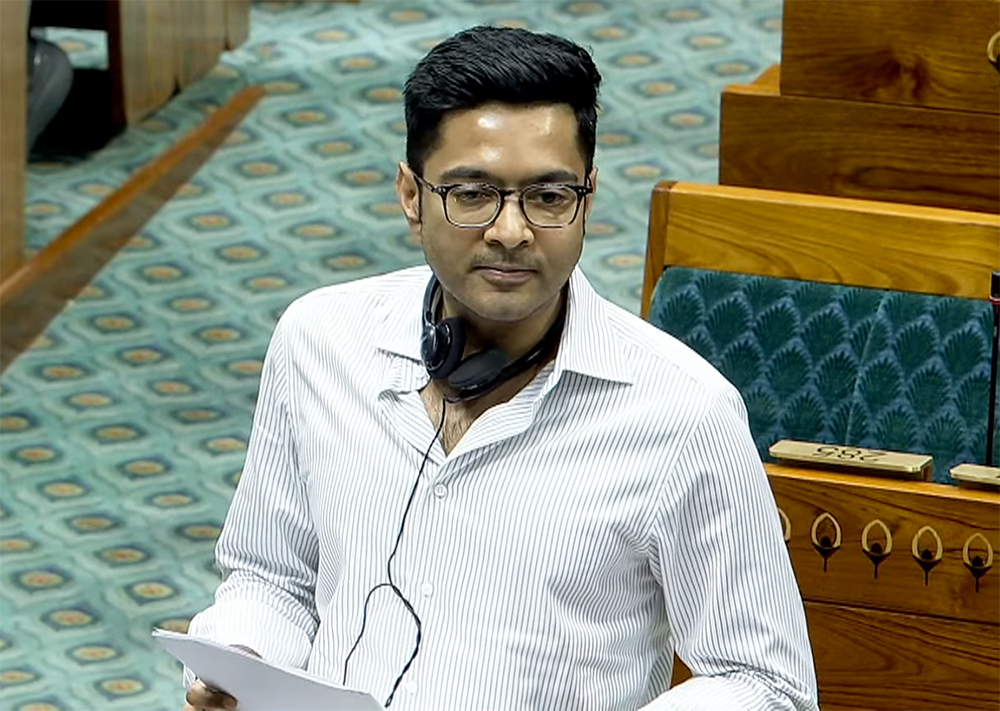
TMC seeks disqualification of 20 rebel MPs
Trinamool Congress leader Abhishek Banerjee has filed 20 disqualification petitions against rebel MPs who have aligned with the Nationalist Citizens Party of India (NCPI). The petitions argue that the rebel MPs have voluntarily given up their party membership and their claimed merger is invalid under anti-defection laws. The Lok Sabha Speaker has received these petitions, and a decision on the matter is pending.
Key Highlights
- TMC filed 20 disqualification petitions against rebel MPs.
- Abhishek Banerjee led the delegation to the Lok Sabha Speaker.
- Rebel MPs allegedly joined the Nationalist Citizens Party of India (NCPI).
- Petitions cite violation of the anti-defection law.
- The Speaker's decision on the disqualifications is awaited.
In a significant political development, Trinamool Congress (TMC) leader Abhishek Banerjee has formally submitted 20 separate disqualification petitions to Lok Sabha Speaker Om Birla, seeking the ousting of 20 rebel Members of Parliament (MPs) from the party. The petitions are based on the grounds of defection and violation of the anti-defection law, specifically the Tenth Schedule of the Indian Constitution. The rebel MPs in question had reportedly revolted against the TMC, announced plans to merge with a lesser-known political outfit, the Nationalist Citizens Party of India (NCPI), and sought recognition as a separate group in the Lok Sabha. Banerjee, accompanied by other senior TMC leaders, presented the case to the Speaker, arguing that the actions of the rebel MPs constitute voluntary abandonment of their TMC membership. He emphasized that under the Tenth Schedule, any member who voluntarily gives up their party's membership is liable for disqualification. Furthermore, Banerjee contended that the claimed 'merger' with the NCPI is constitutionally invalid. He explained that a merger, as per the Tenth Schedule, is recognized only when at least two-thirds of the original political party merges with another entity, not merely when a section of its legislators does so. Banerjee also highlighted that the NCPI is an unrecognised political formation with no prior representation in Parliament or any state legislature, making the purported merger legally questionable. The TMC leader cited various Supreme Court judgments and legal precedents to bolster the party's position, urging the Speaker to adjudicate the matter promptly. He expressed concern over the prolonged pendency of these disqualification proceedings, stating that it frustrates the constitutional objective of the anti-defection law and creates uncertainty. In a subsequent development on July 27, 2026, Banerjee met the Speaker again, submitting two letters urging an expedited decision on the pending disqualification pleas. He also raised concerns about changes in the seating arrangements of TMC MPs, which he believed were made unilaterally based on the claims of the rebel group before a decision on their disqualification. The Speaker, however, did not provide a definitive timeline for a decision. The original petitions were filed on June 19, 2026, and as of late July 2026, the process of issuing notices or scheduling hearings had not yet commenced, according to Banerjee's letters. The situation underscores a significant internal power struggle within the TMC and highlights the complexities of enforcing anti-defection laws in India. The Lok Sabha Speaker's decision on these petitions will be crucial in determining the fate of the rebel MPs and the composition of the TMC's parliamentary party. The overall political climate in West Bengal has been marked by intense rivalry between the TMC and the Bharatiya Janata Party (BJP), and such internal party dynamics further add to the political discourse.
Frequently Asked Questions
What are disqualification petitions in the Indian political context?
Disqualification petitions are legal requests made to the presiding officer of a legislative body (like the Lok Sabha Speaker) to remove a member from their position. In India, these are typically filed under the Tenth Schedule of the Constitution (anti-defection law) when a member is accused of voluntarily giving up their party's membership or voting against the party's whip without permission.
What is the Tenth Schedule of the Indian Constitution?
The Tenth Schedule, often referred to as the anti-defection law, was added to the Constitution in 1985. It outlines the grounds on which a Member of Parliament or a Member of a State Legislature can be disqualified from their membership, primarily to curb political defections.
Who is Abhishek Banerjee?
Abhishek Banerjee is a prominent Indian politician and a Member of Parliament in the Lok Sabha. He is a senior leader of the Trinamool Congress (TMC) and the nephew of West Bengal Chief Minister Mamata Banerjee.
What is the significance of the Nationalist Citizens Party of India (NCPI)?
The Nationalist Citizens Party of India (NCPI) is described in the news reports as a lesser-known or unrecognised political party with no representation in Parliament or state legislatures. The rebel TMC MPs' alleged affiliation with this party is a key point in the disqualification petitions.
What are the legal arguments regarding mergers and defections in this case?
The TMC argues that the rebel MPs have voluntarily given up their party membership by aligning with the NCPI. They also contend that the claimed 'merger' is invalid because a true merger under the Tenth Schedule requires at least two-thirds of the *entire* political party to merge, not just a fraction of its legislative members.