Why Trump Wants Greenland And Asia’s Big Opportunity | Quick Digest
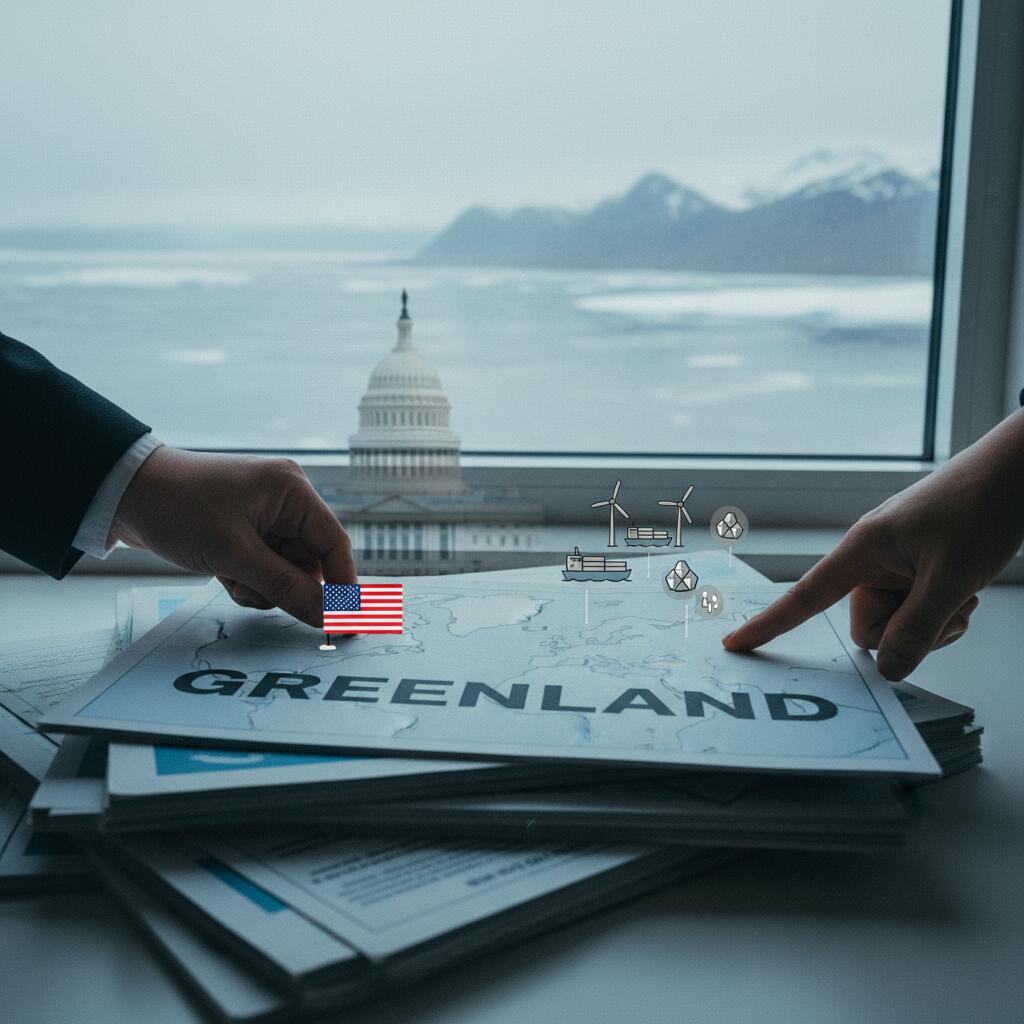
Trump’s interest in buying Greenland is driven by national security, Arctic military positioning, new shipping routes and access to minerals and energy resources.[1][2][3] As the Arctic opens, India and China could seek scientific bases, trade routes and resource partnerships there, potentially boosting energy security, rare-earth access and polar research cooperation.
Greenland is central to U.S. plans for Arctic surveillance, missile warning, and monitoring of Russian and Chinese forces.
The island holds valuable rare earth elements and uranium, making it a key target in global competition over critical minerals.
The U.S. has tried to acquire Greenland multiple times since the 19th century, showing Trump’s push fits a longer strategic pattern.
Rising U.S.–China rivalry in the Arctic creates openings for both China and India to deepen economic, scientific, and diplomatic engagement in Greenland and the wider polar region.
## Why Trump Wants Greenland And Asia’s Big Opportunity
When Donald Trump talks about **buying or annexing Greenland**, it can sound like a political stunt. But behind the headline is a serious contest over the **Arctic, critical minerals, and great‑power influence**—and that is where **Asia, especially India and China, see opportunity**.
This article breaks down why Greenland suddenly matters so much, what Trump is really after, and how Asian powers could turn this Arctic drama to their advantage.
---
## Trump’s Greenland Obsession: More Than a Real‑Estate Joke
Trump first floated the idea of buying Greenland from Denmark in 2019, calling it “a large real estate deal.”[1] He has since **repeatedly returned to the idea**, and during his renewed push has even talked about **seizing the territory “the hard way” if a deal cannot be reached**.[1][3]
In meetings with oil executives and journalists, Trump has argued that **if the U.S. does not act, Russia or China will “take over Greenland”**, and he has said the U.S. is “going to do something on Greenland, whether they like it or not.”[2][3]
At one point, U.S. officials reportedly discussed **direct cash payments to Greenland’s population**—tens of thousands of dollars per person—to entice them away from Denmark’s orbit and toward the U.S.[1][3]
Behind the tough talk are three core motives:
- **National security and military strategy**
- **Critical minerals and energy**
- **Long‑term economic and geopolitical leverage in the Arctic**
---
## Strategic Location: Greenland as an Arctic Gatekeeper
### The GIUK Gap and Arctic surveillance
Greenland sits at the heart of the **GIUK Gap** (Greenland–Iceland–United Kingdom), a chokepoint the U.S. and NATO have long used to monitor submarine and air activity between the Arctic and the North Atlantic.[1] Controlling Greenland gives the U.S. a clearer view of **Russian and potentially Chinese forces** moving through the Arctic.
The U.S. already has an important presence there: under a **1951 defense treaty with Denmark**, Washington can build and operate military bases in Greenland, including the well‑known Thule Air Base.[1] Experts note that this existing treaty already allows significant U.S. activity without owning the island.[1]
Still, Trump’s team has framed **full control** as the best way to:
- **Secure missile‑warning and surveillance infrastructure**
- **Limit Russian naval movement in the Arctic**
- **Block or constrain future Chinese military or dual‑use projects**
### Arctic competition with Russia and China
Russia has built up a powerful **Northern Fleet**, described as the largest ice‑capable naval fleet in the world.[1] As sea ice melts, new routes open and Russia’s Arctic coastline becomes even more valuable.
Trump and his aides also frequently mention China. He has warned that he does not want **Russia or China “as a neighbor” in Greenland**.[2][3] Beijing already calls itself a “near‑Arctic state” and invests in Arctic research, shipping, and resources.
**Key insight:** Greenland is not about polar bears or empty ice; it is a **forward base in a new era of Arctic great‑power politics**.[1][2]
---
## Economic Prize: Critical Minerals, Uranium, and New Trade Routes
### A treasure chest of critical minerals
Greenland is believed to contain **major deposits of rare earth elements**, which are vital for electronics, renewable energy technologies, electric vehicles, and advanced weapon systems.[1] These minerals are small in volume but crucial in value—often described as the “secret sauce” that makes high‑tech products work.[1]
A Trump adviser and former national security official highlighted that the push for Greenland is **“about critical minerals” and “natural resources.”**[1]
In southern Greenland, the **Kvanefjeld (Kuannersuit) area** holds one of the world’s largest uranium deposits, as well as significant rare earth elements.[1] For the U.S., this could support both **nuclear energy and defense supply chains**, reducing dependence on other countries.
### Melting ice, new opportunities
Climate change is opening more of Greenland’s coastline and making some resource extraction easier. As Arctic ice recedes, **shipping routes** between Asia, Europe, and North America are gradually becoming shorter and more accessible.
This gives Greenland added value as:
- A **potential node on shorter trans‑Arctic shipping lanes**
- A base for **energy exploration** and resource export
- A hub for **scientific research and climate monitoring**
**Key insight:** For Washington, acquiring Greenland is a hedge against **resource scarcity and supply chain vulnerability** in a world increasingly defined by competition over critical materials.[1]
---
## A Long American Dream: The U.S. Has Tried This Before
Trump’s idea is not new. The U.S. has **tried to acquire Greenland at least three times** before his presidency.[4][5]
- **1860s–1867:** After the U.S. bought Alaska from Russia, American leaders explored the idea of also acquiring Greenland and Iceland to expand their North Atlantic presence.[4][5]
- **1910:** Under President William Howard Taft, diplomats floated a **land‑swap proposal** that would transfer Greenland to the U.S. in exchange for concessions elsewhere. Denmark rejected it.[4]
- **1946:** At the start of the Cold War, President Harry Truman formally offered Denmark **$100 million in gold** to buy Greenland, citing its strategic importance after World War II.[4]
Each time, Denmark refused. Trump’s push is simply the **most aggressive and public version** of a long‑standing American ambition.[4][5]
**Key insight:** To Washington, Greenland has been a **strategic prize for more than a century**, not a passing Trump impulse.[4][5]
---
## Where India and China Come In: Asia’s Arctic Opening
At first glance, Greenland looks like a U.S.–Europe story. But the **Arctic is now a global arena**, and **Asia’s major powers are already involved or positioning themselves to be.**
### China: From “near‑Arctic state” to Arctic stakeholder
China has been active in Greenland and the wider Arctic for years:
- Chinese companies have sought **mining stakes** in Greenland, including rare earth and uranium projects.
- Beijing promotes a **“Polar Silk Road”**, framing Arctic shipping lanes as an extension of its Belt and Road Initiative.
- China has invested in **Arctic research, icebreakers, and scientific stations** in other parts of the polar region.
From Beijing’s perspective, U.S. attempts to tighten control over Greenland could:
- Limit China’s **direct access to critical minerals** there
- Close off potential **dual‑use infrastructure projects** (such as ports or airfields)
- Push China to **diversify Arctic partnerships** with Russia and Nordic states
Yet even a stronger U.S. footprint in Greenland does not end China’s Arctic play. Instead, it may:
- Encourage China to **move faster in securing long‑term supply contracts** in Greenland while it still can
- Intensify Chinese investment in **alternative Arctic and sub‑Arctic resource hubs**, including in Russia and Canada
### India: A quieter but growing Arctic interest
India is still a **smaller Arctic actor** compared with China, but it has clear reasons to care:
- **Energy security:** Arctic hydrocarbons and shipping routes could diversify India’s access to energy.
- **Climate impact:** Arctic warming has direct consequences for India’s monsoon and Himalayan glaciers.
- **Strategic balance:** As China deepens engagement in the polar regions, New Delhi watches carefully.
India already has an **Arctic research station in Svalbard** (Norway) and an Arctic policy that links polar developments to its climate, economic, and strategic interests. A sharpened U.S.–China contest over Greenland opens diplomatic and economic space for India to:
- Position itself as a **neutral, science‑driven partner** for Arctic states
- Explore **joint projects in climate research, satellite monitoring, and telecommunications** related to the Arctic
- Collaborate with **Denmark, the EU, and even the U.S.** on responsible mining and technology cooperation
**Key insight:** As U.S.–China rivalry reaches the Arctic, both **China and India can leverage Greenland‑related tensions to deepen partnerships, secure resources, and raise their Arctic profiles**.
---
## Asia’s Big Opportunity: Strategic, Economic, and Diplomatic
What makes Trump’s Greenland push an **opportunity** for Asian powers is not the chance to “own” the island, but the broader **re‑ordering of Arctic politics** it accelerates.
### 1. Resource diversification and long‑term contracts
- **China** can negotiate **early‑stage off‑take agreements** or minority stakes in Greenland mining projects while Denmark and Greenland still welcome diversified investment.
- **India** can use its growing tech and space capabilities to offer **remote sensing, mapping, and environmental monitoring** services to Greenlandic and Danish authorities, in exchange for preferential access or partnerships in future projects.
Both countries can frame this as support for **sustainable development**, something important to Greenland’s own leaders, who seek economic growth without losing political autonomy.
### 2. Arctic diplomacy and soft power
Trump’s talk of annexation and “doing it the hard way” has drawn criticism from European allies and former diplomats, who call the approach reckless and disrespectful of Danish and Greenlandic sovereignty.[1][2]
This creates a diplomatic opening:
- **China** can present itself as a partner that respects **multilateral Arctic governance** and works within existing frameworks.
- **India**, often seen as a more cautious power, can build soft power by emphasizing **scientific cooperation, climate research, and capacity‑building** rather than military presence.
### 3. Technology and infrastructure partnerships
Greenland needs infrastructure—ports, telecom, renewable energy, and digital connectivity—but wants to avoid over‑dependence on any single great power.
Asian states can step in with:
- **Satellite and navigation services** to support Arctic shipping and rescue operations
- **Green energy projects** (wind, hydro, small‑scale renewables) suitable for remote communities
- **Digital infrastructure and data centers** that leverage Greenland’s cold climate and potential clean‑energy sources
### 4. Balancing great powers without direct confrontation
For both India and China, the key is to **benefit from the Arctic opening without being pulled into a direct confrontation** over Greenland itself.
They can do this by:
- Working directly with **Greenland’s self‑rule government and Denmark**, rather than challenging U.S. security interests
- Focusing on **economic, scientific, and environmental cooperation**
- Building **coalitions with other Arctic and non‑Arctic states** that support a rules‑based, non‑militarized Arctic
**Key insight:** Asia’s big opportunity lies in becoming **indispensable partners** in the Arctic’s economic and scientific future, not in competing head‑on with the U.S. military footprint in Greenland.
---
## The Road Ahead: What to Watch
The future of Greenland’s status will be shaped by **three overlapping contests**:
1. **U.S.–Europe dynamics:** How far will Washington push, and how firmly will Denmark and Greenland resist any talk of annexation or forced transfer?[1][4]
2. **U.S.–China rivalry:** Will the U.S. seek to **block Chinese investment** in Greenland outright, or merely limit projects with security implications?[1][2]
3. **Greenland’s own agency:** Greenland has its own elected government and aspirations for greater independence from Denmark. Its leaders will try to **maximize investment and autonomy** while avoiding being caught in the middle of great‑power rivalries.
For India and China, the strategic play is long term. Greenland is not just about today’s headlines; it is a window into **how climate change, technology, and geopolitics are reshaping the global map**—from the Himalayas to the Arctic Circle.
In that reshaped world, **whoever can combine scientific credibility, economic partnership, and respect for local sovereignty will have the real advantage**—in Greenland and beyond.
Read the full story on Quick Digest