Amit Shah Launches Three-Year Anti-Drug Campaign from March 31 | Quick Digest
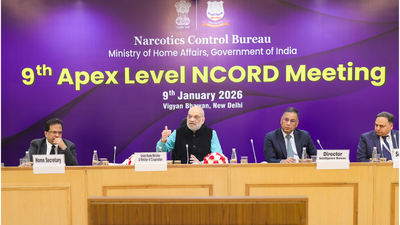
Union Home Minister Amit Shah has announced a three-year nationwide campaign against drugs, commencing on March 31, 2026. He declared the drug menace a 'narco-terrorism' threat to India's future generations. The campaign aims for a 'Drug-Free India' by 2029.
Amit Shah announced a three-year anti-drug campaign.
Campaign to be launched nationwide from March 31, 2026.
Drug problem labeled as 'narco-terrorism', not just crime.
Goal is to achieve a 'Drug-Free India' by 2029.
Strategy involves ruthless action, demand reduction, humane approach.
Announcement made at 9th NCORD meeting in New Delhi.
Union Home Minister Amit Shah announced a comprehensive three-year nationwide campaign against drugs, slated to begin on March 31, 2026. The announcement was made during his address at the 9th apex-level meeting of the Narco-Coordination Centre (NCORD) in New Delhi. Shah emphasized that the drug problem extends beyond a mere law-and-order issue, categorizing it as 'narco-terrorism' and a grave conspiracy to undermine the future generations of the country. He called for a 'collective campaign on all fronts' to achieve a 'Drug-Free India' by 2029.
The campaign's strategy is built on a three-pronged approach: strict and ruthless action against the drug supply chain, strategic measures for demand reduction through sustained awareness efforts, and a humane approach towards individuals who have fallen victim to drug use. Shah directed all central and state government departments to prepare a detailed roadmap by March 31, 2026, including a robust monitoring mechanism, to ensure a comprehensive solution to the drug menace. During the meeting, the Home Minister also virtually inaugurated a Narcotics Control Bureau (NCB) office in Amritsar, reinforcing the government's commitment to strengthening enforcement infrastructure. He highlighted the significant progress made in drug seizures between 2014 and 2025, with a substantial increase compared to the preceding decade, and stressed the importance of leveraging intelligence inputs and artificial intelligence to tackle evolving drug distribution and payment methods.
Read the full story on Quick Digest