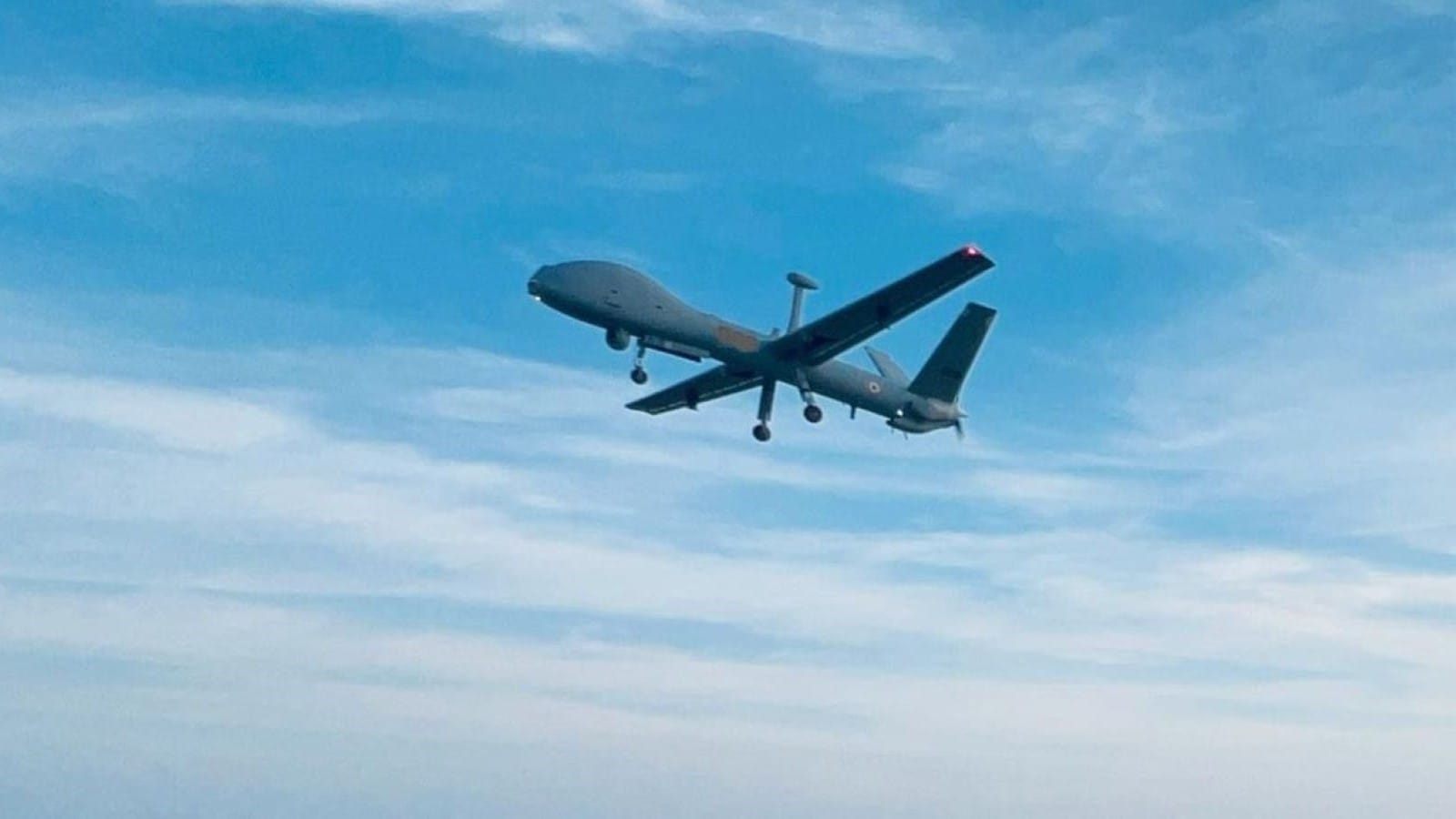
Navy's Drishti-10 UAV Crashes Near Porbandar; Inquiry Ordered
An Indian Navy Drishti-10 Starliner UAV crashed near Gujarat's Porbandar during a training sortie on July 8, 2026. No casualties were reported. A Board of Inquiry has been ordered to investigate the incident, marking the second mishap for this drone platform in 18 months.
Key Highlights
- Indian Navy's Drishti-10 UAV crashed near Porbandar, Gujarat.
- Incident occurred during a routine training sortie on July 8, 2026.
- No injuries or loss of life reported on the ground.
- A formal Board of Inquiry has been ordered to investigate the cause.
- This is the second mishap involving the Hermes-900 based platform.
- Drishti-10 is license-manufactured by Adani Defence and Aerospace.
An Indian Navy Drishti-10 Starliner Unmanned Aerial Vehicle (UAV) crashed on Wednesday, July 8, 2026, near Dharampur village in Gujarat's Porbandar district during a routine training sortie. The incident occurred shortly after the drone took off from the Naval Air Enclave at Porbandar, with the aircraft going down in an open field approximately 6 km from the coastal city. Crucially, the Indian Navy confirmed that no injuries or loss of life were reported on the ground, and there was no significant damage to civilian property, despite the incident causing some panic in the locality.
Following the crash, the Indian Navy promptly ordered a Board of Inquiry (BoI) to ascertain the exact cause of the incident. The investigation will delve into possibilities such as technical malfunction, loss of communication links, or any other system failure that may have led to the crash. Security agencies have already recovered the wreckage from the crash site and initiated a technical examination.
This particular mishap marks the second incident involving a Hermes-900-based platform, specifically the Drishti-10, within a span of approximately 18 months. The previous incident occurred in January 2025 when another Drishti-10 drone, undergoing pre-acceptance trials by the manufacturer near Porbandar, ditched into the Arabian Sea after reportedly losing its communication link. That aircraft, which had not yet been formally inducted into naval service, was subsequently replaced by the manufacturer, ensuring no financial loss to the Navy at that time. The recurrence of such incidents is expected to renew scrutiny regarding the reliability and operational performance of the Drishti-10 platform.
The Drishti-10 Starliner is an Indianised variant of the battle-proven Hermes-900 Medium Altitude Long Endurance (MALE) UAV, developed by Israel's Elbit Systems. It is license-manufactured in India by Adani Defence and Aerospace at its state-of-the-art facility in Hyderabad, showcasing India's push towards self-reliance (Aatmanirbhar Bharat) in defence manufacturing. The Army and Navy had jointly contracted for two Drishti-10 drones each under the fourth tranche of emergency procurement in 2023, with each unit costing around ₹140-145 crore.
These advanced UAVs are designed for critical intelligence, surveillance, and reconnaissance (ISR) missions, providing long-duration maritime surveillance and enhancing situational awareness across vast ocean areas. The Drishti-10 boasts an impressive endurance of up to 36 hours, a payload capacity of 450 kg, and an operating ceiling of 30,000 feet. The Indian Navy primarily deploys these drones from Porbandar to bolster maritime domain awareness over the Arabian Sea, complementing its fleet of P-8I long-range maritime patrol aircraft. Similarly, the Army uses the platform from Bathinda for surveillance along the western frontier with Pakistan.
The significance of this crash is heightened by the Indian Navy's ongoing plans to induct an additional 10 Drishti-10 drones. This procurement aims to further strengthen persistent, round-the-clock surveillance capabilities over the Indian Ocean Region, a strategically vital area where the presence of Chinese naval and research vessels has been steadily increasing. The incidents could potentially impact these future acquisition plans or lead to a more thorough review of the platform's airworthiness and operational protocols.
Globally, the Hermes-900 platform has garnered attention, with reports during the recent Israel-Iran conflict in April suggesting that Iranian forces claimed to have intercepted or shot down Israeli Hermes-900 UAVs. While wartime claims differ from training mishaps, such incidents contribute to the overall scrutiny of the platform's global operational record. The current crash, therefore, is not just an isolated incident but a data point in the broader context of unmanned aerial systems' reliability and strategic deployment in modern defence.
Frequently Asked Questions
What is the Drishti-10 Starliner UAV?
The Drishti-10 Starliner is a Medium Altitude Long Endurance (MALE) Unmanned Aerial Vehicle (UAV). It is an Indianised variant of Israel's battle-proven Hermes-900, license-manufactured by Adani Defence and Aerospace in partnership with Elbit Systems. It is used by the Indian Navy for intelligence, surveillance, and reconnaissance (ISR) missions, with an endurance of 36 hours and a 450 kg payload capacity.
Where and when did the Drishti-10 UAV crash?
The Drishti-10 UAV crashed on Wednesday, July 8, 2026, near Dharampur village in Gujarat's Porbandar district. It went down in an open field, about 6 km from the Porbandar airfield, during a routine training sortie.
Were there any casualties or damage on the ground?
No injuries or loss of life were reported on the ground, nor was there any significant damage to civilian property due to the crash.
Is this the first incident involving a Drishti-10 UAV?
No, this is the second mishap involving a Hermes-900 based platform (Drishti-10) in about 18 months. The first incident occurred in January 2025, when a Drishti-10 being flown by the manufacturer during pre-acceptance trials crashed into the Arabian Sea.
What is the significance of the Drishti-10 UAV for the Indian Navy?
The Drishti-10 UAVs are crucial for enhancing the Indian Navy's maritime domain awareness and surveillance capabilities, especially in the strategically important Indian Ocean Region. They perform long-endurance ISR missions, monitoring shipping lanes, coastal approaches, and other strategic maritime zones. The Navy plans to induct more such drones to further strengthen its surveillance network.