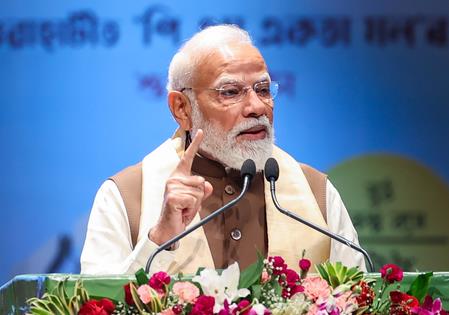
PM Modi Accuses Congress of Spreading Panic Amid Middle East War in Assam
Prime Minister Narendra Modi strongly criticized the Congress party in Assam, accusing it of spreading panic amidst the Middle East war and acting as a 'puppet of anti-India forces'. He emphasized the government's efforts to mitigate the conflict's impact on citizens while Congress sought political gain.
Key Highlights
- PM Modi accused Congress of creating panic during Middle East war.
- Congress labeled 'puppet of anti-India forces' by PM Modi in Assam.
- Statements made during election rallies in Silchar and Guwahati.
- PM highlighted government's efforts to minimize war's impact.
- Criticism came amid inaugurations of development projects in Assam.
- PM Modi cited Nehru's speech for historical context of Congress's alleged propaganda.
Prime Minister Narendra Modi launched a scathing attack on the Congress party during his election rallies in Assam, accusing the opposition of attempting to spread panic among Indian citizens amidst the ongoing Middle East war and alleging that the party was acting as a 'puppet of anti-India forces'. Speaking in Silchar and Guwahati, PM Modi stated that while his government was working diligently to minimize the impact of the international conflict on the nation, Congress was exploiting the situation for political advantage by creating an atmosphere of fear.
During his address in Silchar, Prime Minister Modi asserted that the Congress was making every effort to generate panic within the country, hoping that India would become entangled in difficulties, thereby providing them an opportunity to criticize his administration. He escalated his accusations by claiming that Congress was increasingly becoming a mere puppet in the hands of global forces unable to accept India's rapid development. Modi further criticized Congress for its electoral setbacks, mocking that the party was on course to achieve a 'century of defeats' across various state elections.
In Guwahati, PM Modi reiterated his strong criticism, specifically mentioning the 'West Asia war crisis' and accusing Congress of spreading 'propaganda'. He drew a historical parallel by referencing a speech by India's first Prime Minister, Jawaharlal Nehru, who, according to Modi, attributed rising inflation to the war between North and South Korea on August 15, 1950. Modi used this anecdote to highlight what he perceived as Congress's historical tendency to mislead the country during global crises, contrasting it with his government's focus on national interest and self-reliance.
The Prime Minister emphasized his government's commitment to protecting the identity and interests of Assam. He also used these rallies to inaugurate and lay the foundation stones for multiple development projects worth significant amounts, including an expressway between Silchar and Shillong, an elevated corridor on NH-306 in Silchar, and a College of Agriculture at Patharkandi in Karimganj district, collectively valued at over ₹23,550 crore. Other projects launched or initiated across Assam during these visits included a Brahmaputra bridge and various infrastructure, health, and energy sector initiatives, collectively valued at more than ₹17,500 crore in Jorhat and ₹19,480 crore in Guwahati. These development initiatives were presented as a testament to the 'double engine government's' commitment to the region's progress.
Other credible news outlets, including Times Now, Devdiscourse, Hindustan Times, Asianet Newsable, and The Wall, widely corroborated these statements and events. Times Now reported PM Modi criticizing Congress for allegedly engaging in 'anti-national activities' and enabling illegal immigration during an Assam rally in December 2025. Devdiscourse highlighted Modi's critique of Congress's 'divisive politics' and 'shop of false promises' in March 2026, while emphasizing BJP's commitment to peace and development in the Northeast. Hindustan Times also reported PM Modi's accusations of Congress neglecting the northeastern states and being 'insensitive' towards their resources in March 2024. The consistent reporting across various media houses confirms the core claims made in the India Today article regarding PM Modi's strong criticism of Congress in Assam and the specific nature of his accusations.
The context of these strong remarks is the ongoing political landscape in Assam, particularly with the upcoming Assembly Elections likely in March-April 2026. PM Modi's rallies were part of a broader electoral campaign, where he aimed to highlight the BJP's developmental agenda for the Northeast while simultaneously attacking the opposition. The accusations of 'spreading panic amid war' and being a 'puppet of anti-India forces' are significant in the Indian political discourse, especially when linked to international events and national security, aiming to question the opposition's loyalty and responsibility.
Frequently Asked Questions
What were PM Modi's main accusations against Congress in Assam?
PM Modi accused the Congress party of trying to spread panic among Indian citizens amidst the Middle East war and of acting as a 'puppet in the hands of forces hostile to India's development'. He claimed Congress was seeking to benefit politically from the international crisis.
Which 'war' was PM Modi referring to in his statements?
PM Modi explicitly referred to the 'Middle East war' or 'West Asia war crisis' while criticizing the Congress party in his Assam speeches.
Where did PM Modi make these statements?
Prime Minister Modi made these strong statements during election rallies in Assam, specifically mentioning locations like Silchar and Guwahati.
What was the broader context of PM Modi's visit to Assam?
PM Modi's visit to Assam included addressing election rallies in the run-up to the 2026 Assembly Elections. During these visits, he also inaugurated and laid foundation stones for significant development projects worth thousands of crores, showcasing his government's commitment to the region.
How did PM Modi use historical context in his criticism of Congress?
PM Modi cited a historical speech by former Prime Minister Jawaharlal Nehru, allegedly from August 15, 1950, where Nehru reportedly linked rising inflation to the Korean War. Modi used this to draw a parallel to what he described as Congress's current tendency to spread propaganda during global crises.