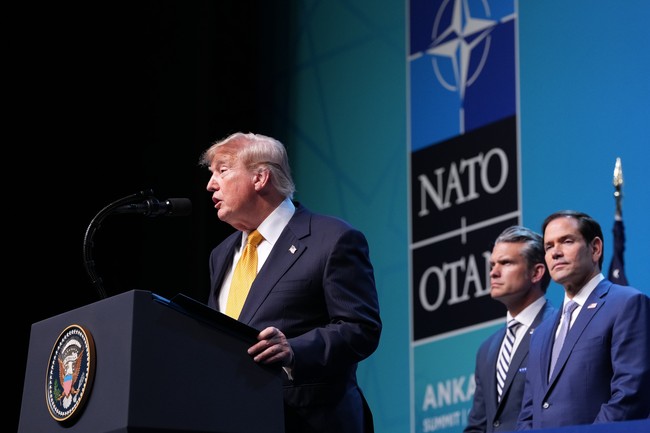
Trump Expresses Disappointment to NATO Chief Rutte Over Iran War Support
Former US President Donald Trump recently conveyed his disappointment to NATO Secretary General Mark Rutte regarding the insufficient support from allied nations in the ongoing conflict with Iran. Trump criticized key European members for their perceived lack of commitment to US-Israel military operations in the region.
Key Highlights
- Trump criticized NATO allies for insufficient Iran war support.
- Statements made during recent meetings with NATO SG Mark Rutte.
- Trump expressed disappointment with UK, Germany, France, Italy, Spain.
- Highlighted allies' reluctance in US-Israel military actions in Iran.
- Ongoing Iran conflict is a significant geopolitical development.
- Discussions focused on burden-sharing and alliance loyalty.
Former U.S. President Donald Trump, in recent discussions with NATO Secretary General Mark Rutte, expressed significant disappointment and a feeling of being 'let down' by several allied nations over their lack of robust support in the ongoing conflict with Iran. This sentiment was conveyed during meetings in June 2026, where Trump specifically called out countries like the United Kingdom, Germany, France, Italy, and Spain for what he perceived as insufficient contributions to the US-Israel military operations targeting Iran.
Mark Rutte officially assumed the role of NATO Secretary General on October 1, 2024, succeeding Jens Stoltenberg, whose term ended after a decade. This recent appointment confirms his standing as the 'NATO Chief' during these crucial discussions with Trump. The interactions underscore ongoing tensions regarding burden-sharing within the transatlantic alliance, a recurring theme during Trump's previous presidency and his current political landscape.
Multiple credible news sources, including Anadolu Agency, India Today, and various reports referenced by CNN-News18 and Bloomberg, have corroborated these events. These reports highlight that Trump's criticisms stem from a belief that while the United States expends significant resources in global security, its allies do not always reciprocate with the expected level of support, particularly in conflicts deemed critical by Washington.
The 'Iran War' or 'Iran conflict' refers to a significant military engagement involving the U.S. and Israel against Iran. Reports indicate that this conflict includes large-scale strikes targeting Iranian military assets and leadership, with stated goals such as destroying Iran's ballistic missile capabilities, eliminating its navy, preventing nuclear weapon acquisition, and severing support for proxy forces. There have also been discussions about the U.S. Navy potentially reinstating its blockade of Iranian ports and Trump ending a tentative ceasefire with Iran, raising the prospect of renewed hostilities.
During his meetings with Rutte, Trump articulated that he was 'testing' NATO partners to see if they would stand with the U.S. in this conflict. He lamented that many, including major European powers, had 'turned the U.S. down.' Despite these strong criticisms, Rutte, while acknowledging Trump's disappointment, also highlighted the extensive logistical and operational support provided by European allies. He noted that thousands of U.S. planes operated from European bases during the six-week conflict and that infrastructure coordination, even at commercial airports, was adjusted to support military requirements. Rutte also emphasized that European allies, overall, stood with the United States and that Iran's nuclear capability had been degraded, a point welcomed by G7 leaders.
The discussions between Trump and Rutte also touched upon broader issues of global security, NATO defense spending, Ukraine, and transatlantic cooperation. Rutte, in an effort to reassure Washington, pointed to a substantial increase in defense spending among NATO allies, amounting to over $260 billion in increased defense spending. This aligns with NATO's long-standing goal for member states to allocate at least 2% of their GDP to defense, a target often championed by the U.S.
Trump's stance has reignited debates over burden-sharing within the alliance and the differing strategic priorities among NATO members. He has insisted that NATO must play a role in reopening the Strait of Hormuz and has consistently complained about the lack of assistance received so far. The rhetoric also revives concerns among some European nations about the U.S.'s commitment to NATO, with reports of fallback plans gaining traction among European nations should the U.S. reconsider its membership. This ongoing tension presents a significant challenge for the newly appointed NATO Secretary General Mark Rutte, who is tasked with maintaining alliance unity and demonstrating NATO's continued relevance in a complex global security landscape. The Indian audience views these developments as critical given India's growing strategic partnerships and its interest in global geopolitical stability, especially concerning energy security and regional dynamics in West Asia.
Frequently Asked Questions
Who is the current NATO Secretary General mentioned in the news?
Mark Rutte, the former Prime Minister of the Netherlands, took office as the NATO Secretary General on October 1, 2024.
What is the 'Iran War' or 'Iran conflict' referred to in the article?
The 'Iran War' or 'Iran conflict' refers to significant ongoing military operations by the U.S. and Israel against Iran, aimed at targets like ballistic missile capabilities, naval assets, and preventing nuclear weapons acquisition.
Why is Donald Trump expressing disappointment with NATO allies?
Donald Trump is disappointed with NATO allies for what he perceives as insufficient support and commitment to the U.S.-Israel military operations against Iran, stating he felt 'let down' and that allies 'turned the U.S. down'.
Which specific NATO allies did Trump criticize?
Trump specifically criticized the United Kingdom, Germany, France, Italy, and Spain for their lack of support during the Iran conflict.
What are the broader implications of Trump's statements for NATO?
Trump's statements reignite concerns over burden-sharing within NATO, the alliance's unity, and the differing strategic priorities among member states, potentially impacting transatlantic cooperation and global security.