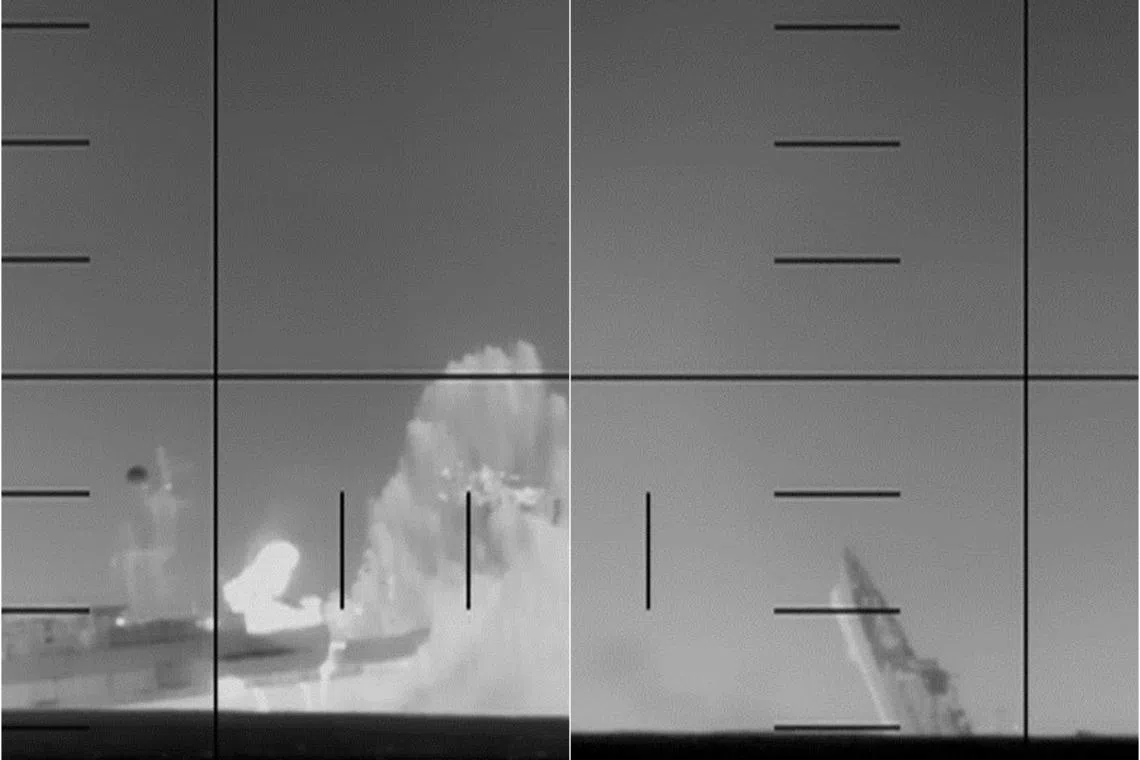
Iran Hits US Tanker After Warship Sunk; Middle East Tensions Escalate
Iran's Revolutionary Guard claims to have struck a US tanker in the Persian Gulf, reportedly setting it ablaze. This alleged attack occurred hours after a US submarine torpedoed and sank the Iranian frigate IRIS Dena in the Indian Ocean, killing dozens of sailors and significantly escalating the ongoing conflict between Iran, the US, and Israel.
Key Highlights
- Iranian warship IRIS Dena sunk by US torpedo on March 4, 2026.
- US Defense Secretary confirmed the sinking of IRIS Dena.
- Iran's IRGC claimed hitting a US tanker on March 5, 2026.
- Tanker attack believed to be retaliation for the warship sinking.
- Incident marks significant escalation in US-Iran conflict.
- Impacts global shipping and raises concerns for Indian interests.
The escalating conflict between Iran and the United States, alongside its allies including Israel, witnessed a critical 'tit-for-tat' exchange on March 4 and 5, 2026, with an Iranian warship being sunk by a US submarine, followed by Iran's claim of striking a US oil tanker.
On March 4, 2026, the Iranian frigate IRIS Dena was torpedoed and sunk by a United States Navy submarine in the Indian Ocean, approximately 40 nautical miles south of Galle, Sri Lanka. The US Department of Defense and War Secretary Pete Hegseth confirmed the attack, stating that a Mark 48 torpedo was used, marking the first acknowledged instance of a US submarine sinking an enemy surface vessel since World War II. The incident resulted in heavy casualties, with at least 87 Iranian sailors killed, 32 rescued, and approximately 60 reported missing from an estimated 180 personnel on board. The IRIS Dena was returning to Iran after participating in the multinational naval exercise MILAN 2026 and the International Fleet Review 2026 in Visakhapatnam, India, making the location of its sinking particularly relevant to India.
Less than 24 hours after the IRIS Dena's sinking, on March 5, 2026, Iran's Islamic Revolutionary Guard Corps (IRGC) claimed responsibility for striking an American tanker in the northern Persian Gulf. Iranian state media reported the US ship was on fire, though details on casualties were not immediately available. This action by Iran was widely perceived as a direct retaliation for the sinking of its warship.
This tanker incident is part of a series of maritime attacks in the region amid heightened tensions. Earlier, on March 2, 2026, a US-flagged tanker, the Stena Imperative, was hit by Iranian missiles while docked in Bahrain, damaging the vessel and causing injuries to shipyard workers. Furthermore, on March 1, 2026, a Palau-flagged oil tanker, the Skylight, with a crew of 15 Indian nationals and 5 Iranians, was attacked near Oman's Musandam Peninsula and reportedly set ablaze, with Iran later confirming it had attacked a tanker for 'defying orders' not to cross the Strait of Hormuz.
The broader context for these maritime hostilities is a significant escalation in the ongoing conflict between Iran, Israel, and the United States. The weeks leading up to these events saw intensified US-Israeli airstrikes on targets within Iran, including nuclear facilities in June 2025, to which Iran has retaliated with missile and drone strikes across the Middle East. US War Secretary Pete Hegseth warned that attacks on Iran would continue as long as necessary, aiming to eliminate Iran's military capabilities.
The expansion of the conflict to the Indian Ocean, with the sinking of the IRIS Dena off Sri Lanka, has brought the war closer to India's backyard and raises concerns for India, especially given the presence of Indian crew members on affected vessels and the IRIS Dena's recent participation in Indian naval exercises. The Strait of Hormuz, a critical maritime artery for global oil supply, has also seen unprecedented disruption, impacting international shipping and raising fears of a significant surge in oil prices if the waterway remains threatened or blocked.
This rapid sequence of events underscores a dangerous escalation in the Middle East, with direct military engagements between major powers and their proxies, and a direct impact on global commerce and regional stability. The 'tit-for-tat' nature of the attacks suggests a high risk of further intensification of hostilities in the near future.
Frequently Asked Questions
What was the immediate cause of the escalation between the US and Iran?
The immediate cause of the recent escalation was the sinking of the Iranian frigate IRIS Dena by a US Navy submarine on March 4, 2026, in the Indian Ocean, followed by Iran's Revolutionary Guard claiming to have struck a US oil tanker in the Persian Gulf on March 5, 2026, in apparent retaliation.
Where did the IRIS Dena warship sink, and what was its significance to India?
The IRIS Dena was sunk in the Indian Ocean, approximately 40 nautical miles south of Galle, Sri Lanka. This location is significant to India because the warship was returning after participating in India's multinational naval exercise MILAN 2026 in Visakhapatnam.
What kind of damage was reported on the US tanker and other vessels?
The US tanker claimed to be hit by Iran on March 5, 2026, was reportedly on fire. Earlier, on March 2, 2026, the US-flagged tanker Stena Imperative was damaged by Iranian missiles while docked in Bahrain, and on March 1, 2026, the Palau-flagged tanker Skylight (with Indian crew) was also attacked and set ablaze near Oman.
What is the broader context of the US-Iran conflict at this time?
The current incidents are part of a wider and rapidly escalating conflict between Iran, the US, and Israel, which has included US-Israeli airstrikes on Iranian targets, including nuclear facilities, and retaliatory missile and drone attacks by Iran across the Middle East. The conflict is expanding geographically and impacting global maritime trade.
How do these events affect global oil supplies and international shipping?
The attacks, particularly those in the Persian Gulf and Strait of Hormuz, pose a significant threat to global oil supplies and international shipping. The Strait of Hormuz is a vital chokepoint for a large portion of the world's crude oil shipments, and disruptions or heightened insecurity in the region can lead to surging oil prices and severe impacts on global trade.