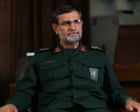
Israel Claims Killing of IRGC Navy Commander Alireza Tangsiri
Israel has claimed to have killed Alireza Tangsiri, the commander of the Islamic Revolutionary Guard Corps (IRGC) Navy, in an airstrike in Bandar Abbas. Defence Minister Israel Katz and Prime Minister Benjamin Netanyahu confirmed the strike, accusing Tangsiri of blocking the strategic Strait of Hormuz. Iran has not yet confirmed his death.
Key Highlights
- Israel Defence Minister confirmed IRGC Navy commander Alireza Tangsiri killed in airstrike.
- Prime Minister Netanyahu also corroborated the killing of the top Iranian naval chief.
- Tangsiri was accused of orchestrating the blockade of the vital Strait of Hormuz.
- US Central Command also confirmed Tangsiri's death, assessing Iran's navy significantly weakened.
- Iran has not yet officially acknowledged or confirmed the death of its naval commander.
- The strike occurred in Bandar Abbas, targeting Tangsiri and other senior naval officers.
In a significant escalation of the ongoing conflict in the Middle East, Israel has announced the killing of Alireza Tangsiri, the commander of the Islamic Revolutionary Guard Corps (IRGC) Navy. The claim was made by Israeli Defence Minister Israel Katz on Thursday, March 26, 2026, who stated that Tangsiri was eliminated in an overnight airstrike. Katz further elaborated that the operation was precise and lethal, also resulting in the deaths of other senior naval officers, including Behnam Rezaei, the IRGC Navy's intelligence chief.
Israeli Prime Minister Benjamin Netanyahu corroborated the defence minister's statement, confirming Tangsiri's death in a video message. Netanyahu emphasized that Tangsiri had 'a great deal of blood on his hands' and was directly responsible for leading the closure of the Strait of Hormuz. The strike reportedly took place in the Iranian port city of Bandar Abbas, where Tangsiri was meeting with senior commanders of the IRGC Navy.
The Israeli officials justified the strike by asserting Tangsiri's central role in the 'terror operation of mining and blocking the Strait of Hormuz to maritime traffic.' This strategic waterway, critical for global energy supplies, has been effectively disrupted since early March, impacting international shipping and driving up global oil prices.
Significantly, the United States Central Command (CENTCOM) also confirmed Tangsiri's death. Admiral Brad Cooper, head of US CENTCOM, stated that the killing placed Iran's navy on a path toward an 'irreversible decline' and warned Iranian naval personnel to abandon their posts. Cooper highlighted that the elimination of Tangsiri, coupled with the destruction of a significant portion of Iran's large naval fleet, had left the IRGC-N without effective leadership or power-projection capability.
Despite these confirmations from Israeli and U.S. officials, Iran has not yet officially acknowledged or confirmed the death of Commodore Alireza Tangsiri. This silence from Tehran comes amidst a broader context of heightened hostilities, with joint U.S.-Israeli attacks on Iran having commenced on February 28, 2026. These ongoing military operations have reportedly resulted in the deaths of several high-ranking Iranian officials, including Supreme Leader Ayatollah Ali Khamenei and security chief Ali Larijani.
The conflict has profound regional and global implications. The Strait of Hormuz, through which approximately 15% of the world's oil and 20% of its liquefied natural gas passes, remains a critical chokepoint. While Iran has selectively permitted passage for "friendly nations" like India, China, and Russia, it has explicitly stated that ships linked to its adversaries will not be allowed to transit. This selective blockade underscores the geopolitical significance of the Strait and the potential for broader economic disruption.
Diplomatic efforts to de-escalate the conflict appear ongoing, albeit with mixed signals. U.S. President Donald Trump has asserted that Iran is "begging to make a deal" and that indirect negotiations are taking place. However, Iran's Foreign Minister Seyed Abbas Araghchi has denied direct negotiations with the Trump administration, conceding only that messages were being exchanged through "friendly countries." Pakistan has emerged as a key intermediary in these mediation efforts. Trump had initially set a five-day deadline for progress on a peace plan and later extended a deadline for Iran to open the Strait of Hormuz to April 6.
The killing of Alireza Tangsiri, a figure described as a hardliner loyalist who significantly expanded the IRGC-N's fast-attack craft and anti-ship missile fleet, marks another critical moment in the escalating confrontation between Israel, the U.S., and Iran. The incident highlights the high stakes in a conflict that has already claimed thousands of lives and is reverberating across the global economy. The international community, including India, is closely watching developments, particularly given the implications for global energy security and regional stability.
Frequently Asked Questions
Who was Alireza Tangsiri and what was his role?
Alireza Tangsiri was the commander of the Islamic Revolutionary Guard Corps (IRGC) Navy. Israeli officials accused him of being directly responsible for mining and blocking the strategic Strait of Hormuz.
What is the significance of the Strait of Hormuz?
The Strait of Hormuz is a crucial global waterway through which approximately 15% of the world's oil and 20% of its liquefied natural gas passes. Its disruption, as seen since early March, significantly impacts international shipping and global energy prices.
Has Iran confirmed the death of Alireza Tangsiri?
As of March 26, 2026, Iran has not yet officially acknowledged or confirmed the death of its naval commander, Alireza Tangsiri, despite claims from Israel and the US.
What are the implications of this strike on the ongoing Iran-Israel conflict?
The killing of a high-ranking military official like Tangsiri marks a significant escalation in the ongoing US-Israeli military campaign against Iran. It signals continued assertive action by Israel and could lead to further retaliation from Iran, intensifying regional tensions and impacting global energy security.
What is the United States' role in this situation?
The United States is actively involved in the ongoing conflict with joint military operations alongside Israel against Iran. US Central Command confirmed Tangsiri's death and assessed it as a major blow to Iran's naval capabilities. US President Donald Trump has also spoken of ongoing, albeit indirect, negotiations with Iran to de-escalate the conflict.