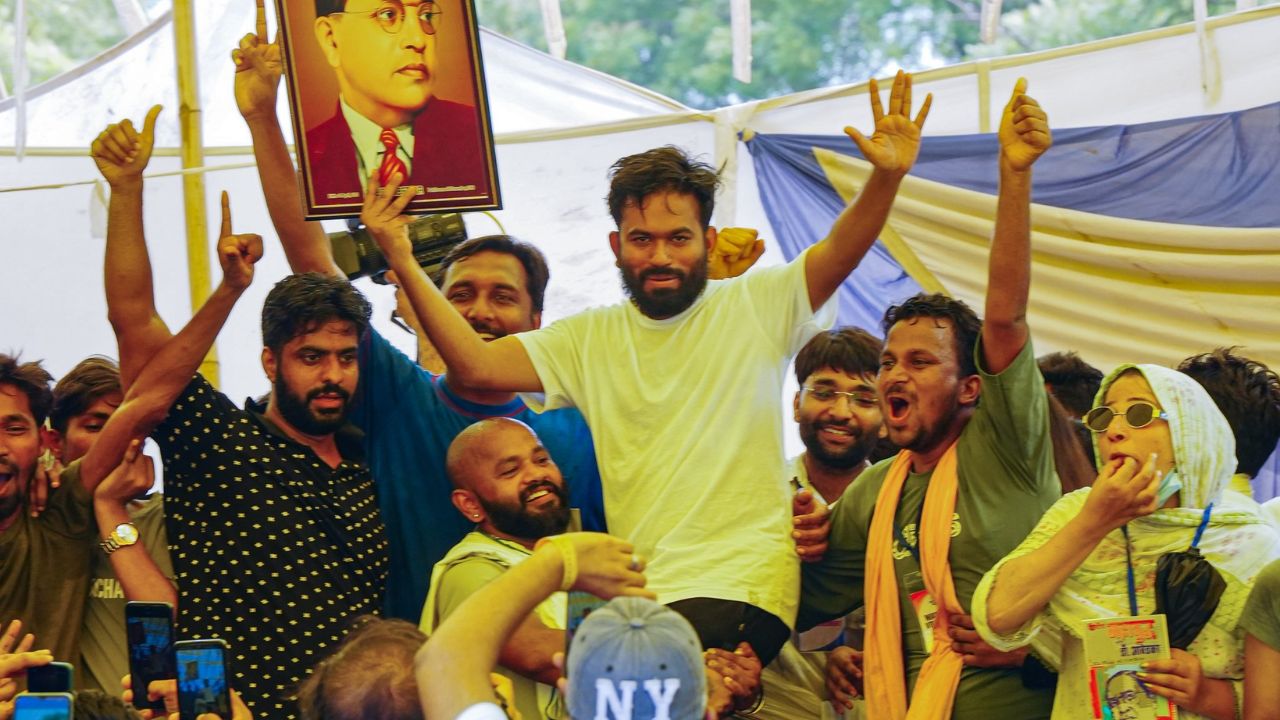
CJP protests lead to Education Minister Pradhan's resignation over NEET leak
India's youth-led Cockroach Janta Party (CJP) intensified its protests at Jantar Mantar, New Delhi, demanding the resignation of Union Education Minister Dharmendra Pradhan over the NEET-UG 2026 paper leak. The sustained agitation, which saw clashes with police, ultimately culminated in Pradhan's resignation on July 25, 2026, marking a significant victory for the movement.
Key Highlights
- CJP spearheaded extensive protests against NEET-UG 2026 paper leak.
- Protests culminated in Education Minister Dharmendra Pradhan's resignation.
- Movement was founded by Abhijeet Dipke, gained significant youth support.
- Demonstrations at Jantar Mantar, Delhi, faced police crackdowns.
- Resignation marked a rare concession from Modi's government.
- The CJP also demanded compensation for victims' families and withdrawal of FIRs.
The youth-led Cockroach Janta Party (CJP), founded by Abhijeet Dipke, spearheaded a significant and prolonged protest movement in India, demanding the resignation of Union Education Minister Dharmendra Pradhan. The agitation, centered at Delhi's Jantar Mantar, was primarily fueled by widespread outrage over alleged irregularities and paper leaks in the NEET-UG 2026 examination, which impacted millions of aspiring medical students across the country. The movement, which emerged as a satirical response to a judicial remark comparing unemployed youth to 'cockroaches,' quickly transformed into a formidable real-world political force, mobilizing tens of thousands of protesters.
The protests gained significant momentum in July 2026, particularly after a major march towards Parliament on July 20, 2026, which was met with a harsh police crackdown involving batons and tear gas. This police action resulted in numerous injuries to both protesters and security personnel, further intensifying public outrage and resolve among the student community. Following these clashes, demonstrations continued for several days, with supporters refusing to disperse from Jantar Mantar, vowing to persist until their demands were met. The 'third day' mentioned in the article's title likely refers to a specific, intensified phase of these ongoing protests in the immediate aftermath of the July 20th crackdown.
The core demand of the CJP and its supporters was the resignation of Dharmendra Pradhan, holding him accountable for the integrity of the examination system. This demand was consistently reiterated by the movement's leaders, including Abhijeet Dipke, even as other prominent figures like activist Sonam Wangchuk ended their hunger strikes after receiving assurances from the government on other aspects of examination reforms and protection for peaceful protesters.
After weeks of relentless protests, culminating in a 36 to 37-day agitation, Education Minister Dharmendra Pradhan eventually tendered his resignation to Prime Minister Narendra Modi on Saturday, July 25, 2026. This development marked a significant political victory for the CJP and was widely covered by national and international media as a rare instance of Prime Minister Modi's government bowing to public pressure. Pradhan, in his resignation, acknowledged the controversies surrounding the NEET-UG 2026 examination and stated his decision was in the larger interest of the students, aiming to prevent further confusion.
Beyond Pradhan's resignation, the CJP also put forth other key demands, including financial compensation of ₹1 crore (10 million Indian rupees) for the families of students who tragically died by suicide due to the paper leak crisis, and the withdrawal of First Information Reports (FIRs) lodged against student protesters across the country. Following Pradhan's resignation, the CJP announced the withdrawal of its agitation, with Union Ministers J.P. Nadda and Jitendra Singh holding talks with CJP representatives and accepting demands related to compensation and FIR withdrawals.
The movement underscored the growing power of youth activism and issue-based politics in India, bringing national attention to critical concerns regarding education, unemployment, and government accountability. The CJP, initially a social media phenomenon, effectively demonstrated its ability to mobilize and sustain real-world protests, leading to concrete political outcomes and challenging the established political narrative.
Frequently Asked Questions
What is the Cockroach Janta Party (CJP)?
The Cockroach Janta Party (CJP) is a youth-led movement in India, founded by Abhijeet Dipke, that emerged as a satirical response to a judicial comment. It rapidly evolved into a significant political force, mobilizing large-scale protests, particularly against issues like exam paper leaks and demanding government accountability.
Why did the CJP protest against Dharmendra Pradhan?
The CJP protested against Dharmendra Pradhan, who was the Union Education Minister, primarily due to the alleged paper leak and irregularities in the NEET-UG 2026 examination. They demanded his resignation, holding him accountable for the integrity of the country's education system and the severe impact on millions of students.
When did Dharmendra Pradhan resign?
Dharmendra Pradhan resigned from his position as Union Education Minister on Saturday, July 25, 2026, following weeks of intense protests led by the CJP and widespread public pressure over the NEET-UG 2026 paper leak controversy.
What were the other demands of the CJP besides Pradhan's resignation?
In addition to demanding Dharmendra Pradhan's resignation, the CJP also called for financial compensation of ₹1 crore for the families of students who died by suicide due to the exam leak and the withdrawal of all FIRs lodged against student protesters across India.
How significant was this protest movement?
The CJP-led protests were highly significant as they represented one of the largest displays of public dissent against Prime Minister Narendra Modi's government in recent years and resulted in the resignation of a Union Minister due to public pressure—a rare occurrence. It highlighted the growing power of youth activism and issue-based politics in India.