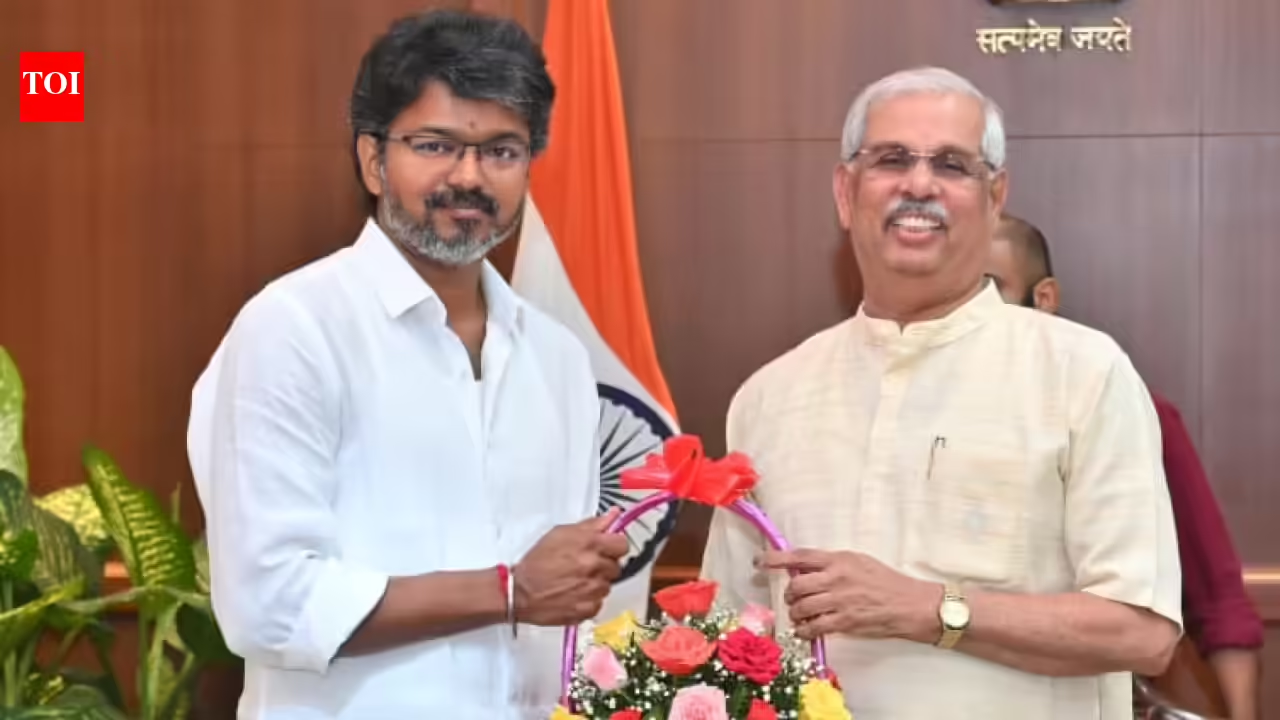
Actor Vijay Sworn In as Tamil Nadu Chief Minister
Actor-turned-politician C. Joseph Vijay, leader of Tamilaga Vettri Kazhagam (TVK), was sworn in as the Chief Minister of Tamil Nadu on May 10, 2026. This historic event marks the end of decades-long Dravidian party dominance, as TVK formed a coalition government after the recent assembly elections.
Key Highlights
- C. Joseph Vijay sworn in as Tamil Nadu Chief Minister on May 10, 2026.
- His party, TVK, emerged as the single largest in the 2026 Assembly elections.
- TVK secured 108 seats, ending Dravidian parties' 59-year dominance.
- M.K. Stalin's DMK lost power, with Stalin himself losing his constituency.
- Vijay secured coalition support to form the government.
- First decisions include free power, women's safety, and anti-drug measures.
In a landmark political shift, actor-turned-politician C. Joseph Vijay, the founder of Tamilaga Vettri Kazhagam (TVK), was sworn in as the Chief Minister of Tamil Nadu on Sunday, May 10, 2026. This monumental event, administered by Governor Rajendra Vishwanath Arlekar at the Jawaharlal Nehru Indoor Stadium in Chennai, marks a historic departure from the state's nearly six-decade-long dominance by Dravidian parties, namely the DMK and AIADMK.
The political landscape of Tamil Nadu underwent a dramatic transformation following the 2026 Tamil Nadu Legislative Assembly elections. Polling was held on April 23, 2026, with the results declared on May 4, 2026. The Tamilaga Vettri Kazhagam, in its very first electoral outing, emerged as the single largest party, securing an impressive 108 seats in the 234-member assembly. This outcome shattered the established duopoly of the Dravida Munnetra Kazhagam (DMK) and the All India Anna Dravida Munnetra Kazhagam (AIADMK).
The incumbent DMK, led by M.K. Stalin, faced a significant setback, managing to secure only 59 seats. In a surprising turn of events, M.K. Stalin, who had served as Chief Minister from 2021 to 2026, lost his own Kolathur constituency, a seat he had held since 2011. This defeat marked the first instance since 1996 that an incumbent chief minister in Tamil Nadu lost their assembly election. The AIADMK, the other major Dravidian force, secured 47 seats, further highlighting the extent of the TVK's disruptive entry into state politics.
Despite TVK emerging as the single largest party, it fell short of the 118 seats required for an outright majority, leading to Tamil Nadu's first hung assembly. Consequently, a period of intense negotiations and political maneuvering ensued to form a coalition government. Actor Vijay, leading the TVK, successfully garnered the support of other parties, including the Indian National Congress (INC), Communist Party of India (CPI), Communist Party of India (Marxist) (CPI(M)), Viduthalai Chiruthaigal Katchi (VCK), and Indian Union Muslim League (IUML). These alliances collectively provided him with the support of 120 MLAs-elect, surpassing the majority mark and paving the way for his government formation.
Vijay's swearing-in ceremony was a high-profile event attended by various political figures and celebrities. Notably, Rahul Gandhi, Leader of the Opposition in the Lok Sabha, was present and congratulated Vijay on X (formerly Twitter). Prominent figures from the Tamil film industry, including Kamal Haasan and R. Madhavan, also extended their congratulations, acknowledging the historic nature of Vijay's transition from cinema to the highest political office in the state. Vijay becomes not only the first chief minister from a non-Dravidian party since 1969 but also the first member of a minority religious denomination (Christian) to hold the top post in Tamil Nadu.
Immediately after taking the oath of office, Chief Minister Vijay signed his first set of official files, outlining his government's initial priorities. These significant decisions included providing 200 units of free power to every family, establishing a special unit dedicated to women's safety, and forming another special unit to combat drug smuggling. These initiatives signal the new administration's focus on public welfare, safety, and addressing social challenges within the state. Along with Vijay, nine cabinet ministers were also sworn in, indicating the formation of a new council of ministers to govern Tamil Nadu. The Governor has directed Chief Minister Vijay to seek a vote of confidence in the Assembly on or before Wednesday, May 13, 2026.
Vijay himself contested and won from two constituencies, Perambur and Tiruchirappalli East. Following his victories, he is expected to resign from the Tiruchirappalli East seat and retain Perambur. The emergence of TVK and Vijay as Chief Minister marks a new era in Tamil Nadu politics, moving beyond the long-standing bipolar system and introducing a fresh political dynamic to the state.
Frequently Asked Questions
Who is the new Chief Minister of Tamil Nadu?
C. Joseph Vijay, the founder of Tamilaga Vettri Kazhagam (TVK), has been sworn in as the new Chief Minister of Tamil Nadu on May 10, 2026.
Which party did C. Joseph Vijay represent in the elections?
C. Joseph Vijay is the leader and founder of the Tamilaga Vettri Kazhagam (TVK) party, which made its electoral debut in the 2026 Tamil Nadu Assembly elections.
What was the outcome of the 2026 Tamil Nadu Assembly Elections?
The 2026 Tamil Nadu Assembly elections, held on April 23 and results declared on May 4, resulted in a hung assembly where TVK emerged as the single largest party with 108 seats. The DMK and AIADMK lost their long-held dominance.
What were CM Vijay's first major decisions after taking office?
Immediately after his swearing-in, Chief Minister Vijay signed files approving 200 units of free power for every family, establishing a special unit for women's safety, and another special unit to combat drug smuggling.
Why is Vijay's appointment as CM considered historic?
Vijay's appointment is historic because it marks the first time since 1969 that Tamil Nadu has a Chief Minister from a non-Dravidian party, breaking a nearly 60-year tradition of power alternating between DMK and AIADMK. He is also the first CM from a minority religious denomination.