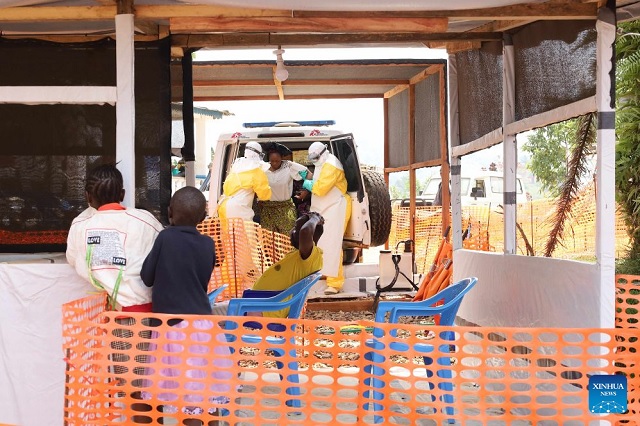
Congo Ebola Outbreak Outpaces Responders Amid Patient Flight, WHO Warns
The World Health Organization has warned that the Ebola outbreak in the Democratic Republic of Congo is spreading faster than containment efforts can manage. This rapid spread is exacerbated by patients fleeing clinics and ongoing insecurity in the conflict-hit eastern regions, complicating response efforts. The outbreak, caused by the Bundibugyo virus, has seen a significant rise in cases and deaths, making it one of the most challenging Ebola epidemics on record.
Key Highlights
- Ebola outbreak in Congo is spreading faster than responders can contain it, WHO reports.
- Patients fleeing clinics and insecurity hinder containment of the rapid epidemic.
- The outbreak is the second-largest on record, caused by the Bundibugyo virus.
- Conflict-ridden eastern Congo faces significant challenges in public health response.
- WHO is working to scale up testing and contact tracing amidst complex conditions.
The World Health Organization (WHO) has issued a stark warning regarding the Ebola outbreak in the Democratic Republic of Congo (DRC), stating that the epidemic is outpacing the efforts of responders to contain it. This alarming situation is compounded by patients absconding from treatment centers and a backdrop of persistent insecurity in the conflict-plagued eastern regions of the country, which severely impedes the effectiveness of containment strategies [9, 2, 4].
The current outbreak, caused by the Bundibugyo virus, is characterized by its rapid spread and has become the second-largest Ebola outbreak on record. As of recent reports, the number of confirmed cases has surged, with figures exceeding 7,000 cases and over 3,300 deaths in the DRC alone [3]. The virus has spread to multiple provinces, with Sud-Ubangi becoming the seventh affected province, raising concerns about regional dissemination [4]. This rapid proliferation contrasts sharply with previous outbreaks, such as the 2018 DRC outbreak, which took significantly longer to reach a comparable number of cases [2].
Several complex factors contribute to the challenges faced by responders. Limited healthcare infrastructure, including insufficient access to healthcare services, diagnostic and laboratory capabilities, and essential infection prevention and control supplies, creates a difficult environment for combating the disease [2]. Furthermore, ongoing conflict and the presence of armed groups in the affected areas create security issues that complicate contact tracing, patient management, and the overall public health response. Violence against healthcare workers and shortages of personal protective equipment have also led to infections among those on the front lines of care [2].
The WHO has acknowledged that the epidemic had a significant head start, and while efforts are being made to 'catch up,' the response is still behind [12]. The organization is focusing on scaling up laboratory and diagnostic capacity to reduce delays in case confirmation and to support quicker response decisions. Despite progress in testing, contact tracing remains a challenge, with only about 45% of contacts being followed up, falling short of the over 90% target needed to get ahead of the outbreak [12].
Compounding these issues is a lack of trust in government and health officials among some local communities. This mistrust, sometimes fueled by misinformation, creates barriers to effective communication and can lead to resistance towards containment measures, including attacks on Ebola treatment centers [2, 12]. The wide geographical dispersion of cases, the mobile nature of the populations, and the porous international borders further increase the risk of spread to neighboring countries such as Uganda, South Sudan, and Rwanda [2, 10].
The international community, including organizations like the CDC, is involved in the response, though the scale and complexity of the outbreak present significant hurdles. Efforts are underway to improve coordination and resource allocation, but historical issues with delayed responses and disagreements between international bodies like the WHO and the World Bank have also been noted as hindrances in past outbreaks [8].
The implications for India are primarily related to global health security and the potential for international spread, necessitating robust national preparedness and surveillance. While the direct risk to India from this specific outbreak is currently assessed as low, the interconnectedness of the world means that understanding and monitoring such events is crucial for global public health.
Frequently Asked Questions
What is the World Health Organization (WHO) warning about the Ebola outbreak in Congo?
The WHO is warning that the Ebola outbreak in the Democratic Republic of Congo is spreading faster than responders can contain it, exacerbated by patients fleeing clinics and ongoing insecurity.
What are the main challenges in responding to this Ebola outbreak?
Key challenges include limited healthcare infrastructure, ongoing conflict and insecurity, violence against healthcare workers, a lack of trust in authorities, and the rapid movement of populations, which complicates contact tracing and containment efforts.
How widespread is this Ebola outbreak?
The outbreak has spread to at least seven provinces in the Democratic Republic of Congo and has also affected neighboring Uganda, making it one of the largest and fastest-spreading Ebola outbreaks on record.
What type of Ebola virus is causing this outbreak?
This outbreak is caused by the Bundibugyo virus, which is a rare strain of the Ebola virus. There are currently no licensed treatments or vaccines specifically for this strain, though some are being tested.