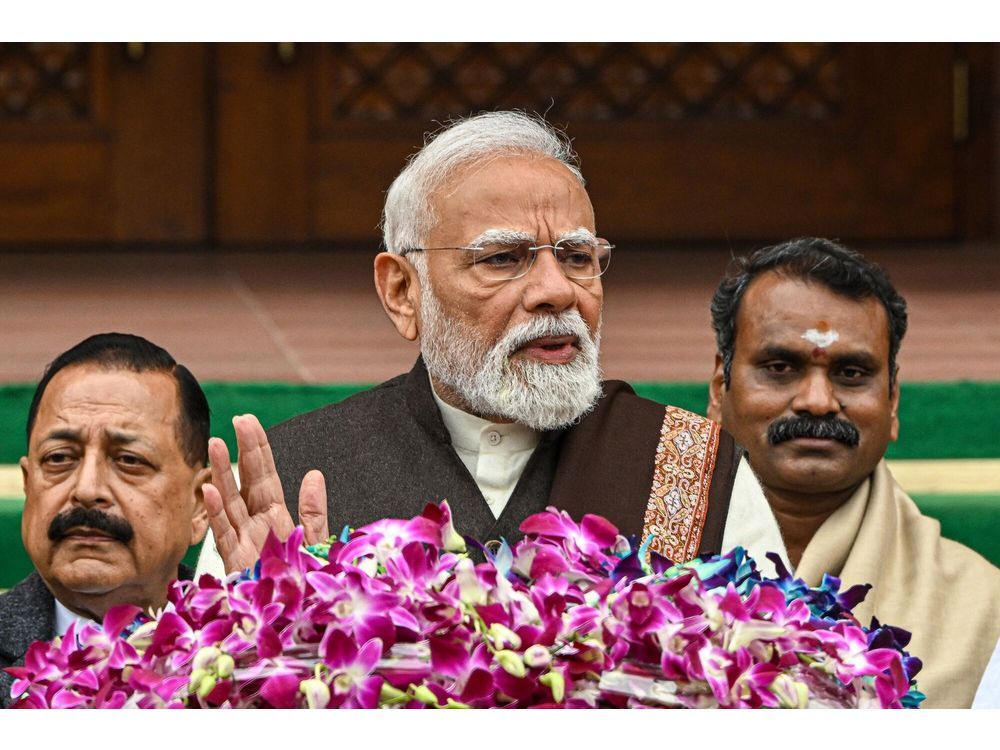
Modi Leverages AI Summit to Boost India's Global Tech Ambitions
Prime Minister Narendra Modi utilized the high-profile India AI Impact Summit in New Delhi to project India as a leading force in global artificial intelligence. The summit, attended by world leaders and tech CEOs, aims to showcase India's AI strategy for inclusive growth and assert its technological prowess on the world stage, despite initial logistical challenges.
Key Highlights
- PM Modi asserts India's AI leadership at global summit.
- Summit brings together world leaders, top tech executives.
- India aims for 'AI for All' approach, focusing on inclusive growth.
- IndiaAI Mission to develop sovereign AI infrastructure.
- Logistical issues and chaos reported at the summit's opening.
- Summit viewed as a platform to overcome recent political challenges.
Prime Minister Narendra Modi has strategically leveraged the ongoing India AI Impact Summit in New Delhi to vigorously assert India's burgeoning global ambitions in the realm of artificial intelligence. The summit, a five-day gathering running through February 20, 2026, has drawn significant international attention, with participation from several heads of state, including French President Emmanuel Macron and Brazilian President Luiz Inácio Lula da Silva, alongside prominent figures from the global tech industry such as Google's Sundar Pichai, OpenAI's Sam Altman, and Microsoft's Brad Smith.
The Bloomberg.com article highlights this summit as a crucial opportunity for Modi to showcase not only India's global aspirations but also his own resurgence following what it characterized as a 'tough year.' While the article's reference to challenges like 'verbal attacks from US President Donald Trump' seems to allude to an earlier period, the 'tough year' framing likely encompasses more recent political and economic hurdles. For instance, the Bharatiya Janata Party (BJP) faced an unexpected electoral setback in the 2024 general elections, failing to secure an outright parliamentary majority and necessitating the formation of a coalition government, which represented a significant political challenge for Modi. Additionally, 2023 saw diplomatic tensions, such as accusations regarding the extraterritorial murder of Khalistan activists by Canada and the United States, and ongoing concerns about high unemployment rates, particularly among youth, despite robust economic growth. However, the Bloomberg article also points to a recent positive turnaround for Modi, citing major trade pacts with the EU and US, strong popular support following key state elections, and optimistic economic growth forecasts. The AI summit thus provides a platform for India to pivot from these challenges and project a forward-looking image of technological leadership.
India's commitment to AI is deeply rooted in its 'AI for All' strategy, outlined by NITI Aayog's National Strategy for Artificial Intelligence (NSAI). This vision aims to position India among global AI leaders by focusing on social and inclusive growth, addressing both national and complex global challenges through technological intervention. The strategy emphasizes leveraging India's unique scale and diverse opportunities as an ideal test-bed for developing sustainable and scalable AI solutions that can also benefit other developing economies.
The government's proactive approach materialized with the launch of the IndiaAI Mission in March 2024, backed by a substantial outlay of Rs 10,372 crore (approximately $1.25 billion USD). This mission is designed to democratize access to advanced AI infrastructure, foster indigenous capabilities, and support the development of homegrown AI models. A key objective is to build a 'sovereign AI' ecosystem by investing heavily in high-performance computing, including Graphics Processing Units (GPUs), to reduce reliance on foreign cloud providers and develop large-scale models domestically. Initiatives like BharatGen for public services and BHASHINI for multilingual access underscore India's focus on creating AI solutions tailored to its diverse linguistic and cultural landscape. The aspiration is to make India a world leader in AI by 2047, aligning with the broader vision of a 'Viksit Bharat' (Developed India).
However, the grand aspirations of the summit were somewhat marred by logistical issues at its opening. Related articles reported 'long queues and confusion' and a 'mess' at the India AI Impact Summit, leading to apologies from Union Minister Ashwini Vaishnaw and criticism from opposition leaders like Mallikarjun Kharge, who called out the 'chaos' and a 'PR hungry' government. These challenges, though significant for attendees, do not fundamentally undermine the strategic intent behind India hosting such a high-profile event. Instead, they highlight the operational complexities sometimes faced in executing large-scale international gatherings.
Ultimately, the India AI Impact Summit serves as a powerful testament to India's ambition to be a significant player in the global AI landscape, acting as a bridge between advanced economies and the Global South. The nation intends to share its experience in building large-scale digital public infrastructure as a model for deploying AI at scale cost-effectively worldwide. This strategic positioning, coupled with substantial investments and policy frameworks, reinforces Modi's assertion of India's growing global stature through technological advancement.
Frequently Asked Questions
What is the India AI Impact Summit?
The India AI Impact Summit, held in New Delhi from February 16-20, 2026, is a significant international event organized by India to showcase its capabilities and vision in Artificial Intelligence. It brings together global leaders, tech executives, and experts to discuss AI development, ethical practices, and its role in inclusive growth.
What are India's main goals for AI?
India aims to be a global leader in AI by 2047 with an 'AI for All' approach, focusing on social and inclusive growth. Key goals include building sovereign AI infrastructure, fostering indigenous AI models, democratizing access to AI, and leveraging its digital public infrastructure to create scalable solutions for India and the Global South.
Who attended the India AI Impact Summit?
The summit saw attendance from prominent figures including Indian Prime Minister Narendra Modi, French President Emmanuel Macron, Brazilian President Luiz Inácio Lula da Silva, and top tech CEOs like Sundar Pichai (Google), Sam Altman (OpenAI), and Brad Smith (Microsoft).
Were there any issues at the AI Summit?
Yes, there were reports of logistical challenges at the opening of the summit, including long queues and confusion, which led to Union Minister Ashwini Vaishnaw issuing an apology. Opposition leaders also criticized the management of the event.
How does this summit reflect India's global ambitions?
By hosting such a high-profile international summit and bringing together diverse global stakeholders, India is asserting its growing influence in the technological landscape and positioning itself as a crucial bridge between developed nations and the Global South in shaping the future of AI.