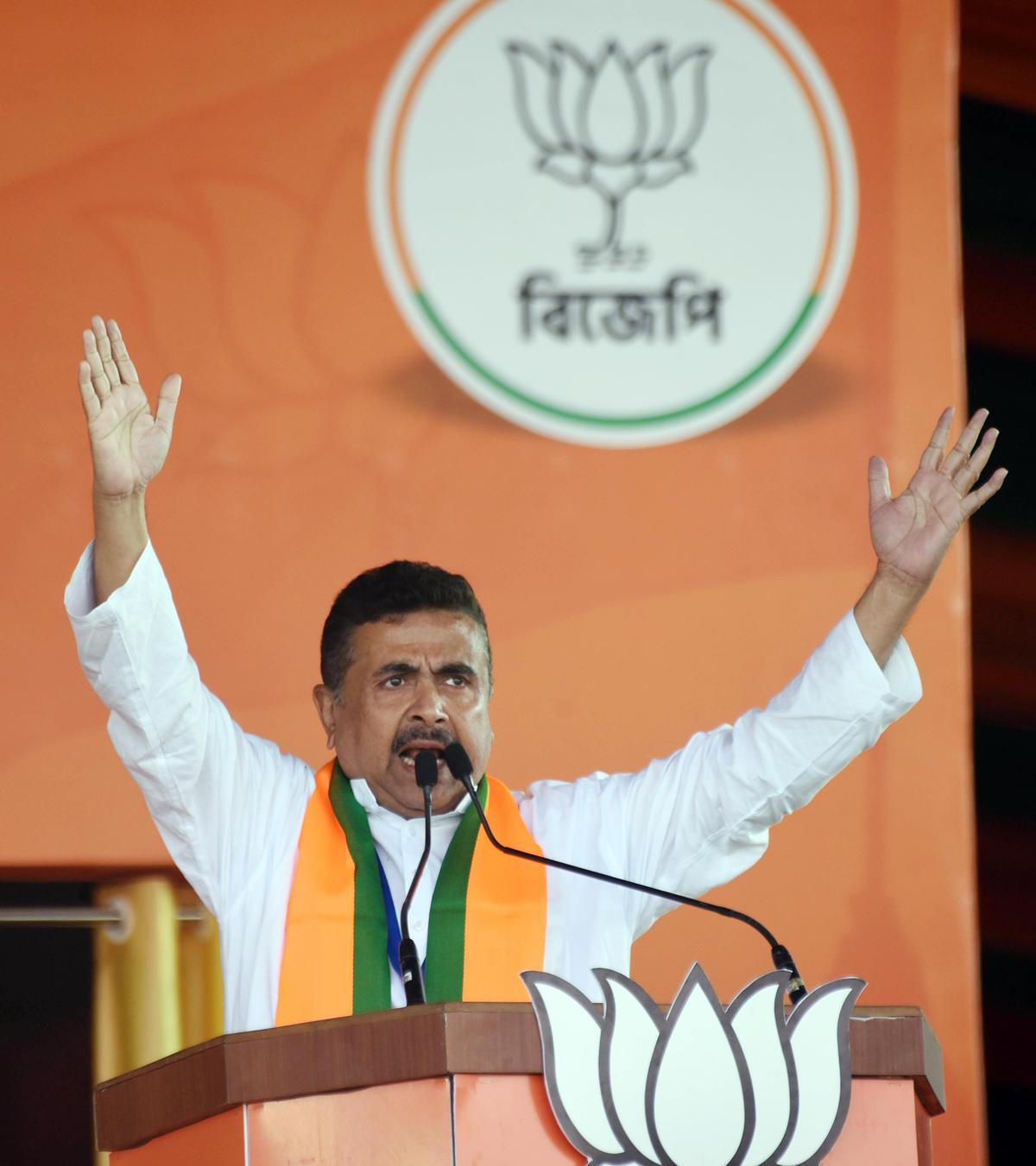
BJP's Bhabanipur Strategy: Trapping Mamata for Bengal 2026 Polls
The BJP is reportedly employing a 'Chakravyuh' strategy for the upcoming 2026 West Bengal Assembly Election by fielding Leader of Opposition Suvendu Adhikari against Chief Minister Mamata Banerjee in Bhabanipur. This move aims to confine Banerjee to her constituency, limiting her statewide campaign efforts and forcing her into a defensive battle. The strategy draws on the 2021 election context where Banerjee lost Nandigram to Adhikari but subsequently won the Bhabanipur by-election.
Key Highlights
- BJP fields Suvendu Adhikari against Mamata Banerjee in Bhabanipur for 2026 polls.
- Strategy aims to restrict Mamata Banerjee's statewide election campaigning.
- Bhabanipur is Mamata's political anchor after her 2021 Nandigram loss.
- BJP's first list of 144 candidates for 2026 Assembly elections released.
- Mamata Banerjee previously won Bhabanipur by-election in 2021 by over 58,000 votes.
The Bharatiya Janata Party (BJP) is strategically aiming to constrain West Bengal Chief Minister Mamata Banerjee in her Bhabanipur constituency for the upcoming 2026 West Bengal Assembly Election, a move characterized by India Today as a 'Chakravyuh' or an intricate trap. This high-stakes political maneuver involves fielding the current West Bengal Leader of Opposition, Suvendu Adhikari, from Bhabanipur, the very seat Mamata Banerjee won in a crucial 2021 by-election to retain her Chief Ministerial post. Adhikari will also contest from his traditional seat of Nandigram, where he famously defeated Banerjee in the 2021 general assembly elections.
The core objective of the BJP's strategy, as reported, is to 'bog down Mamata Banerjee' in her home turf, thereby limiting her ability to campaign extensively across West Bengal's 23 districts. As the Trinamool Congress' (TMC) most prominent star campaigner, Banerjee's statewide presence is vital for her party's candidates, especially in tightly contested constituencies. By forcing her into a localized, defensive battle in Bhabanipur, the BJP hopes to disrupt the TMC's broader electoral strategy and potentially impact the morale and campaign efforts of other TMC candidates.
The context for this strategic battle is rooted in the 2021 West Bengal Assembly elections. In a closely watched contest, Mamata Banerjee had opted to contest from Nandigram, a move to challenge her former aide Suvendu Adhikari, who had by then defected to the BJP. Adhikari emerged victorious in Nandigram by a narrow margin of 1,956 votes against Banerjee. Despite this personal defeat, the TMC secured a resounding majority across the state, winning 213 out of 292 seats, enabling Banerjee to form the government. However, to continue as Chief Minister, she was constitutionally required to be elected to the legislative assembly within six months. This led to the Bhabanipur by-election in September 2021, a constituency she had previously represented and won in both 2011 and 2016.
In the Bhabanipur by-election held on September 30, 2021, Mamata Banerjee secured a decisive victory against BJP's Priyanka Tibrewal, winning by a substantial margin of 58,832 votes. Her victory ensured her continuation as Chief Minister. The BJP's current strategy for 2026 seeks to leverage this history, aiming to turn Bhabanipur into a prestige battle that demands Banerjee's full attention, potentially diverting resources and focus from other critical campaigns.
Reports indicate that the BJP has already established a 'war room' in Bhabanipur, specifically in Ward No-70, to meticulously plan and execute its campaign against Banerjee. This area has historically shown a decent vote share for the BJP, with the party leading in several wards of Bhabanipur in past elections. The demography of Bhabanipur, often referred to as a "mini Bharat" due to its significant non-Bengali population (approximately 40% including Gujaratis, Marwaris, Punjabis, and Odias, alongside about 20% Muslim voters), adds another layer of complexity to the electoral dynamics, as these communities have historically favored Banerjee.
The headline's use of "Chakravyuh" is an analytical framing, effectively conveying the perceived strategic complexity and challenge that the BJP intends to create for Mamata Banerjee in Bhabanipur. It reflects a tactical approach designed to pin down a key political figure rather than a literal trap. The BJP's decision to field Suvendu Adhikari in Bhabanipur is a direct challenge on Banerjee's political stronghold, signalling an intent to make the contest a high-profile, energy-sapping affair for the Chief Minister. The 2026 West Bengal Assembly elections are scheduled with polling in two phases on April 23 and April 29, and results on May 4, 2026.
Frequently Asked Questions
What is the BJP's 'Chakravyuh' strategy for Mamata Banerjee in Bhabanipur?
The BJP's 'Chakravyuh' strategy involves fielding Leader of Opposition Suvendu Adhikari from Bhabanipur in the 2026 West Bengal Assembly elections. This is intended to tie down Chief Minister Mamata Banerjee to her constituency, limiting her ability to campaign statewide for the Trinamool Congress and forcing her into a defensive electoral battle.
Why is Bhabanipur significant for Mamata Banerjee?
Bhabanipur is significant for Mamata Banerjee because it is her traditional political stronghold, and she won a crucial by-election there in 2021 by over 58,000 votes to retain her position as Chief Minister after losing Nandigram in the general assembly elections that year.
Who is Suvendu Adhikari, and what is his electoral history with Mamata Banerjee?
Suvendu Adhikari is the current Leader of Opposition in the West Bengal Assembly and a prominent BJP leader. He famously defeated Mamata Banerjee in the Nandigram constituency during the 2021 West Bengal Assembly elections by a margin of 1,956 votes. He is now slated to contest against her in Bhabanipur for the 2026 elections.
When are the 2026 West Bengal Assembly elections scheduled?
The 2026 West Bengal Assembly elections are scheduled to be held in two phases, with polling on April 23 and April 29, and the counting of votes and declaration of results on May 4, 2026.
How did Mamata Banerjee become Chief Minister in 2021 after losing Nandigram?
Despite losing the Nandigram seat to Suvendu Adhikari in the 2021 Assembly elections, the Trinamool Congress secured a majority statewide, allowing Mamata Banerjee to be sworn in as Chief Minister. She then fulfilled the constitutional requirement of becoming an elected MLA by winning the Bhabanipur by-election in October 2021.