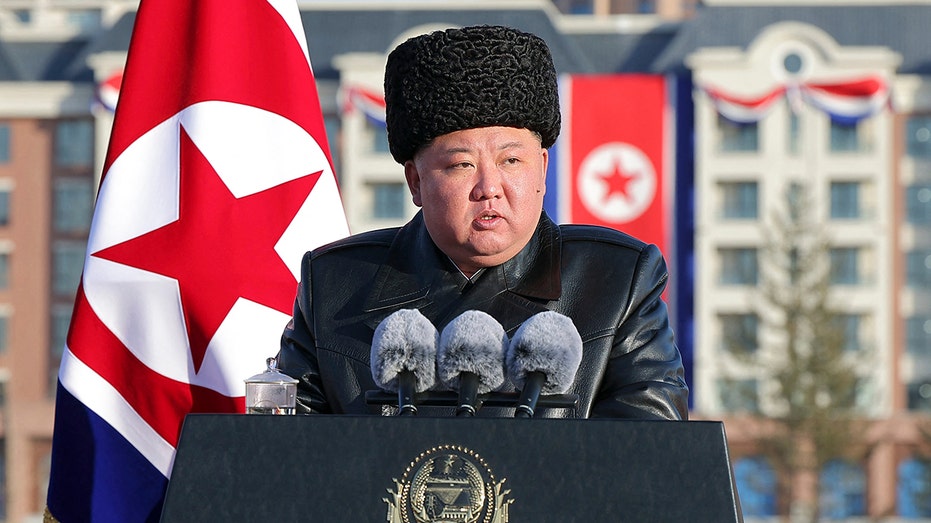
Kim Jong Un Cites Iran Conflict to Justify Nuclear Arsenal
North Korean leader Kim Jong Un has asserted that the ongoing conflict involving Iran justifies his nation's decision to maintain its nuclear weapons, declaring its nuclear status "irreversible". He also escalated rhetoric against South Korea, formally designating it as the "most hostile state" in a recent speech to parliament.
Key Highlights
- Kim Jong Un links Iran conflict to North Korea's nuclear justification.
- North Korea declares its nuclear status as "irreversible".
- South Korea formally designated as "most hostile state" by Pyongyang.
- Kim accused the U.S. of "state terrorism and aggression".
- Pyongyang vows "merciless" response to any South Korean provocation.
- Speech delivered amidst signals for potential U.S.-North Korea talks.
North Korean leader Kim Jong Un has recently delivered a pivotal speech to the Supreme People's Assembly, wherein he explicitly linked the ongoing conflict involving the United States and Iran to his nation's rationale for retaining and advancing its nuclear weapons program. Kim asserted that the 'present situation' serves as clear evidence that North Korea was justified in rejecting international pressure and 'sweet talk' aimed at denuclearization. He underscored that North Korea's nuclear status is now 'irreversible,' signifying a hardened stance against any future denuclearization efforts.
In his address, Kim Jong Un accused Washington of engaging in 'acts of state sponsored terrorism and aggression' across various regions, an apparent reference to the Middle East conflict, though he refrained from directly naming U.S. President Donald Trump. This sentiment resonates with North Korea's long-held belief that countries without nuclear weapons are susceptible to U.S. military power, whereas those possessing such capabilities can effectively deter it. The timing of these remarks is particularly significant, as it coincides with renewed speculation about potential talks between Kim and Trump, raising questions about the parameters of any future diplomatic engagement, especially given Kim's insistence that any dialogue must accept North Korea as a nuclear power.
Beyond justifying its nuclear arsenal, Kim Jong Un also dramatically escalated rhetoric towards South Korea. In the same policy speech, he formally declared South Korea to be the 'most hostile state' and vowed 'merciless' consequences for any acts of provocation. This declaration marks a significant shift, as it signals Pyongyang's intent to permanently sever any ideological or ethnic ties with the South and treat it purely as an enemy. There is speculation that North Korea might have amended its constitution to reflect this new hostile 'two-state relationship,' although concrete details on constitutional revisions were not immediately released by state media.
This hardening of North Korea's stance is not new; Kim Jong Un first mentioned the term 'hostile state' in late December 2023, and has since consistently reiterated this position, irrespective of changes in South Korean leadership. Experts suggest this redefinition effectively terminates the 'provisional special relationships' framework that has guided inter-Korean ties since 1991, urging Seoul to adapt to this fundamentally altered reality. The move also reflects Kim's apparent view that South Korea is no longer a useful intermediary with Washington but rather an impediment to his more assertive regional ambitions.
North Korea's nuclear weapons program has been a cornerstone of its national security strategy for decades. The country conducted its first nuclear test in 2006 and its most recent in 2017. Kim's policy speech reiterated the need to 'exponentially' boost nuclear weapons production and diversify its strike capabilities, further cementing the country's nuclear force-building policy as a permanent, foundational law of the state. This is consistent with earlier statements where North Korea has defended its nuclear program as essential for self-defense against perceived threats from the U.S. and its allies.
The international community, including major powers like the United States, China, and Russia, has long grappled with North Korea's nuclear ambitions. While the U.S. and its allies condemn Pyongyang's weapons development and missile tests, China and Russia have been criticized for not fully enforcing sanctions, which some analysts believe emboldens North Korea. For India, a nation deeply invested in global stability and non-proliferation, North Korea's unequivocal commitment to its nuclear arsenal and escalating tensions with South Korea represent a significant geopolitical concern. The precedent of a nuclear-armed state justifying its program by referencing international conflicts like the 'Iran war' (often interpreted as the broader Middle East instability or the Israel-Hamas conflict with Iranian involvement) could have far-reaching implications for non-proliferation efforts worldwide. The continuous development of North Korea's nuclear capabilities and its increasingly hostile rhetoric contribute to regional instability in East Asia, an area of strategic interest for India's Act East policy. Furthermore, India, as a responsible nuclear power, consistently advocates for global nuclear disarmament while upholding its own credible minimum deterrence, making such pronouncements from North Korea a matter of close observation for their potential impact on international nuclear norms and security architecture.
In essence, Kim Jong Un's recent declarations reinforce North Korea's resolve to remain a nuclear power, leveraging global conflicts as justification and redefining its relationship with South Korea in starkly hostile terms. This development poses ongoing challenges for regional security and international efforts to curb nuclear proliferation.
Frequently Asked Questions
What was Kim Jong Un's primary justification for North Korea's nuclear weapons program?
Kim Jong Un justified North Korea's nuclear weapons program by referencing the ongoing conflict involving the United States and Iran, asserting that it proves the necessity for a strong nuclear deterrent against perceived foreign aggression.
What is the new status of North Korea's nuclear weapons program, according to Kim Jong Un?
Kim Jong Un declared that North Korea's nuclear status is now 'irreversible,' indicating a permanent commitment to its nuclear arsenal and a rejection of denuclearization efforts.
How has North Korea's stance towards South Korea changed?
North Korea has formally designated South Korea as its 'most hostile state,' signaling a complete abandonment of previous reconciliation goals and a shift towards an openly adversarial relationship.
When did Kim Jong Un make these significant statements?
These statements were made by Kim Jong Un in a speech delivered to North Korea's Supreme People's Assembly, widely reported by international media on March 24-25, 2026.
What are the broader implications of these developments for international security?
These developments signify a heightened risk of instability on the Korean Peninsula and reinforce North Korea's status as a nuclear power, complicating international non-proliferation efforts and potentially influencing other states' perceptions of nuclear deterrence.