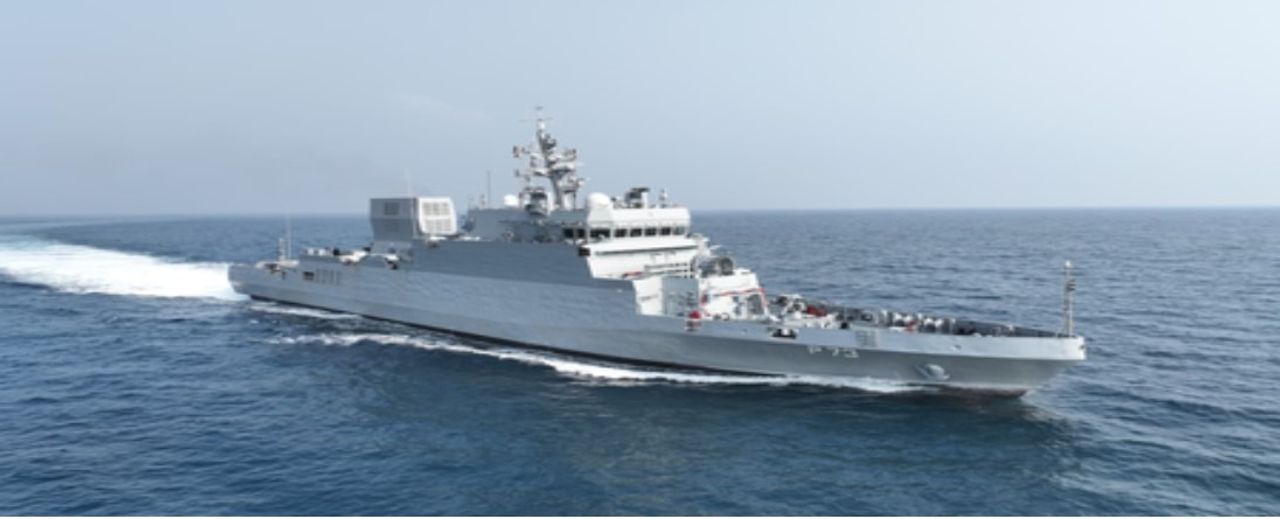
Indian Navy Commissions 'Dolphin Hunter' INS Anjadip for Coastal ASW
The Indian Navy has commissioned INS Anjadip, the third Anti-Submarine Warfare Shallow Water Craft (ASW-SWC), at Chennai Port. Nicknamed the 'Dolphin Hunter', this indigenous vessel significantly boosts India's coastal defence and anti-submarine capabilities, reinforcing the 'Aatmanirbhar Bharat' initiative in defence manufacturing.
Key Highlights
- INS Anjadip commissioned on February 27, 2026, at Chennai Port.
- It is the third of eight Anti-Submarine Warfare Shallow Water Crafts (ASW-SWC).
- Known as 'Dolphin Hunter' for its specialized anti-submarine role.
- Built indigenously by GRSE, Kolkata, enhancing 'Aatmanirbhar Bharat'.
- Equipped with advanced indigenous sonar, torpedoes, and ASW rockets.
- Enhances coastal surveillance, low-intensity maritime operations, and SAR.
The Indian Navy officially commissioned INS Anjadip, a state-of-the-art Anti-Submarine Warfare Shallow Water Craft (ASW-SWC), on Friday, February 27, 2026, at Chennai Port under the Eastern Naval Command. This significant induction, presided over by the Chief of Naval Staff, Admiral Dinesh K Tripathi, marks a crucial stride in bolstering India's maritime security and its commitment to indigenous defence manufacturing under the 'Aatmanirbhar Bharat' initiative.
INS Anjadip is the third vessel in a series of eight ASW-SWC projects, with its primary mission focused on detecting, tracking, and neutralizing enemy submarines operating in coastal and shallow waters. The vessel has earned the informal yet widely recognized moniker 'Dolphin Hunter' due to this specialized role in littoral combat environments, where traditional larger warships face operational constraints.
Designed and constructed by Garden Reach Shipbuilders and Engineers (GRSE) in Kolkata, INS Anjadip exemplifies India's growing self-reliance in naval shipbuilding. The ship measures 77 meters in length and is propelled by a high-speed water-jet system, allowing it to achieve speeds of up to 25 knots. This propulsion system provides rapid response and sustained operational capability, essential for navigating and operating effectively in the challenging shallow-water environments critical for India's extensive coastline.
The vessel is equipped with an advanced and largely indigenous anti-submarine warfare weapons and sensor package. Key among its combat suite is the Hull Mounted Sonar 'Abhay,' specifically optimized for shallow water detection. It is also armed with lightweight torpedoes and anti-submarine warfare rockets, significantly enhancing its capability to engage and neutralize sub-surface threats.
Beyond its primary ASW role, INS Anjadip is designed as a multi-role platform capable of undertaking coastal surveillance, low-intensity maritime operations (LIMO), and search-and-rescue (SAR) missions. Its versatility makes it a critical asset for safeguarding India's maritime interests, protecting key shipping lanes, and securing offshore assets, particularly along the coasts of Tamil Nadu and Puducherry.
The name 'Anjadip' is derived from the historically significant island off the coast of Karwar in Karnataka/Goa, which has maritime historical relevance, linking the vessel to India's naval heritage. This vessel is also a reincarnation of an erstwhile Petya-class Corvette of the same name, which was decommissioned in 2003.
The commissioning of INS Anjadip underscores India's accelerated progress towards achieving self-reliance in defence and transforming the Indian Navy into a formidable 'Builder's Navy'. With over 80% indigenous content, the project aligns with the government's 'Make in India' initiative, significantly reducing reliance on foreign defence imports. This induction enhances India's operational readiness in countering evolving maritime threats in the strategically vital Indian Ocean Region, particularly in shallow-water acoustic environments where detection is technically challenging.
Looking ahead, the Indian Navy plans to induct approximately 15 more vessels in 2026, signaling one of its most active expansion cycles in decades, further solidifying its naval power and commitment to securing its vast maritime boundaries.
Frequently Asked Questions
What is INS Anjadip and what is its primary role?
INS Anjadip is the Indian Navy's latest Anti-Submarine Warfare Shallow Water Craft (ASW-SWC). Its primary role is to detect, track, and neutralize enemy submarines in coastal and shallow waters, effectively serving as a 'Dolphin Hunter'.
When and where was INS Anjadip commissioned?
INS Anjadip was commissioned on Friday, February 27, 2026, at Chennai Port, under the Eastern Naval Command.
Who built INS Anjadip and what is its significance for India?
INS Anjadip was indigenously designed and built by Garden Reach Shipbuilders and Engineers (GRSE) in Kolkata. Its commissioning highlights India's progress in defence self-reliance under the 'Aatmanirbhar Bharat' initiative, strengthening indigenous shipbuilding capabilities.
What are the key features and capabilities of INS Anjadip?
Measuring 77 meters, INS Anjadip features a high-speed water-jet propulsion system (up to 25 knots) and is equipped with indigenous weapons and sensor packages, including the Hull Mounted Sonar 'Abhay', lightweight torpedoes, and ASW rockets. It can also perform coastal surveillance, low-intensity maritime operations, and search-and-rescue missions.
How many such vessels are part of the ASW-SWC project?
INS Anjadip is the third of eight vessels being built under the Indian Navy's Anti-Submarine Warfare Shallow Water Craft (ASW-SWC) project.