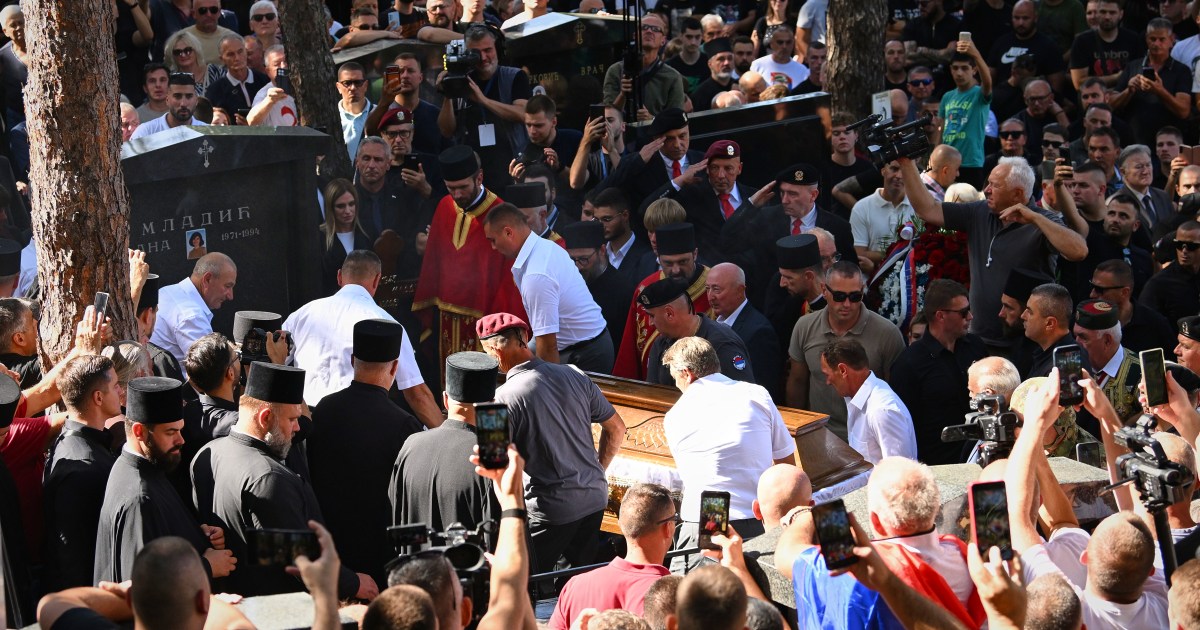
Ratko Mladic, 'Butcher of Bosnia,' Receives Hero's Burial in Serbia Amid Outcry
Convicted war criminal Ratko Mladic, known as the 'Butcher of Bosnia,' was given a hero's funeral in Belgrade, Serbia, attended by thousands, despite his life sentence for genocide and war crimes. The event sparked international condemnation and further strained relations between Serbia and Bosnia and Herzegovina.
Key Highlights
- Thousands attended Ratko Mladic's funeral in Belgrade, Serbia.
- Mladic was a convicted war criminal for genocide and crimes against humanity.
- The funeral included military honors and displays of national pride.
- International bodies and Bosnia condemned the 'hero's burial.'
- The event highlights deep divisions and challenges for reconciliation in the Balkans.
- Serbia faced EU warnings regarding the glorification of war criminals.
Ratko Mladic, the former Bosnian Serb general infamously known as the 'Butcher of Bosnia,' received a controversial hero's funeral in Belgrade, Serbia, drawing thousands of mourners despite his conviction for genocide, war crimes, and crimes against humanity. Mladic, who died in late August 2026 at the age of 84 while serving a life sentence in a UN detention facility in The Hague, was laid to rest in a ceremony that reignited painful memories of the 1990s Yugoslav wars and drew sharp international criticism.
The funeral, held on Monday, September 7, 2026, saw large crowds gather outside the Church of St. Luke in Belgrade. Many attendees, some waving Serbian flags and wearing shirts praising Mladic, viewed him as a national hero who defended Serbs during the conflict. His coffin, draped in the Serbian flag, was carried by uniformed soldiers, and a military salute was part of the proceedings at the cemetery, showcasing significant military pomp. Banners displayed across streets read, 'Welcome, General, thanks be to your mother for bearing a hero, so that Serbdom's glory may return.' Serbian Orthodox priests conducted prayers, and the patriarch of the Serbian Orthodox church, Porfirije, stated that Mladic's name would 'remain deeply etched in the memory and prayers of the majority of our Serbian Orthodox people,' who felt 'a deep sense of gratitude towards him.'
Mladic was a central figure in the Bosnian War (1992-1995), leading the Army of Republika Srpska (VRS). In 2017, the International Criminal Tribunal for the former Yugoslavia (ICTY) convicted him on 10 of 11 charges, including genocide, five counts of crimes against humanity, and four counts of violations of the laws or customs of war. His convictions included orchestrating the 1995 Srebrenica massacre, where over 8,000 Bosniak Muslim men and boys were systematically killed, and the brutal nearly four-year-long siege of Sarajevo, which resulted in thousands of civilian deaths through shelling and sniping. He was also found responsible for establishing detention camps for non-Serb civilians and taking UN personnel hostage. His life sentence was upheld on appeal in 2021.
The decision to accord Mladic such a prominent and largely unhindered funeral by the Serbian state, despite its claims of leaving arrangements to the family, drew immediate and severe condemnation. The European Union's Enlargement Commissioner, Marta Kos, canceled a planned visit to Serbia, denouncing the event as the glorification of a war criminal. An EU spokesperson reiterated that 'any glorification of war criminals, genocide denial and revisionism contradict the most fundamental European values and have no place in the EU or in EU candidate countries,' a warning that carries weight given Serbia's ongoing EU accession negotiations.
Bosnia and Herzegovina reacted strongly, with its Foreign Minister Elmedin Konaković announcing the withdrawal of embassy staff from Belgrade, signaling serious diplomatic repercussions. The Office of the High Representative for Bosnia and Herzegovina warned that glorifying condemned war criminals and denying genocide generates divisions, causes more pain to victims and their families, and undermines the process of reconciliation. This event underscored the deep ethnic divisions that persist in the Balkans, with many Serbs continuing to view Mladic as a defender of his people, a sentiment starkly opposed by Bosniak victims and much of the international community.
The funeral highlights the persistent challenges to reconciliation in the post-conflict Balkans, where historical narratives often clash. While international courts have delivered verdicts, a significant portion of the Serbian public and some political figures continue to resist acknowledging the full extent of the atrocities committed by Mladic and his forces. This persistent glorification fuels tensions and complicates efforts to move towards a shared understanding of the past, crucial for lasting peace and stability in the region. The state's involvement, even if indirectly, in facilitating a funeral with such honors for a convicted genocidaire, casts a shadow over its commitment to European values and its path towards EU membership.
Frequently Asked Questions
Who was Ratko Mladic?
Ratko Mladic was a Bosnian Serb military officer who led the Army of Republika Srpska (VRS) during the 1992-1995 Bosnian War. He was convicted by the International Criminal Tribunal for the former Yugoslavia (ICTY) for genocide, crimes against humanity, and war crimes, earning him the moniker 'Butcher of Bosnia'.
What were Ratko Mladic's main convictions?
Mladic was convicted for his role in the Srebrenica massacre, where over 8,000 Bosniak Muslim men and boys were killed, and for the siege of Sarajevo, which caused thousands of civilian casualties. He was found guilty of genocide, extermination, murder, persecution, and other inhumane acts.
Why was his funeral controversial?
His funeral was highly controversial because, despite his convictions for horrific war crimes, he received a 'hero's burial' with military honors in Serbia, attended by thousands of admirers. This glorification of a convicted genocidaire sparked outrage from victims' groups, Bosnia and Herzegovina, and the European Union, highlighting deep divisions and challenging reconciliation efforts.
How did the international community react to the funeral?
The international community, particularly the European Union, strongly condemned the funeral. The EU's Enlargement Commissioner canceled a visit to Serbia, and EU officials warned that such glorification of war criminals contradicts European values and could impact Serbia's path to EU membership. Bosnia and Herzegovina reduced diplomatic ties with Serbia.
What does this event signify for the Balkans region?
The funeral signifies the enduring ethnic divisions and the complex, often conflicting, narratives of the past in the Balkans. It underscores the ongoing challenges to genuine reconciliation and justice in the region, as well as the difficulty of confronting war crimes when perpetrators are still regarded as heroes by segments of the population.