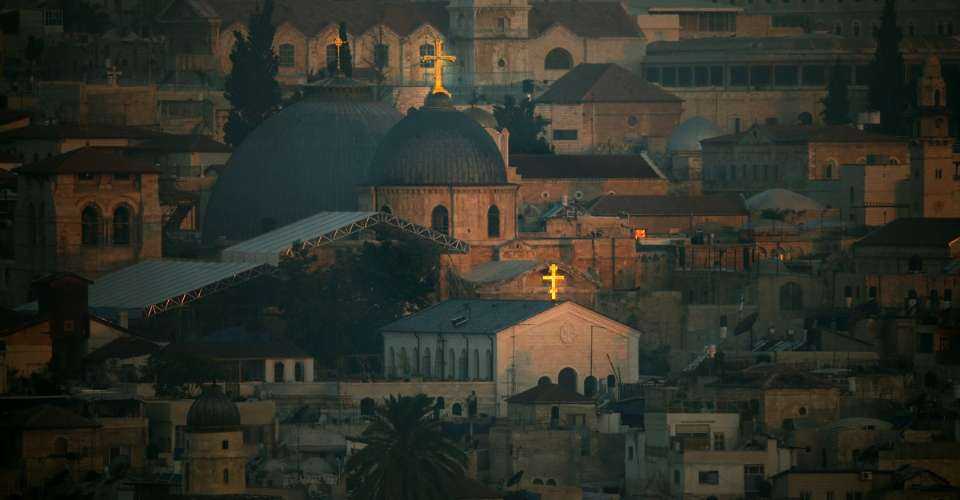
Israel Blocks Catholic Leaders from Holy Sepulchre on Palm Sunday
In an unprecedented move, Israeli police blocked senior Catholic leaders, including the Latin Patriarch, from entering Jerusalem's Church of the Holy Sepulchre on Palm Sunday in March 2024, citing security concerns amid regional tensions. The Latin Patriarchate condemned the action as a 'first time in centuries' infringement on religious freedom, drawing international criticism.
Key Highlights
- Israeli police blocked Catholic leaders from Holy Sepulchre in March 2024.
- Latin Patriarch Pierbattista Pizzaballa was among those denied entry.
- Church claims this was 'first time in centuries' for such restrictions.
- Israel cited security concerns due to ongoing regional conflict.
- Incident sparked international condemnation from global leaders.
- Event raised concerns about religious freedom and status quo in Jerusalem.
In a highly contentious incident that garnered international condemnation, Israeli police blocked senior Catholic leaders, most notably Cardinal Pierbattista Pizzaballa, the Latin Patriarch of Jerusalem, and Friar Francesco Ielpo, the Custos of the Holy Land, from accessing the revered Church of the Holy Sepulchre on Palm Sunday, March 24, 2024. This decision, reported extensively by global news outlets including The Times of India in March 2026, was described by the Latin Patriarchate of Jerusalem as a 'grave precedent' and 'for the first time in centuries' that church heads were prevented from celebrating Palm Sunday Mass at the site where Christians believe Jesus was crucified, buried, and resurrected.
The Israeli authorities justified their actions by citing security concerns, particularly in the context of the then-ongoing regional conflict and the general security situation in Jerusalem's Old City. Police statements indicated that the Old City's narrow alleys and lack of access for large emergency vehicles posed a 'real risk to human life in the event of a mass casualty incident' and that the Patriarch's request for access had been denied due to these security considerations. They asserted that all holy sites in the Old City had been closed to worshippers since the escalation of regional tensions, particularly those without adequate bomb shelters.
However, the Latin Patriarchate vehemently rejected the Israeli police's justification, characterizing the decision as 'a manifestly unreasonable and grossly disproportionate measure.' Church officials emphasized that Cardinal Pizzaballa and other clerics were attempting to enter the church 'privately and without any characteristics of a procession or ceremonial act' and had already complied with previous wartime restrictions, including canceling public gatherings and arranging for broadcasts of services. They argued that the Church of the Holy Sepulchre had been hosting private Masses since the conflict began and questioned why the Palm Sunday Mass and access for the religious leaders were treated differently. The Patriarchate stated that the move disregarded the sensibilities of billions of Christians worldwide who look to Jerusalem during Holy Week.
The incident triggered immediate and widespread international criticism. French President Emmanuel Macron condemned the Israeli police decision on X, expressing full support for the Latin Patriarch and Christians in the Holy Land, and calling it part of 'a disturbing sequence of violations of the status quo of the holy places in Jerusalem.' He stressed that freedom of worship in Jerusalem must be ensured for all religions. Italy's foreign ministry summoned the Israeli Ambassador to Italy, Jonathan Peled, for an explanation, with Prime Minister Giorgia Meloni calling the decision 'an offense to the faithful.' The United States and other foreign embassies also sought clarification from Israel's foreign ministry.
In response to the backlash, Israel's Prime Minister Benjamin Netanyahu's office denied any 'malicious intent' behind the decision, stating that it was made 'out of special concern for his safety' and that authorities were 'putting together a plan to enable church leaders to worship at the holy site in the coming days.' Early on the Monday following the incident, the Israeli police announced that they had approved a 'limited prayer framework' for the church in consultation with the Latin Patriarchate of Jerusalem, aiming to 'enable freedom of worship' while safeguarding worshippers from potential attacks.
Palm Sunday marks the beginning of Holy Week, commemorating Jesus Christ's entry into Jerusalem. It is a day traditionally observed with a large procession from the Mount of Olives into the Old City, an event that typically draws thousands of pilgrims. The cancellation of this traditional procession and the denial of access to senior clergy for the Mass at the Holy Sepulchre underscored the severe impact of regional tensions on religious observances in the Holy Land. The broader context of restrictions also affected Jewish and Muslim worshippers during their respective holy periods of Passover and Ramadan in 2024.
Frequently Asked Questions
When did the incident of Israel blocking Catholic leaders occur?
The incident where Israeli police blocked senior Catholic leaders from entering the Church of the Holy Sepulchre on Palm Sunday took place on March 24, 2024.
Who was primarily affected by the restrictions?
Cardinal Pierbattista Pizzaballa, the Latin Patriarch of Jerusalem, and Friar Francesco Ielpo, the Custos of the Holy Land, were among the senior Catholic leaders prevented from accessing the church.
What was Israel's stated reason for blocking access?
Israeli authorities cited security concerns amidst regional tensions, stating that the Old City's layout made access difficult for emergency vehicles and posed a risk in case of mass casualties.
How did the Latin Patriarchate respond to Israel's decision?
The Latin Patriarchate condemned the decision as 'unreasonable and disproportionate,' calling it a 'grave precedent' and the 'first time in centuries' that church leaders were prevented from celebrating Palm Sunday Mass at the Holy Sepulchre. They noted that clerics were attempting private entry and had already complied with previous restrictions.
What were the international reactions to this incident?
The incident drew sharp criticism from several countries, including France and Italy, whose leaders condemned the move and called for the assurance of religious freedom in Jerusalem. The United States and other embassies also sought explanations from Israel.