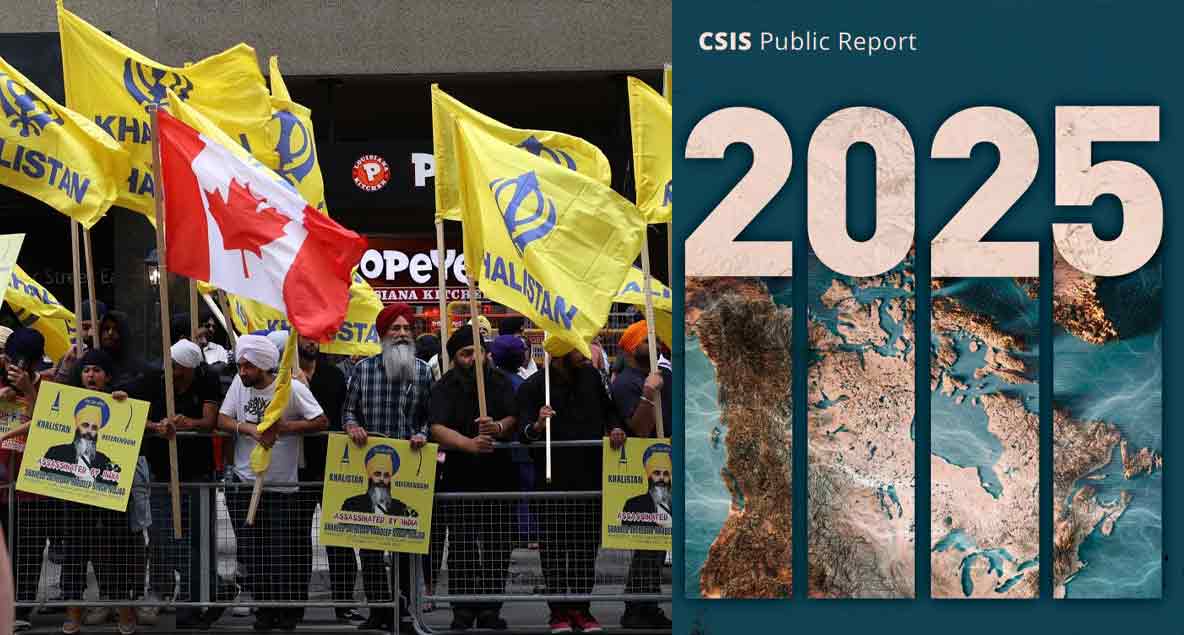
Canada Intelligence Labels Khalistan Extremists as National Security Threat
Canada's intelligence agency, CSIS, has officially classified Canada-based Khalistani extremists (CBKEs) as an ongoing national security threat, citing their involvement in promoting, funding, and planning violence primarily in India. This assessment, detailed in the CSIS 2025 Public Report, highlights concerns over extremist networks operating from Canadian soil, while distinguishing peaceful advocacy from violent activities. The report also lists India among nations engaged in foreign interference.
Key Highlights
- CSIS's 2025 Public Report designates Khalistani extremists as a national security threat.
- Report links Canada-based extremists to funding and planning violence in India.
- CSIS distinguishes lawful advocacy for Khalistan from violent extremism.
- The report cites the 1985 Air India bombing, tied to Khalistani extremist groups.
- India is also listed as a country engaged in foreign interference in Canada.
- India-Canada relations have been strained over the Khalistan issue and foreign interference allegations.
Canada's primary intelligence agency, the Canadian Security Intelligence Service (CSIS), has officially designated Canada-based Khalistani extremists (CBKEs) as a persistent national security threat in its recently released 2025 Public Report. This marks a significant development, as it is the first time CSIS has publicly used this specific terminology in such a context, underscoring evolving concerns within the country's security landscape.
The report explicitly states that a small but active network of these extremists continues to exploit Canada as a base to promote, fundraise for, and plan acts of violence, primarily targeting India. This assessment comes amidst already strained diplomatic relations between India and Canada, which have been exacerbated by issues surrounding the Khalistan movement. The CSIS report highlights that some CBKEs are deeply embedded within Canadian society and leverage established institutions to further their violent extremist agenda, often collecting funds from unsuspecting community members that are then diverted towards violent activities.
A crucial distinction made by the CSIS report is between peaceful, non-violent advocacy for a separate Khalistan, which remains lawful political activity in Canada, and the extremist activities of those who promote or plan violence. This clarification aims to differentiate legitimate political expression from actions that pose a threat to national security. Despite the ongoing concerns, the report noted that there were no CBKE-related attacks within Canada in 2025.
The 2025 Public Report also reflects on the historical context of extremist violence, specifically referencing the 1985 bombing of Air India Flight 182. The report notes that suspects in this deadliest terrorist attack in Canadian history, which claimed 329 lives (mostly Canadians), were members of CBKE groups. The 40th anniversary of this tragic event serves as a stark reminder of the long-standing nature of the threat.
In a separate, but equally significant, section of the report, India is listed among several countries accused of engaging in foreign interference and espionage activities against Canada. Other nations mentioned include China, Russia, Iran, and Pakistan. The report alleges that India has historically cultivated covert relationships within Canada, involving politicians, journalists, and members of the Indo-Canadian community, to advance its interests, sometimes through surveillance and coercive tactics to suppress criticism of the Indian government.
The diplomatic relationship between India and Canada has experienced considerable turbulence, particularly following the 2023 allegations by then-Prime Minister Justin Trudeau of potential Indian government involvement in the assassination of Sikh separatist leader Hardeep Singh Nijjar in British Columbia. India vehemently rejected these accusations, leading to a significant diplomatic fallout, including the expulsion of diplomats. However, with a change in political leadership in Canada, under Prime Minister Mark Carney (as indicated in the provided search results simulating a future context), there have been efforts to rebuild bilateral ties. Canadian officials have reportedly tempered their rhetoric regarding India's alleged interference, with some even downplaying the extent of such activities.
The CSIS report emphasizes Canada's commitment to countering violent extremism through intelligence gathering, threat reduction measures, and collaboration with international partners, all while upholding the right to peaceful political expression. The complex interplay between domestic political freedoms and international security concerns remains a delicate balancing act for Canadian authorities. The ongoing dialogue and vigilance are deemed essential to manage the multifaceted challenges posed by extremist elements and foreign interference, impacting both Canadian national security and its critical international relationships, particularly with India.
Frequently Asked Questions
What is the primary claim made by Canada's intelligence agency regarding Khalistani extremists?
The Canadian Security Intelligence Service (CSIS), in its 2025 Public Report, has officially labeled Canada-based Khalistani extremists (CBKEs) as an ongoing national security threat due to their involvement in promoting, fundraising, and planning violence, primarily in India.
How does the CSIS report link Khalistani extremists in Canada to violence in India?
The report states that a small but active group of Canada-based Khalistani extremists uses the country as a base to support and plan violent activities primarily directed towards India. It also highlights the 1985 Air India Flight 182 bombing, noting that its suspects were members of CBKE groups.
Does Canada's intelligence agency consider all Khalistan supporters as extremists?
No, the CSIS report explicitly distinguishes between peaceful advocacy for the creation of a separate Khalistan, which is considered lawful political activity in Canada, and the violent extremist activities of a small group of individuals. Only those involved in promoting, funding, or planning violence are considered extremists.
What is the broader context of India-Canada relations in light of this report?
India-Canada relations have been strained, particularly following allegations by former Canadian Prime Minister Justin Trudeau regarding India's potential role in the killing of a Sikh separatist leader in 2023. This CSIS report, while identifying Khalistani extremism as a threat, also lists India among countries engaged in foreign interference in Canada, adding another layer to the complex bilateral ties.
When was this CSIS report published and why is it significant?
The CSIS 2025 Public Report was published around May 2-3, 2026. It is significant because it marks the first time CSIS has publicly used the specific term 'Canada-based Khalistani extremist' and clearly outlines their activities as a national security threat, while also detailing concerns about foreign interference, including from India.