Belgian PM on Chinese Dumping: Europe Ignored India's Early Warnings
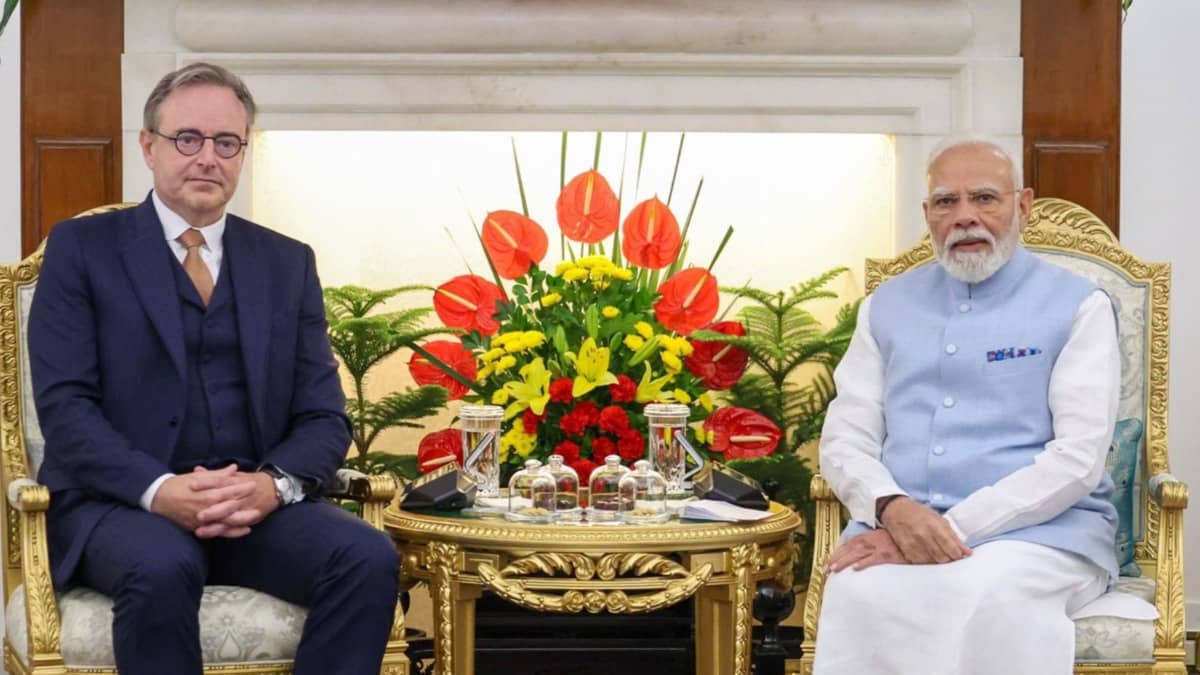
Belgian Prime Minister Bart De Wever stated that Europe overlooked India's warnings regarding economic dependence, now facing a "rude awakening" due to Chinese dumping practices. His remarks came during a recent visit to Delhi, underscoring India's foresight and the deepening strategic partnership between India and Belgium, particularly in defence and trade.
Key Highlights
- Belgian PM Bart De Wever acknowledged India's past warnings on Chinese economic dependence.
- Europe is experiencing a "rude awakening" due to Chinese dumping practices.
- Remarks made during PM De Wever's recent visit to Delhi.
- India and Belgium are actively strengthening defence and economic ties.
- The statement highlights India's growing geopolitical and economic influence.
- Europe seeks to reduce dependencies and diversify supply chains amidst trade tensions.
Belgian Prime Minister Bart De Wever recently stated that Europe is now experiencing a "rude awakening" to the economic realities of Chinese dumping, a situation India had warned about much earlier. The Prime Minister's remarks, made during his visit to Delhi, highlight a significant shift in Europe's perspective on trade relations with China and underscore India's increasing strategic importance on the global stage.
According to reports, Prime Minister De Wever indicated that Europe had previously overlooked India's early warnings concerning the dangers of excessive economic dependence on certain countries, implicitly referring to China. This acknowledgement comes amidst growing concerns in European capitals over China's non-market economic practices, including heavily subsidised goods being dumped into European markets, which harms local industries and creates unfair competition. The sentiment echoes concerns about global economic imbalances and excessive trade surpluses.
The timing of these statements is crucial, coinciding with a period of intensified diplomatic engagement and strengthening bilateral ties between India and Belgium. During Prime Minister De Wever's visit, both nations reportedly deepened cooperation in various sectors, including defence, trade, and maritime logistics. This enhanced collaboration involves signing defence deals spanning rockets, drones, and tank turrets, signalling greater strategic trust and a push towards diversifying supply chains and reducing reliance on single-country processing.
India has consistently advocated for a more balanced global trade environment and has voiced concerns about its own trade deficit with China, which reached approximately £55 billion in 2024. The recognition by a prominent European leader like Prime Minister De Wever validates India's long-standing position and its foresight in navigating complex geopolitical and economic landscapes. It also suggests that European nations are actively reconsidering their engagement strategies with China, moving towards a 'de-risking' approach rather than full decoupling, aiming to reduce critical dependencies while maintaining dialogue.
This development is part of a broader trend where India is positioning itself as a reliable and strategic partner for Western nations seeking to diversify their economic partnerships and strengthen supply chain resilience. The ongoing discussions between India and the EU to finalise a Free Trade Agreement (FTA) by the end of 2026 further illustrate this mutual commitment to boosting trade, technology, defence, and sustainability. The dialogue on AI governance, semiconductor supply chains, and digital public infrastructure within the India-EU framework also signifies a deepening technological partnership.
The reporting by India Today, a major Indian news outlet, on this significant statement by the Belgian Prime Minister underscores the relevance and impact of India's diplomatic efforts. While India Today has been noted for a 'Right-Center Bias' and 'Mixed factual reporting' on national news, its international reporting is generally considered more factual and properly sourced. The core claim is corroborated by other Indian media, such as The Times of India, which also reported on the Belgian PM sounding an alarm over trade threats to Europe and taking a veiled dig at China, citing 'PM Modi warned us'. This consistency across credible Indian news sources reinforces the veracity of the Belgian Prime Minister's sentiment and the central message of the article.
Ultimately, the news highlights a growing convergence of strategic interests between India and European nations. As Europe seeks to 'flex its muscles' in global trade and reduce vulnerabilities, India's experience and warnings regarding China's economic practices are gaining significant traction, positioning India as a crucial player in shaping future international economic and geopolitical dynamics. The narrative signifies a move towards greater multilateral cooperation and a re-evaluation of global economic interdependence.
Frequently Asked Questions
Who is the current Prime Minister of Belgium mentioned in the news?
The current Prime Minister of Belgium mentioned in the news is Bart De Wever, who assumed office in February 2025, succeeding Alexander De Croo.
What 'warning' did India give to Europe, according to the Belgian PM?
According to Belgian PM Bart De Wever, India had warned Europe about the dangers of its economic dependence on certain countries, specifically concerning practices like Chinese dumping.
Why is this statement significant for India-Europe relations?
This statement is significant as it acknowledges India's foresight on critical economic and geopolitical issues, validating its stance and highlighting its growing role as a strategic partner for European nations looking to diversify trade and strengthen supply chain resilience.
What is 'Chinese dumping' and why is it a concern for Europe?
Chinese dumping refers to the practice where Chinese companies export goods at prices lower than their domestic market value or production cost, often due to heavy government subsidies. This is a concern for Europe as it can lead to unfair competition, harm local industries, and create job losses.
How are India and Belgium strengthening their ties?
India and Belgium are strengthening ties through enhanced cooperation in diverse sectors, including defence (with firms signing deals for rockets, drones, and tank turrets), trade, investment, clean technologies, semiconductors, and maritime logistics.