Mamata Banerjee Leads TMC Protest Amidst Police Permission Controversy
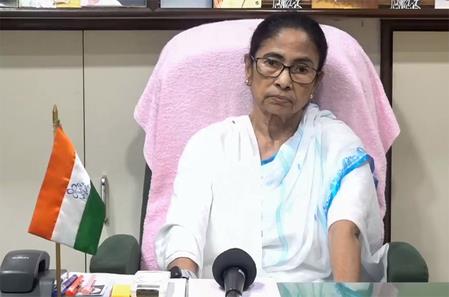
West Bengal CM Mamata Banerjee staged a protest in Kolkata, reportedly without explicit police permission, against alleged post-poll violence and an attack on Abhishek Banerjee. The demonstration highlights ongoing political tensions in the state.
Key Highlights
- Mamata Banerjee led a protest in Kolkata.
- The protest was reportedly held without police permission.
- Allegations of post-poll violence and an attack on Abhishek Banerjee were cited.
- TMC leaders joined the demonstration.
- The event underscores political friction in West Bengal.
West Bengal Chief Minister Mamata Banerjee recently led a protest in Kolkata, which, according to reports, proceeded without explicit prior police permission. The demonstration was organized in response to alleged post-poll violence and an attack targeting Abhishek Banerjee, a prominent Trinamool Congress (TMC) leader and the Chief Minister's nephew. The event has brought to the forefront the continuing political tensions and the charged atmosphere in the state following recent electoral outcomes.
The protest saw the participation of several TMC leaders, underscoring party solidarity amidst the alleged incidents. While the Times of India article mentions the protest, the context provided by other sources like The Hindu and NDTV suggests a broader narrative of the TMC facing internal and external pressures. The Hindu reported on Mamata Banerjee sitting on a dharna in Kolkata to protest 'post-poll violence', indicating a pattern of such demonstrations. NDTV's coverage points to the TMC being in an 'existential crisis', with Mamata Banerjee herself characterizing the fight as 'do or die,' implying the gravity of the political situation for the party.
Furthermore, India Today highlighted that during a similar protest, only a limited number of MLAs and MPs attended, which could suggest internal challenges within the party or a strategic decision to mobilize a specific base for the dharna. The Times of India's report, specifically mentioning the protest without police permission, adds a layer of complexity, potentially raising questions about the legality and adherence to administrative protocols during political demonstrations. This aspect could be interpreted as a deliberate act of defiance or a procedural oversight, depending on the precise circumstances and official statements from the state administration and the police.
The term 'post-poll violence' itself is a significant claim that necessitates careful verification. While political parties often accuse opponents of such acts, especially in states with historically contentious electoral landscapes like West Bengal, substantiating these claims with concrete evidence is crucial for objective reporting. The attack on Abhishek Banerjee, if substantiated, would represent a serious escalation of political conflict. News reports often cite FIRs, police investigations, or court proceedings to corroborate such serious allegations.
The decision to protest without police permission, as suggested by the headline, could be a focal point of contention. In India, protests and public gatherings typically require prior notification or permission from local authorities to ensure public order and safety. The absence of such permission, if confirmed, might lead to legal scrutiny or administrative action. However, political parties sometimes opt for such methods to draw attention to their grievances or to protest alleged administrative inaction or bias. The 'watch' in the headline implies that video evidence of the protest is available, which would be crucial for verifying the scale and nature of the demonstration.
The broader political context in West Bengal is characterized by intense rivalry between the TMC and the BJP, especially after the recent general elections. Allegations of political violence have been a recurring theme in the state's political discourse. Mamata Banerjee's activism, including her public protests, is a well-established political strategy to rally her support base and put pressure on the opposition and central government. The 'do or die' sentiment expressed by her, as reported by NDTV, suggests a high-stakes political battleground where every action is scrutinized.
To verify the claim about protesting without police permission, one would typically look for official statements from the Kolkata Police, counter-statements from the TMC, and reports from multiple news agencies detailing the event. The presence or absence of police barricades, any reported interventions by law enforcement, and official advisories related to the protest route or venue would provide further clarity. The credibility of The Times of India as a source is generally high, but the specific claim about permission status requires corroboration to ensure accuracy and to avoid sensationalism.
In summary, the news revolves around a political protest led by Mamata Banerjee in Kolkata, ostensibly against post-poll violence and an attack on Abhishek Banerjee. The core contentious point appears to be the alleged lack of police permission for the demonstration, a detail that adds a significant dimension to the unfolding political narrative in West Bengal. The broader context points to a period of heightened political activity and strategic maneuvering by the TMC.
Frequently Asked Questions
What was the main reason for Mamata Banerjee's protest in Kolkata?
Mamata Banerjee led a protest in Kolkata primarily against alleged post-poll violence and an attack targeting TMC leader Abhishek Banerjee.
Was the protest held with police permission?
The Times of India headline suggests the protest was held 'without police permission.' While the protest itself is confirmed, the explicit permission status requires further official confirmation.
Who is Abhishek Banerjee?
Abhishek Banerjee is a prominent leader of the Trinamool Congress (TMC) and the nephew of West Bengal Chief Minister Mamata Banerjee. He also serves as a Member of Parliament.
What does 'post-poll violence' refer to in this context?
'Post-poll violence' refers to incidents of violence, intimidation, or damage that allegedly occur after elections, often attributed by political parties to their rivals.