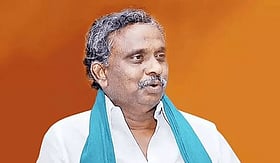
TN CM Vijay Urges PM Modi to Halt Karnataka's Mekedatu Dam
Tamil Nadu Chief Minister C. Joseph Vijay has written to Prime Minister Narendra Modi, urging him to stop Karnataka's proposed Mekedatu dam project. Vijay asserts the project violates established Cauvery water dispute awards and Supreme Court judgments, demanding no approvals be granted without downstream states' consent.
Key Highlights
- Tamil Nadu CM C. Joseph Vijay wrote to PM Modi against Mekedatu dam.
- Vijay argues project violates Cauvery Water Disputes Tribunal award and SC judgment.
- Letter challenges Centre's view that lower riparian states' consent isn't required.
- Mekedatu project proposed by Karnataka for drinking water and power generation.
- Tamil Nadu fears adverse impact on its share of Cauvery river water.
- The dispute is a long-standing interstate river water conflict.
Tamil Nadu Chief Minister C. Joseph Vijay has recently urged Prime Minister Narendra Modi to intervene and prevent Karnataka from proceeding with the proposed Mekedatu dam project across the Cauvery River. In a letter dated July 28, 2026, CM Vijay highlighted that the project represents a 'clear violation' of the final award of the Cauvery Water Disputes Tribunal (CWDT) and subsequent judgments by the Supreme Court.
The core of Tamil Nadu's objection lies in the assertion that the Mekedatu project, a multi-purpose balancing reservoir, cannot be undertaken without the explicit consent of the lower riparian states, primarily Tamil Nadu. CM Vijay specifically challenged a statement made by the Union Minister of State for Jal Shakti in the Rajya Sabha on July 27, 2026, which indicated that the 2018 Supreme Court verdict did not explicitly require Karnataka to obtain the consent of lower riparian states for constructing a dam. Vijay deemed this reply 'disappointing' and argued it was made without adequately considering the prevailing legal position and settled law concerning inter-state river water disputes.
He cited the Supreme Court's 2000 Constitution Bench judgment in the Almatti Dam dispute between Karnataka and Andhra Pradesh, which, according to Vijay, clearly held that Karnataka could not increase the dam's height or construct a new dam without the consent of downstream states and Central government approval. Furthermore, the Tamil Nadu Chief Minister pointed to Clause XVIII of the Cauvery Water Disputes Tribunal's final award, which preserves a state's authority to regulate water within its territory only when such actions are consistent with the tribunal's order. Vijay contended that any project affecting the regulated flow regime established under the award must be thoroughly examined for compliance.
The Mekedatu Balancing Reservoir cum Drinking Water Project is proposed by Karnataka to address Bengaluru's drinking water needs and generate 400 MW of power. Karnataka views it as a crucial project for managing its water resources and ensuring urban water security. However, Tamil Nadu consistently argues that the dam would 'irreparably and irreversibly affect the flow of water' from the Cauvery River to its lower riparian regions, thereby jeopardizing the livelihoods of millions of farmers and threatening numerous combined water supply schemes. The Tamil Nadu government has consistently opposed the project, including through unanimous Assembly resolutions and legal challenges.
The historical context of the Cauvery water dispute is extensive, dating back decades. The Cauvery Water Disputes Tribunal (CWDT) issued its final award in 2007, allocating the basin's waters, which was later modified by the Supreme Court in 2018. The Supreme Court also directed the establishment of the Cauvery Water Management Authority (CWMA) and the Cauvery Water Regulation Committee (CWRC) to ensure the implementation of its orders. While the Supreme Court allowed Karnataka to prepare a Detailed Project Report (DPR) for Mekedatu, it explicitly stated that this did not amount to permission for construction, which would require all necessary statutory approvals, including the concurrence of the CWMA. Karnataka has submitted a revised DPR for the project in August 2026, which still awaits environmental and forest clearances.
CM C. Joseph Vijay, who assumed office as the Chief Minister of Tamil Nadu on May 10, 2026, has made the Mekedatu issue a significant focus of his administration. He has also sought bilateral talks with his Karnataka counterpart regarding the Cauvery water shortfall and Mekedatu. The ongoing dispute highlights the complexities of inter-state river water sharing in India, where the needs of upstream and downstream states often clash, requiring Central intervention and adherence to judicial pronouncements. Tamil Nadu remains firm in its stance to protect its riparian rights and ensure the stipulated water releases from the Cauvery.
Frequently Asked Questions
Who is the current Chief Minister of Tamil Nadu, and what is his stance on the Mekedatu dam?
C. Joseph Vijay is the current Chief Minister of Tamil Nadu, having assumed office on May 10, 2026. He strongly opposes Karnataka's Mekedatu dam project, arguing it violates the Cauvery Water Disputes Tribunal award and Supreme Court judgments, and insists on the necessity of consent from lower riparian states.
What is the Mekedatu dam project, and why is it controversial?
The Mekedatu dam project is a proposed multi-purpose balancing reservoir by Karnataka across the Cauvery River, aimed at providing drinking water to Bengaluru and generating hydropower. It is controversial because Tamil Nadu, a lower riparian state, fears it will adversely affect its share of Cauvery water, violating established water-sharing agreements and Supreme Court directives.
What are the legal aspects of the Mekedatu dam dispute?
The dispute is governed by the Cauvery Water Disputes Tribunal (CWDT) final award and a 2018 Supreme Court judgment, which allocated Cauvery waters and established the Cauvery Water Management Authority (CWMA). Tamil Nadu argues that construction requires the consent of lower riparian states and all statutory approvals, including CWMA concurrence, which Karnataka has not yet secured.
When did Tamil Nadu CM Vijay write to PM Modi about the Mekedatu dam?
Tamil Nadu CM C. Joseph Vijay wrote to Prime Minister Narendra Modi on July 28, 2026, urging him to halt the Mekedatu project. He also communicated his concerns on other occasions, including May 26 and May 27, 2026.
Has Karnataka received approval for the Mekedatu dam project?
No, while Karnataka has submitted a Detailed Project Report (DPR) and a revised DPR for the Mekedatu project, it has not yet received all necessary statutory approvals, including environmental, forest clearances, and concurrence from the Cauvery Water Management Authority (CWMA), for construction to begin.