Myxoma Virus Evolution: Adaptation Through Gene Loss and Attenuation | Quick Digest
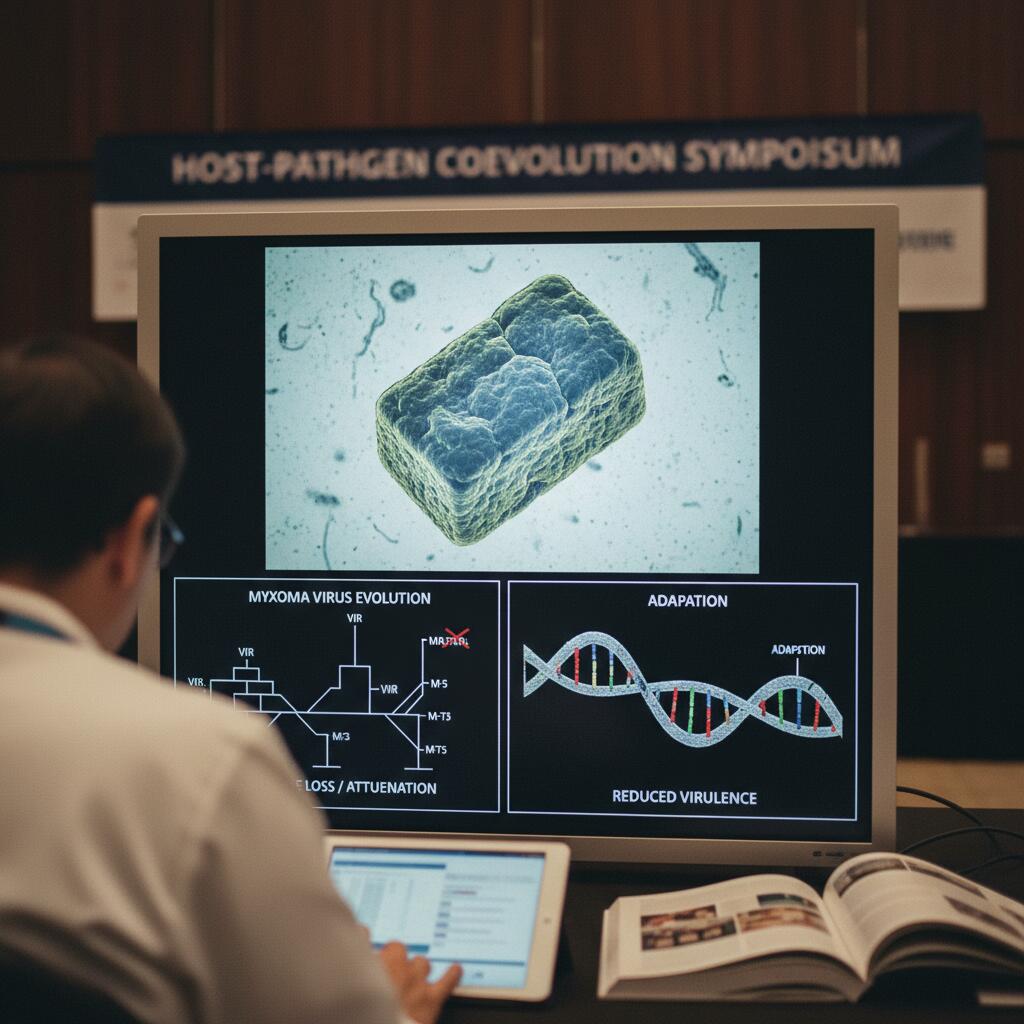
The Myxoma virus, used as a biological control in rabbits, has undergone rapid adaptive evolution. It shows attenuation (reduced virulence) in its new host, involving gene loss rather than a reversal of evolution. The claim of losing half its DNA is a significant exaggeration.
Myxoma virus (MYXV) is a classic example of host-pathogen coevolution.
The virus adapted to European rabbits by reducing its virulence (attenuation).
Evolutionary changes involved mutations and significant loss of gene function.
The scientific literature does not support a 'half-DNA' reduction.
The term 'evolving in reverse' is a sensationalized description of adaptive changes.
MYXV genome is approximately 160-162 kilobase pairs, with noted deletions being much smaller than 50%.
The WION article's headline, 'Creature that has chomped down on its DNA by half is evolving in reverse,' refers to the Myxoma virus (MYXV), a double-stranded DNA virus. This virus is a well-documented case study in evolutionary biology, particularly regarding host-pathogen coevolution. MYXV was intentionally introduced in Australia and Europe in the 1950s to control wild European rabbit populations, which were an invasive species. Initially, the virus caused a highly lethal disease called myxomatosis in the European rabbit, a new host for which it was extremely virulent.
However, over time, the virus underwent rapid adaptive evolution. Natural selection favored less virulent (attenuated) strains of MYXV. These attenuated strains allowed infected rabbits to survive for longer periods, thereby increasing the window for the virus to be transmitted to new hosts, primarily by mosquito vectors. This is a classic example of virulence evolution, where a pathogen adapts to maximize its transmission, not necessarily its lethality.
Genomic analyses of Myxoma virus strains have indeed shown significant evolutionary changes, including mutations leading to losses of open reading frames and gene functions due to insertion-deletion events. However, the specific claim that the virus 'chomped down on its DNA by half' is a considerable exaggeration and is not supported by scientific literature. While gene loss and genomic rearrangements occurred, the overall genome size of MYXV, which is around 160-162 kilobase pairs, has not been reported to have been reduced by 50%. For instance, one vaccine strain was noted to be 14.2 kb shorter than the reference strain, representing a reduction of less than 10%.
Similarly, the phrase 'evolving in reverse' is a sensationalized simplification. In scientific terms, evolution does not have a 'forward' or 'reverse' direction but rather describes adaptive changes driven by natural selection. The attenuation and gene loss observed in MYXV are adaptive responses to a new host environment, leading to a different but successful evolutionary trajectory for the virus. This phenomenon showcases the dynamic nature of evolution and adaptation.
Read the full story on Quick Digest