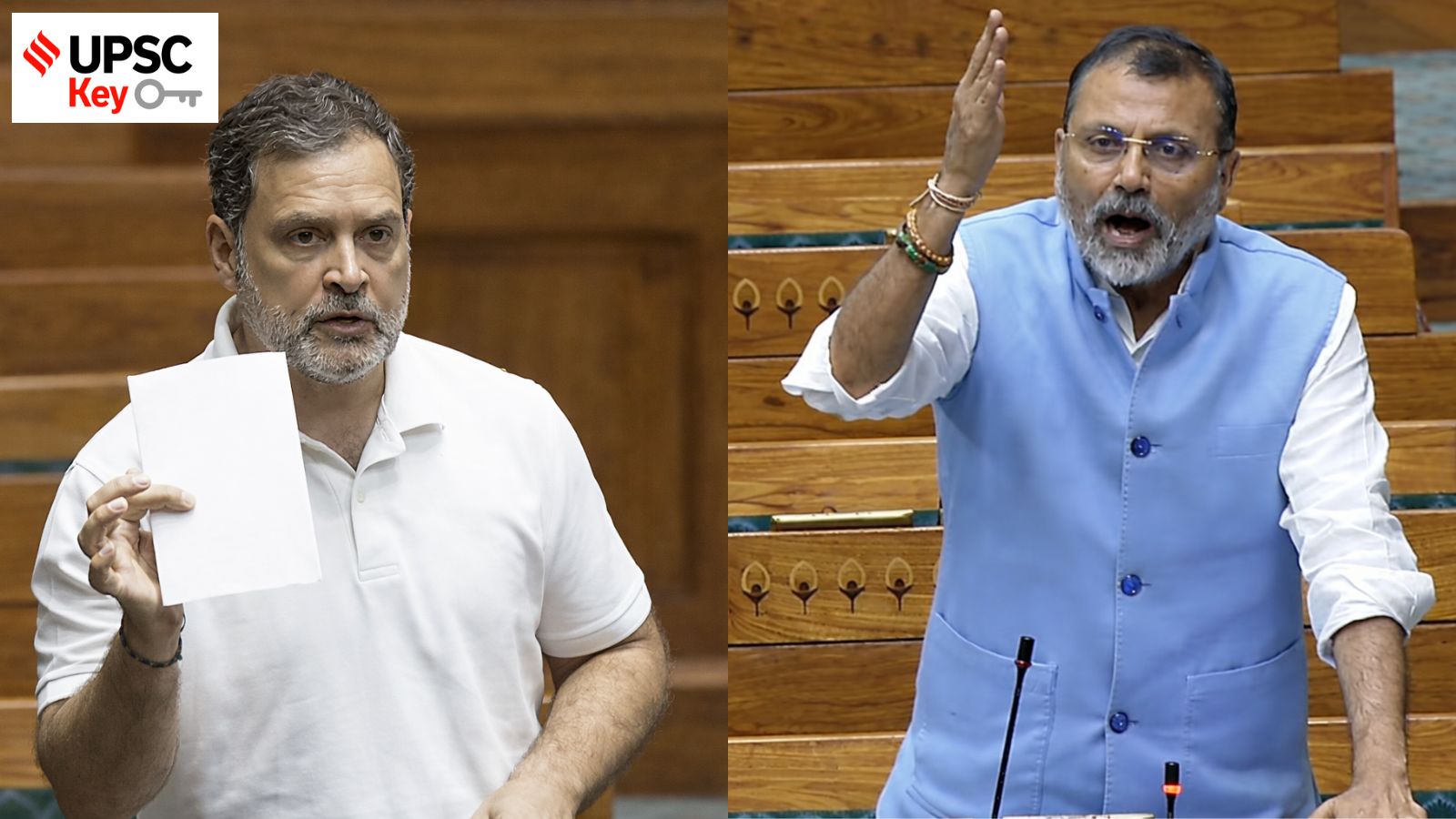
Rahul Gandhi's Assertive Parliamentary Stance: Impact and Future Outlook
Rahul Gandhi showcased a combative and assertive style during the recent Budget Session of Parliament, focusing heavily on the India-US trade deal, national security, and the Naravane memoir controversy. His aggressive approach energized the opposition, prompting significant debate and government responses. The critical question now is whether this parliamentary momentum can translate into broader political mobilization.
Key Highlights
- Rahul Gandhi adopted a combative stance in Parliament's Budget Session.
- Targeted India-US trade deal, citing national interest compromise.
- Raised concerns over national security and Gen. Naravane's memoir.
- His aggressive style revitalized Congress MPs and opposition.
- Government reacted strongly, including privilege motion threats.
- Focus shifts to translating parliamentary impact into wider political movement.
During the recent Budget Session of Parliament in February 2026, Rahul Gandhi, as Leader of the Opposition, demonstrated a notably combative and assertive style, which has been widely reported and analyzed across Indian media. An India Today article, published on February 14, 2026, highlighted his aggressive parliamentary performance, stating that it "stole the show" and positioned him as a central figure in the debates. This assessment is largely corroborated by other credible news outlets.
Gandhi's primary line of attack centered on the proposed India-US trade deal, which he vehemently criticized as "unequal" and a compromise of India's national interests. He alleged that the United States was dictating terms, maintaining high tariffs on Indian goods while expecting India to reduce its own, and influencing India's energy security choices by asking it not to purchase Russian oil. In a particularly forceful argument, Gandhi used a martial arts analogy of a "chokehold" to suggest that Prime Minister Narendra Modi was under immense pressure, possibly linked to the Epstein files, to agree to terms detrimental to India, especially its farmers, textile sector, and energy security. He warned that such concessions could expose sensitive sectors to external pressure and limit India's strategic autonomy, urging the nation to negotiate as an equal power, leveraging its data advantage.
Another significant focus of Gandhi's combative approach was the controversy surrounding former Army Chief General MM Naravane's unpublished memoir and its purported revelations regarding the 2020 India-China border standoff. He repeatedly attempted to cite portions of the memoir or articles based on it in Parliament, leading to considerable uproar and disruptions. Defence Minister Rajnath Singh and Speaker Om Birla objected to this, stating that quoting from unpublished or unrelated articles was against parliamentary rules. Gandhi, however, insisted on the authenticity of his claims and questioned why the government was so "scared" of the information. His actions on this matter even led to chaotic scenes, including Congress MPs climbing on tables and hurling papers, resulting in the suspension of eight MPs for the duration of the Budget session.
The government and ruling party leaders strongly rebutted Gandhi's allegations. Finance Minister Nirmala Sitharaman accused the UPA government of weakening India's global stance in the past and defended the current government's economic policies, asserting there was no inflation crisis. Union Minister Hardeep Singh Puri rejected Gandhi's allegations linking him to the Epstein files, clarifying his limited interactions with Jeffrey Epstein. BJP MPs, including Nishikant Dubey, filed a substantive motion against Rahul Gandhi, seeking termination of his parliamentary membership and a lifetime ban, accusing him of misleading the nation with baseless statements. Shiv Sena MP Shrikant Shinde criticized Gandhi's speech as "purely fictional" and advised the opposition to address internal issues rather than international deals.
Gandhi's aggressive posture undeniably energized the Congress party, with MPs appearing buoyed and rallying behind their leader through suspensions, dharnas, and slogans. This visible camaraderie and renewed vigor within the opposition were a notable outcome of his parliamentary interventions. However, the India Today article, and others, raise a crucial question about "what next?". While Gandhi's parliamentary performance was impactful, the challenge for the Congress lies in translating this rhetoric into sustained grassroots mobilization and a wider political movement. Past attempts, such as the Voter Adhikar Yatra and protests over MGNREGA, have not consistently generated the desired momentum, highlighting the party's organizational weaknesses at the grassroots level. The ability to bridge the gap between parliamentary debates and street-level activism will be the true test of this renewed combative style's long-term political impact.
In essence, Rahul Gandhi's recent performance in Parliament during the Budget Session 2026 marked a significant shift towards a more assertive and combative leadership style, generating intense debate on critical national and international issues. While successful in galvanizing the opposition within the legislative chambers, the real challenge and future trajectory for the Congress party will depend on its capacity to extend this political energy beyond Parliament and engage the wider Indian electorate.
Frequently Asked Questions
What were the main issues Rahul Gandhi raised during the Budget Session?
Rahul Gandhi primarily focused on criticizing the India-US trade deal, calling it "unequal" and detrimental to India's interests, particularly concerning farmers and energy security. He also raised concerns about national security, referencing an unpublished memoir by former Army Chief General MM Naravane related to the India-China border standoff.
How did the government respond to Rahul Gandhi's allegations?
The government strongly rebutted Gandhi's claims. Finance Minister Nirmala Sitharaman defended the government's policies, while BJP MPs, including Nishikant Dubey, moved a substantive motion against Gandhi, accusing him of misleading Parliament. Union Minister Hardeep Singh Puri also refuted allegations linking him to the Epstein files.
What was the controversy surrounding General MM Naravane's memoir?
Rahul Gandhi attempted to cite portions of General MM Naravane's unpublished memoir in Parliament, which he claimed contained revelations about the 2020 India-China border tensions. This led to disruptions and objections from the Speaker and Defense Minister, who stated that quoting from unpublished or unrelated articles was against parliamentary rules.
What impact did Rahul Gandhi's combative style have on the Congress party?
Gandhi's aggressive and assertive performance in Parliament reportedly energized Congress MPs. They rallied behind him, participating in protests, facing suspensions, and displaying visible camaraderie, hoping to amplify the party's leadership.
Will Rahul Gandhi's parliamentary performance translate into a broader political movement?
The India Today article and other analyses suggest that the real challenge for Congress now is to convert this parliamentary rhetoric into sustained grassroots mobilization. Past attempts to create mass movements from legislative debates have faced organizational hurdles at the grassroots level.