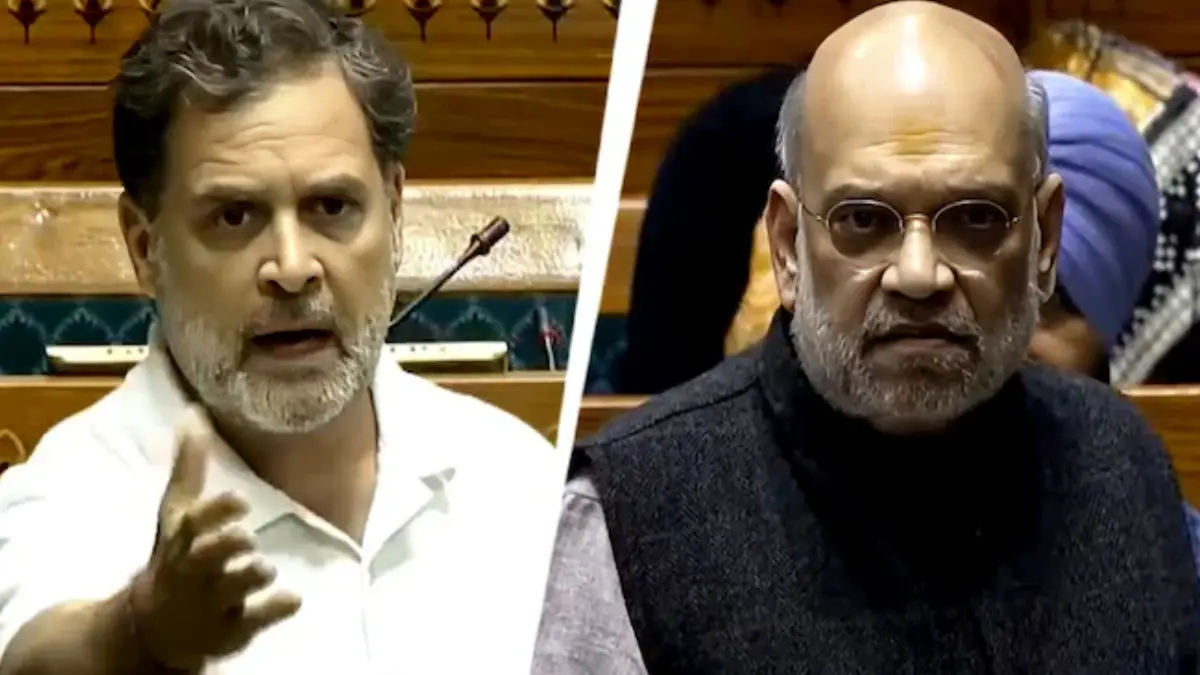
Rahul Gandhi Questions India-US Trade Deal's Impact on Farmers and Textiles
Rahul Gandhi has accused the Modi government of betraying Indian farmers and textile exporters through the recently framed India-US interim trade deal. He raised five pointed questions to the Prime Minister, citing concerns over unfair tariffs, imports of US agricultural products, and potential long-term damage to India's farming sector.
Key Highlights
- Rahul Gandhi questioned the Modi government on the India-US trade deal.
- Concerns raised over 18% tariff on Indian garments versus 0% for Bangladesh.
- Impact of US GM corn (DDG) and soy oil imports on Indian agriculture highlighted.
- Government accused of harming cotton farmers and textile exporters.
- Piyush Goyal defended the deal, stating farmers' interests are protected.
- Farmer unions are mobilizing against the interim trade agreement.
Congress leader Rahul Gandhi has launched a strong attack on the Narendra Modi-led government over the recently announced framework for an interim trade deal between India and the United States, accusing it of 'betraying' Indian farmers and textile exporters. Gandhi articulated his concerns by posing five specific questions to Prime Minister Narendra Modi, demanding clarity on several aspects of the agreement [3, 4, 17, 21].
The primary points of contention raised by Gandhi revolve around the perceived disadvantages for India's crucial agricultural and textile sectors. He highlighted a significant disparity in garment tariffs, noting that while Indian garments face an 18% tariff in the US market, neighboring Bangladesh is reportedly granted zero-duty access on the condition that it imports American cotton [2, 6, 8, 9, 10, 12]. Gandhi argued that this situation places Indian cotton farmers and textile exporters in a 'damned if you do, damned if you don't' trap: importing American cotton would ruin domestic farmers, while not importing it would cripple the Indian textile industry by making its exports uncompetitive [6, 8, 10, 12]. He further stated that millions of families dependent on these sectors could face unemployment and economic crisis [8, 12].
Beyond textiles, Rahul Gandhi expressed apprehension regarding the agricultural implications of the deal. He questioned the potential import of Dried Distillers' Grains (DDG) made from genetically modified (GM) American corn, suggesting it could make India's dairy products dependent on the US agricultural industry [3, 4]. Similarly, he voiced concerns about the impact of allowing genetically modified soy oil imports on domestic soy farmers, particularly in states like Madhya Pradesh, Maharashtra, and Rajasthan, warning of another potential price shock for these growers [3, 4]. He also sought clarification on the terms 'additional products' and 'non-trade barriers' mentioned in the agreement, fearing these could be avenues for pressure to liberalize GM crops, weaken existing procurement policies, or reduce Minimum Support Prices (MSPs) and bonuses for Indian farmers [4]. Gandhi consistently framed these measures as a move by the US to gain a long-term foothold in India's agriculture sector, ultimately jeopardizing India's food security [3, 4, 11].
The government, through Union Commerce and Industry Minister Piyush Goyal, has strongly refuted Rahul Gandhi's allegations. Goyal dismissed Gandhi's criticism as 'misleading,' 'ignorant,' and 'immature,' asserting that the Modi government has fully protected the interests of Indian farmers [6, 10]. He stated that 90-95% of sensitive agricultural sectors remain shielded from the deal, with no tariff concessions granted for key domestic crops such as wheat, rice, maize (corn), and millets (jowar, bajra, ragi). Furthermore, products like milk, ghee, butter, paneer, and chicken are said to remain fully protected, and the government has explicitly maintained a ban on the import of genetically modified (GM) products [20]. Goyal emphasized that the trade deal is structured to benefit various sectors, including farmers, fishermen, youth, Micro, Small, and Medium Enterprises (MSMEs), startups, and artisans [6].
It is important to note the nature of the agreement itself. The deal is described as a 'framework for an Interim Agreement' or an 'interim trade deal,' not a comprehensive Bilateral Trade Agreement (BTA) [7, 13, 16, 18, 19, 22, 23, 26, 27]. This framework was announced on February 6, 2026, by the US and India [13, 22, 23]. Key components include India's commitment to reduce or eliminate tariffs on all US industrial goods and a range of US food and agricultural products (including DDGs and soybean oil). In return, the United States will apply an 18% reciprocal tariff on certain Indian goods, such as textiles, apparel, leather, footwear, and organic chemicals, with the removal of these reciprocal tariffs contingent upon the successful conclusion of the full Interim Agreement [7, 16, 18, 22, 27].
A significant development, crucial for understanding the current context, is the revision of certain aspects of the deal's fact sheet. Initially, India was understood to have 'committed' to purchasing $500 billion worth of US goods over five years. However, this was later revised to an 'intention' rather than a binding commitment, and importantly, agricultural goods were excluded from this purchase plan. Additionally, earlier references to India reducing tariffs on 'certain pulses' were removed, making the deal 'more politically palatable' for India by addressing some farmer concerns [26].
Beyond Rahul Gandhi, veteran Congress leader P. Chidambaram also voiced strong criticism, calling the framework 'heavily tilted in favour of the US' and 'opaque and one-sided,' lacking true reciprocity [7, 13, 15, 27]. He highlighted that India's agreement to reduce tariffs on US industrial and agricultural goods was not met with equivalent concessions from the US, which maintained reciprocal tariffs on Indian exports [7, 27].
Against this backdrop, farmer unions across India have expressed strong opposition to the interim trade deal. They have met with Rahul Gandhi to convey their fears that the agreement poses a 'grave threat' to the livelihoods of farmers cultivating crops such as corn, soybean, cotton, fruits, and nuts. These unions are advocating for a nationwide movement to resist the implementation of the deal and safeguard farmers' rights and incomes [5, 19, 20]. The situation underscores an ongoing and heated political and economic debate within India regarding its trade relations with the US and the protection of its domestic agricultural sector.
Frequently Asked Questions
What are Rahul Gandhi's main criticisms of the India-US trade deal?
Rahul Gandhi primarily criticizes the deal for allegedly betraying Indian farmers and textile exporters. His main points include concerns over an 18% US tariff on Indian garments compared to 0% for Bangladesh (conditional on US cotton imports), potential imports of US genetically modified corn (DDG) and soy oil, and the broader risk of the US gaining a long-term hold over India's agricultural sector. [2, 3, 4, 6, 8, 9, 10, 12]
How has the Indian government responded to these accusations?
The Indian government, through Commerce Minister Piyush Goyal, has strongly denied Rahul Gandhi's accusations, calling them misleading and ignorant. The government asserts that the deal fully protects farmers' interests, with 90-95% of sensitive agricultural sectors shielded, no tariff concessions on key crops, and a ban on GM product imports. [6, 10, 20]
What is the nature of the India-US trade deal being discussed?
The deal in question is a 'framework for an Interim Agreement,' not a full Bilateral Trade Agreement (BTA). It involves India reducing or eliminating tariffs on US industrial and some agricultural goods, while the US applies an 18% reciprocal tariff on certain Indian exports (like textiles), with potential removal of these tariffs upon the successful conclusion of the full interim agreement. [7, 16, 18, 22, 27]
Were there any revisions to the initial trade deal framework that are relevant?
Yes, significant revisions were made. An initial 'commitment' for India to purchase $500 billion worth of US goods over five years was changed to an 'intention,' making it non-binding. Additionally, agricultural goods were excluded from this purchase plan, and earlier references to tariff reductions on 'certain pulses' were removed, addressing some concerns. [26]
Are Indian farmers and unions protesting the deal?
Yes, farmer unions have met with Rahul Gandhi and are actively opposing the interim trade deal. They fear it poses a grave threat to their livelihoods, particularly those growing corn, soybean, cotton, fruits, and nuts, and are calling for a nationwide movement against its implementation. [5, 19, 20]