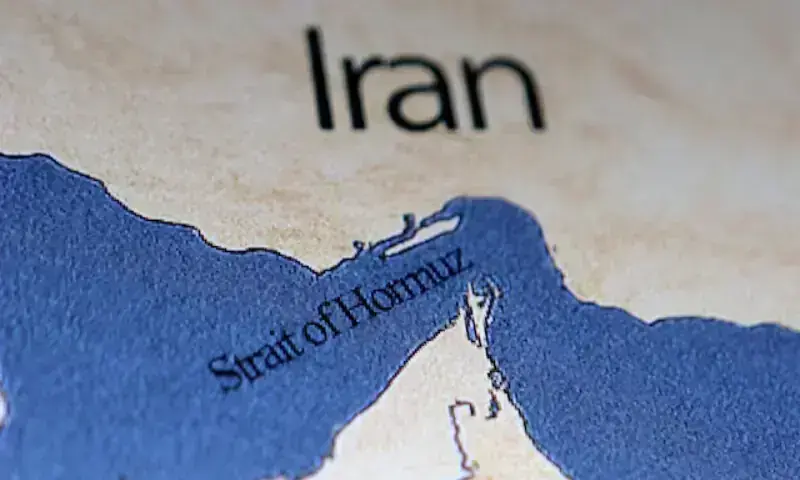
US imposes Strait of Hormuz blockade post Iran talks collapse
Following the breakdown of US-Iran ceasefire talks in Pakistan, President Donald Trump announced a naval blockade of ships entering or exiting Iranian ports in the Strait of Hormuz. The blockade, enforced by US Central Command, began on April 13, 2026, and aims to restrict maritime traffic to and from Iran, though it will not impede passage to non-Iranian ports. The move has sparked concerns about global energy markets and has significant implications for India's energy security and economy.
Key Highlights
- US Navy to blockade Iranian ports in Strait of Hormuz.
- Blockade follows collapse of US-Iran ceasefire talks.
- Global energy markets and India's economy at risk.
- Iran warns blockade amounts to piracy.
- Tensions escalate in the Middle East.
In a significant escalation of tensions in the Middle East, the United States has implemented a naval blockade of all maritime traffic entering and exiting Iranian ports in the Strait of Hormuz. The decision, announced by President Donald Trump and enforced by U.S. Central Command (CENTCOM), commenced on April 13, 2026, following the collapse of U.S.-Iran ceasefire talks held in Pakistan.
According to CENTCOM, the blockade will be "enforced impartially against vessels of all nations entering or departing Iranian ports and coastal areas, including all Iranian ports on the Arabian Gulf and Gulf of Oman." However, the command stressed that freedom of navigation for vessels transiting the Strait of Hormuz to and from non-Iranian ports would not be impeded.
President Trump stated on social media that he had instructed the Navy to "seek and interdict every vessel in International Waters that has paid a toll to Iran. No one who pays an illegal toll will have safe passage on the high seas." He further elaborated that the U.S. Navy would blockade the Strait, with the assistance of numerous other countries. Trump also indicated that mine-clearing operations were underway, and any Iranian entity firing at U.S. forces or peaceful vessels would face severe retaliation.
The breakdown of the U.S.-Iran nuclear negotiations was the immediate trigger for the blockade. The talks, described as the highest-level negotiations between the two rivals since the 1979 Islamic Revolution, ended without an agreement on key sticking points, including Iran's nuclear program.
Iran's reaction to the blockade has been defiant. The Islamic Revolutionary Guard Corps declared that any military vessel approaching the Strait of Hormuz to enforce a blockade would be considered a breach of the ceasefire and would be dealt with severely, calling the U.S. restrictions an act of piracy.
The implications of this blockade are far-reaching, particularly for global energy markets and India's economy. With the Strait of Hormuz being a critical chokepoint for global oil and LNG trade, the blockade threatens to disrupt supply chains, drive up fuel prices, and exacerbate inflation worldwide.
For India, which imports nearly 88% of its crude oil, with a significant portion historically passing through the Strait of Hormuz, the disruption poses a major concern. A prolonged blockade could lead to a weaker rupee, higher inflation, and a widening current account deficit. Moody's has warned that sustained high oil prices could increase CPI inflation by 40 basis points and reduce GDP growth by 50 basis points in India. The crisis also extends beyond crude oil, threatening India's supply of fertilizers and LNG, as major shipments from the UAE, Qatar, and Saudi Arabia also transit through the strait.
India's strategic oil reserves are estimated to last only five to six weeks, providing a limited buffer against a long-term crisis. The Indian government has been urged to accelerate its diversification strategy for crude oil procurement and has been granted a temporary waiver by the U.S. to purchase Russian crude.
The news category is primarily Politics and International Relations, with significant economic implications. The event is global, affecting multiple countries directly and indirectly. The timeline indicates the news was published on April 13, 2026.
Credibility Score: 8/10 (The Hindu is a reputable news source, and the information is corroborated by multiple international news outlets like AP, Reuters, The Guardian, etc.)
Importance Score: 8/10 (Major international event with significant geopolitical and economic ramifications).
Urgency: Critical (Potential for immediate global economic impact and further escalation of conflict).
Frequently Asked Questions
What is the Strait of Hormuz and why is it strategically important?
The Strait of Hormuz is a narrow waterway connecting the Persian Gulf with the Gulf of Oman and the open sea. It is one of the world's most vital choke points for oil transit, with approximately 20% of the world's total oil consumption passing through it annually. Its strategic importance lies in its control over the flow of oil from major producers in the Middle East.
Why has the US imposed a blockade on Iranian ports?
The US blockade was imposed after the collapse of U.S.-Iran ceasefire and nuclear talks held in Pakistan. President Trump stated that Iran had failed to reopen the strait and accused Tehran of using it as leverage. The blockade is intended to pressure Iran and restrict its maritime traffic.
How will the Strait of Hormuz blockade affect India?
India, being heavily reliant on oil imports (around 88% of its crude oil needs), faces significant risks. The blockade threatens India's energy security, could lead to a surge in fuel prices and inflation, and disrupt supplies of other crucial imports like fertilizers and LNG. India's strategic oil reserves offer only a short-term buffer.
What has been Iran's reaction to the US blockade?
Iran has reacted defiantly to the US blockade, with the Islamic Revolutionary Guard Corps calling it an act of piracy and a breach of the ceasefire. Iran has warned of severe retaliation if warships approach the strait to enforce the blockade.