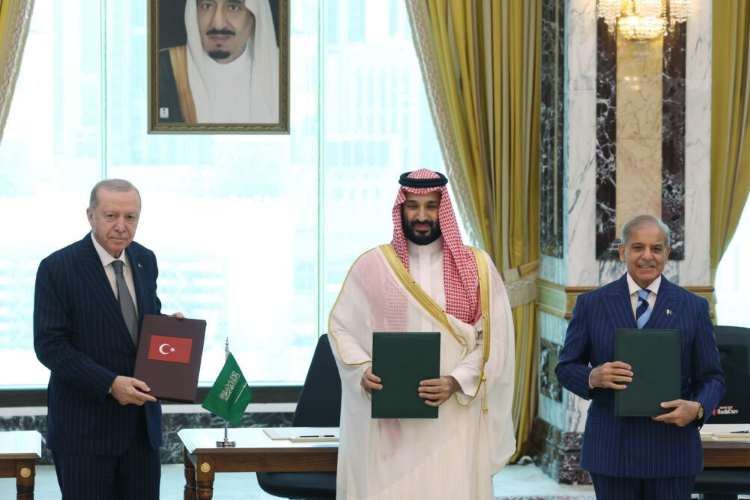
Mecca Pact: Saudi-Pakistan-Turkey Alliance Reshapes Middle East Security
Saudi Arabia, Pakistan, and Turkey have signed the 'Mecca Joint Defence Agreement,' a collective security pact echoing NATO's Article 5. This landmark deal aims to bolster regional deterrence amid escalating Middle East tensions, bringing together three major Muslim-majority nations in a new strategic alignment. India is closely monitoring the implications for regional stability.
Key Highlights
- Saudi Arabia, Pakistan, Turkey signed 'Mecca Joint Defence Agreement'.
- Pact includes collective defense clause, similar to NATO's Article 5.
- Aims to enhance deterrence amidst US-Israel-Iran conflict, Houthi attacks.
- Saudi Arabia provides capital, Pakistan manpower, Turkey defense industry.
- India closely watches pact's regional security and strategic implications.
- Iran reacts cautiously, viewing itself as potential target of the alliance.
The geopolitical landscape of the Middle East and South Asia is undergoing a significant transformation following the signing of the 'Mecca Joint Defence Agreement' by Saudi Arabia, Pakistan, and Turkey. This landmark trilateral pact, inked in the holy city of Mecca on August 7, 2026, establishes a collective security framework, stipulating that an armed attack against any one of the three signatory states shall be regarded as an attack against them all. This core provision, reminiscent of NATO's Article 5, signals a profound shift in regional power dynamics and defense cooperation.
The agreement builds upon an earlier bilateral Strategic Mutual Defence Agreement (SMDA) between Saudi Arabia and Pakistan, signed in September 2025. The expansion to include Turkey broadens the alliance's scope, bringing together key Muslim-majority nations with diverse strengths. Analysts suggest that Saudi Arabia contributes significant financial resources and diplomatic weight, Pakistan offers military manpower and its unique status as the world's only nuclear-armed Muslim state (though Pakistani officials clarify the trilateral pact does not include a nuclear umbrella), and Turkey provides its rapidly growing defense industry and NATO-standard military expertise.
The immediate backdrop to this alliance is a period of heightened regional instability. The ongoing "US-Israel war on Iran" has led to a series of Iranian retaliatory strikes against Gulf states, disrupting vital shipping lanes, particularly the Strait of Hormuz and the Red Sea. Additionally, a truce between Saudi Arabia and the Houthi rebels in Yemen has broken down, leading to renewed Houthi attacks on Saudi energy infrastructure. These developments have underscored the perceived vulnerabilities of Gulf nations and prompted a re-evaluation of security guarantees, particularly concerning the reliability of the United States as a sole security provider.
The Mecca Joint Defence Agreement is intended to strengthen collective deterrence against aggression and enhance various aspects of defense cooperation. This includes provisions for joint military exercises, training, technology transfers, and intelligence sharing among the three states. While the agreement's detailed operational mechanisms and specific military commitments have not been fully disclosed, its symbolic and strategic significance is undeniable.
Reactions to the pact have been varied. Turkey, Saudi Arabia, and Pakistan have publicly stated that the agreement is defensive in nature, not directed against any specific actor, and remains open to other regional countries seeking peace and stability. However, Iran has reacted cautiously, with some officials dismissing it as a mere "paper agreement" that will not ensure Saudi security, while others called for greater Muslim unity. Many in Iran, nevertheless, perceive the alliance as implicitly targeting their nation and its regional network of non-state actors.
For India, the formation of this alliance presents a new strategic challenge. The Indian Ministry of External Affairs has stated that New Delhi is "closely following the development." Indian national security analysts express concern that Turkey's expanding influence and defense support for Pakistan could bolster Islamabad's military capabilities and extend Ankara's footprint into South Asia and the Indian Ocean. The pact's potential to strengthen Pakistan's battlefield capabilities and influence political timelines in potential conflicts is a key concern for Indian defense planners. India is advised to intensify engagement with other Gulf partners and strengthen its own defense, maritime, and intelligence capabilities to safeguard its strategic interests in the evolving regional security architecture.
Experts highlight that the pact formalizes and accelerates existing cooperation, such as Pakistan's long-standing training and technical assistance to Saudi forces and Riyadh's acquisition of Turkish drones. The signing in Mecca adds significant symbolic weight, underscoring the religious and cultural bonds uniting these Sunni Muslim nations. The ultimate effectiveness of this alliance in creating a truly "new regional order" remains a subject of ongoing analysis, but it undeniably marks a pivotal moment in the complex geopolitics of the Middle East and beyond.
Frequently Asked Questions
What is the 'Mecca Joint Defence Agreement'?
The 'Mecca Joint Defence Agreement' is a collective security pact signed by Saudi Arabia, Pakistan, and Turkey on August 7, 2026. It includes a clause stating that an armed attack against any one member will be considered an attack against all three, aiming to strengthen regional deterrence.
What are the primary motivations behind this alliance?
The alliance is driven by heightened regional tensions, particularly the 'US-Israel war on Iran' and subsequent retaliatory strikes on Gulf states, and renewed Houthi attacks on Saudi Arabia. It reflects a desire for increased self-reliance in security and a diversification of defense partnerships away from sole dependence on Western powers.
How does this pact impact India's strategic interests?
India is closely monitoring the pact, with concerns that it could strengthen Pakistan's military capabilities through Turkish defense support and expand Turkey's strategic influence into South Asia and the Indian Ocean, potentially altering regional power balances.
What are the key contributions of each country to the alliance?
Saudi Arabia is expected to contribute financial capital and diplomatic influence. Pakistan offers military manpower and its status as a nuclear power. Turkey brings its advanced and rapidly growing defense industry and NATO-standard military expertise.
How has Iran reacted to the formation of this alliance?
Iran's reaction has been mixed. While some Iranian officials have called for greater Muslim unity, others have dismissed the pact as a 'paper agreement' and generally view it as implicitly targeting Iran and its regional network of non-state actors.