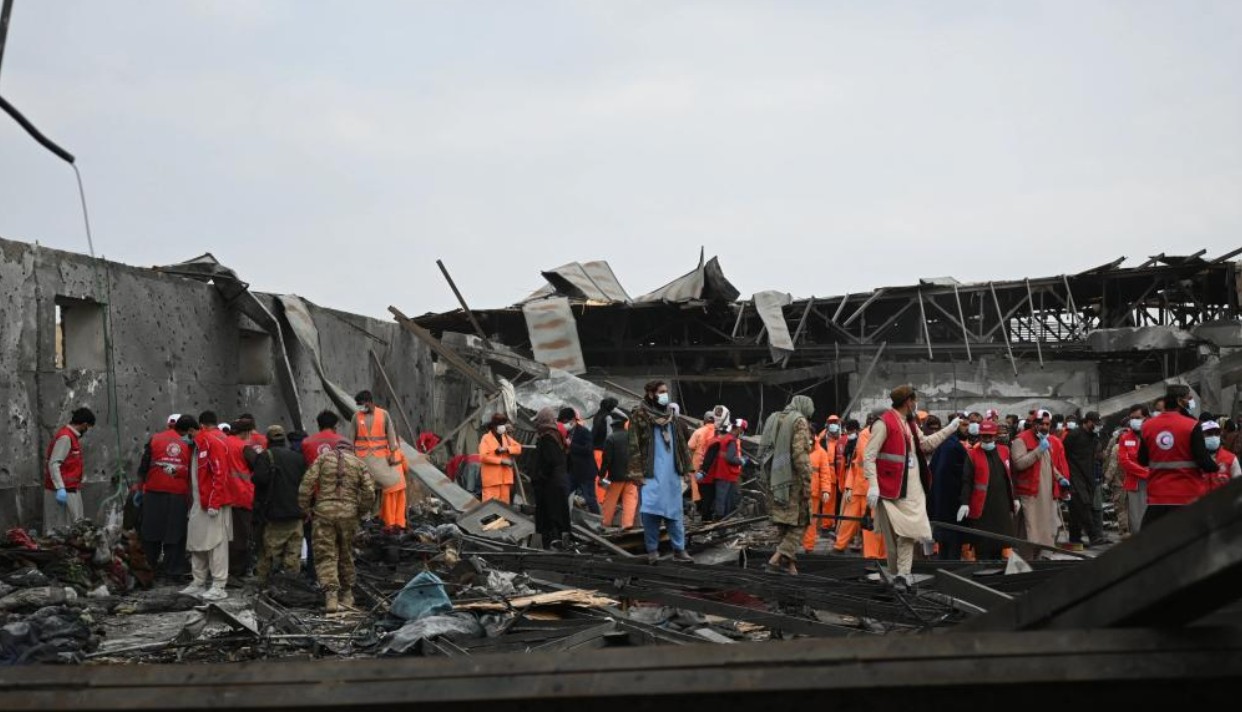
India condemns Pakistan's alleged strike on Afghan hospital
India has strongly condemned Pakistan's alleged airstrike on the Omid Addiction Treatment Hospital in Kabul, Afghanistan, calling it a "barbaric" and "cowardly" act. The incident, which occurred on March 16, 2026, has led to significant international concern and calls for an investigation, with Afghanistan claiming over 400 people were killed and injured. Pakistan denies targeting the hospital, asserting it struck military installations.
Key Highlights
- India unequivocally condemns Pakistan's airstrike on Kabul hospital.
- Afghanistan claims over 400 killed and injured in the incident.
- Pakistan denies targeting the hospital, stating military sites were hit.
- The strike occurred during the holy month of Ramadan, adding to condemnation.
- International bodies urge de-escalation and adherence to international law.
India has issued a strong condemnation of Pakistan's alleged airstrike on the Omid Addiction Treatment Hospital in Kabul, Afghanistan, terming the act as "barbaric" and "cowardly." The incident, which took place on the night of March 16, 2026, has escalated the ongoing conflict between the two neighboring countries and drawn widespread international attention. Afghanistan's Taliban government has claimed that the airstrike resulted in the deaths of over 400 people and injured approximately 265 others. The Omid Addiction Treatment Hospital, a 2,000-bed facility, was reportedly devastated, with large sections destroyed. Rescue efforts were underway to recover bodies from the rubble. The attack, occurring during the holy month of Ramadan, has been met with particular outrage.
Pakistan has vehemently denied Afghanistan's accusations, with its Ministry of Information and its military spokesperson stating that the strikes were precisely targeted at military installations and terrorist support infrastructure, not civilian facilities. Pakistan's Director-General of Inter-Services Public Relations (ISPR), Lieutenant General Ahmed Sharif Chaudhry, dismissed the claims as "ridiculous" and suggested that the facility might have been located near an ammunition storage site. He stated that Pakistan had struck an ammunition storage depot, leading to secondary explosions that were visible across Kabul. The Pakistani government has accused Afghanistan of harboring extremist groups responsible for attacks within Pakistan and has framed its strikes as a necessary response to terrorism.
The international community has responded with grave concern. The United Nations Assistance Mission in Afghanistan (UNAMA) has initiated an investigation and reported a death toll of at least 143 people killed and 119 injured. The UN High Commissioner for Human Rights has called for an investigation and accountability for those responsible. The World Health Organization (WHO) has expressed concern about the intensifying conflict and its impact on health systems. Several other international organizations and countries have condemned the attack and urged for de-escalation, respect for international humanitarian law, and the protection of civilians and medical facilities.
India's condemnation, articulated by its Ministry of External Affairs (MEA), specifically highlighted that the attack could not be justified as a military target and accused Pakistan of attempting to "dress up a massacre as a military operation." India also characterized the strike as an assault on Afghanistan's sovereignty and a threat to regional stability. The MEA reiterated India's unwavering support for Afghanistan's sovereignty and territorial integrity and stood in solidarity with the Afghan people. This stance reflects a broader trend of India taking a more assertive public position on issues related to Pakistan and Afghanistan.
The conflict between Pakistan and Afghanistan has been escalating since February 2026, with both sides accusing the other of cross-border attacks and harboring militants. Pakistan has accused Afghanistan of providing safe havens for the Tehrik-e-Taliban Pakistan (TTP), a group that has been responsible for numerous attacks within Pakistan. Afghanistan, in turn, denies these charges.
Following the airstrike and subsequent international pressure, Pakistan announced a five-day pause in its strikes against Afghanistan to observe Eid al-Fitr, a request reportedly made by Saudi Arabia, Qatar, and Turkey. The Afghan Taliban government also announced a temporary suspension of its military operations.
The incident raises serious questions about adherence to international humanitarian law and the protection of civilian infrastructure during armed conflict. The conflicting narratives from Afghanistan and Pakistan, the differing casualty figures reported by Afghan authorities and the UN, and the denial by Pakistan all contribute to a complex and highly charged situation. The original article from Moneycontrol.com seems to focus on the remarks of Pakistan's DG ISPR, Lieutenant General Ahmed Sharif Chaudhry, who described the Afghan claims as "ridiculous" and suggested that drug addicts were used for suicide bombings.
Frequently Asked Questions
What happened at the Omid Addiction Treatment Hospital in Kabul?
On March 16, 2026, an airstrike occurred at the Omid Addiction Treatment Hospital in Kabul, Afghanistan. Afghan authorities claim it was a deliberate Pakistani airstrike that killed over 400 people, while Pakistan denies targeting the hospital and states it struck military installations.
What is Pakistan's official stance on the Kabul hospital strike?
Pakistan vehemently denies targeting the hospital, asserting that its military strikes were precisely aimed at military installations and terrorist support infrastructure. Pakistan's DG ISPR dismissed claims of targeting a hospital as 'ridiculous' and suggested the site was near an ammunition storage depot.
How has India reacted to the incident?
India has strongly condemned the alleged Pakistani airstrike, calling it a 'barbaric' and 'cowardly' act. India accused Pakistan of attempting to 'dress up a massacre as a military operation' and affirmed its support for Afghanistan's sovereignty and territorial integrity.
What is the reported death toll from the incident?
Afghan authorities claim over 400 people were killed and around 265 injured. The United Nations Assistance Mission in Afghanistan (UNAMA) reported a lower figure, stating at least 143 people were killed and 119 injured, and has launched an investigation.