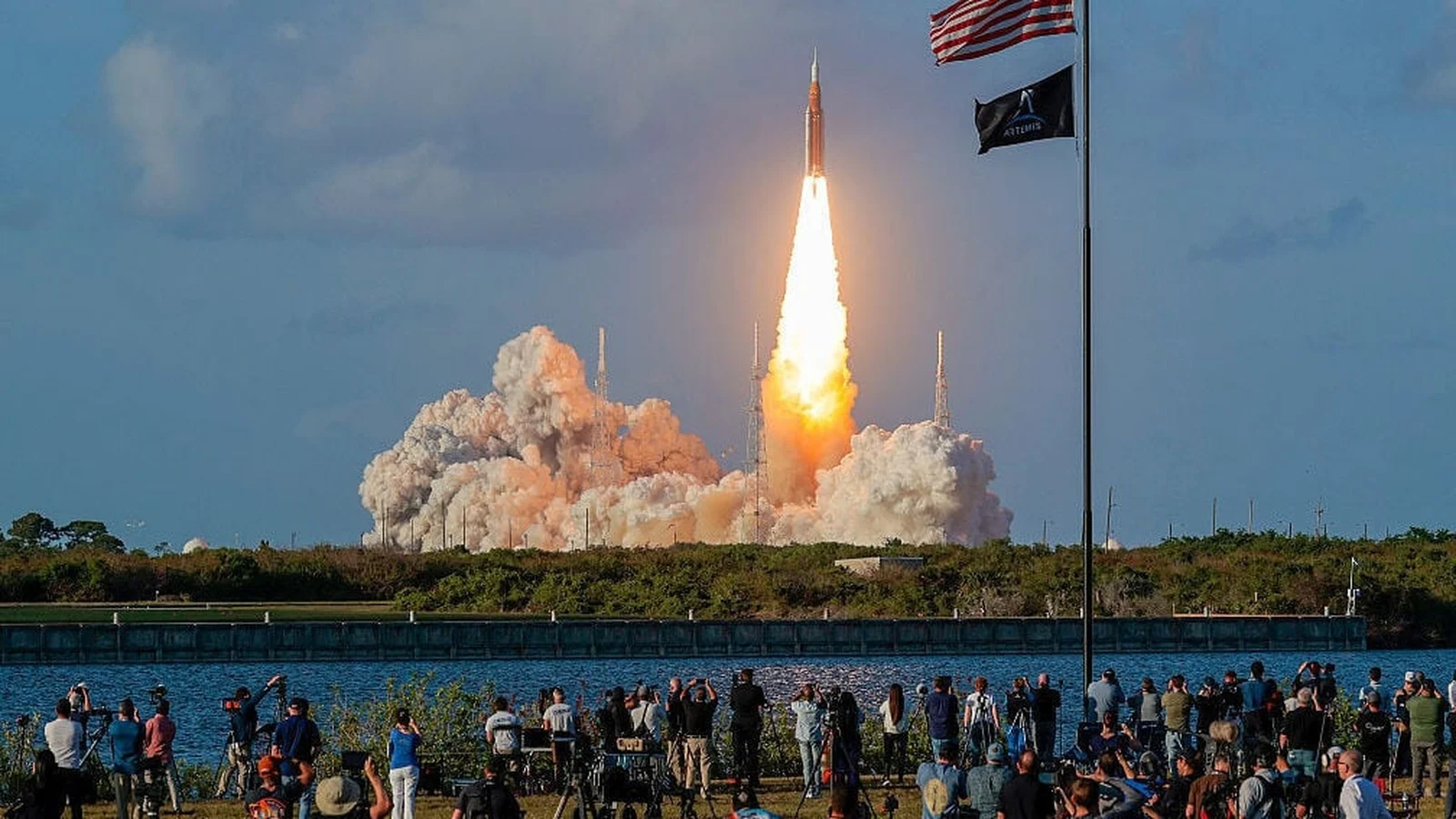
Artemis II: Humanity's Return to Deep Space After Five Decades
NASA's Artemis II mission, launched on April 1, 2026, marks the first crewed journey to the Moon's vicinity in over 50 years, following Apollo 17 in 1972. This historic 10-day lunar flyby, featuring an international crew of four, is a critical test for future lunar landings and eventual Mars missions.
Key Highlights
- Artemis II is the first crewed mission beyond low Earth orbit since 1972.
- The mission involves a 10-day lunar flyby, not a Moon landing.
- Apollo 17 in December 1972 was the last human mission to the Moon.
- Crew includes Commander Reid Wiseman, Pilot Victor Glover, Christina Koch, and Jeremy Hansen.
- It tests Orion spacecraft systems and prepares for future lunar landings.
- India has signed the Artemis Accords, highlighting global collaboration in space.
NASA's Artemis II mission, launched on April 1, 2026, represents a monumental leap in human space exploration, undertaking the first crewed journey to the vicinity of the Moon in over five decades. This 10-day lunar flyby is a crucial stepping stone in the broader Artemis program, which aims to establish a long-term human presence on and around the Moon and ultimately pave the way for missions to Mars.
The last time humans ventured beyond low Earth orbit and traveled to the Moon was with Apollo 17, which launched on December 7, 1972, and concluded on December 19, 1972. The original article's claim of '56 years' is an exaggeration; the actual duration between Apollo 17 and Artemis II is approximately 54 years. However, phrases like 'over 50 years' or 'over half a century' are widely used and accurate to describe this significant gap.
The Artemis II mission is crewed by an international team of four astronauts: NASA astronauts Commander Reid Wiseman, Pilot Victor Glover, and Mission Specialist Christina Koch, alongside Canadian Space Agency (CSA) astronaut Mission Specialist Jeremy Hansen. This mission marks several historic firsts: Victor Glover becomes the first person of color, Christina Koch the first woman, and Jeremy Hansen the first non-American to travel around the Moon.
Unlike the Apollo missions that landed humans on the lunar surface, Artemis II is a lunar flyby. The crew will orbit Earth a couple of times to test systems before heading towards the Moon, where the Orion spacecraft will perform a trajectory around it without landing, before returning to Earth. This distinction is vital for understanding the immediate goals of the mission. The primary objectives of Artemis II are to thoroughly test NASA's Space Launch System (SLS) rocket and the Orion spacecraft's life-support systems, navigation, communication links, and overall performance in the deep-space environment with a human crew onboard. These critical validations are essential for the safety and success of subsequent Artemis missions.
The journey will push the boundaries of human spaceflight, with the Orion spacecraft potentially traveling farther from Earth than any human has before, exceeding records set by Apollo 13. The European Service Module (ESM), built by Airbus on behalf of the European Space Agency (ESA), is a crucial component of the Orion spacecraft, providing propulsion, power, air, and water for the crew.
India's audience will find this mission particularly relevant, not only due to the global significance of renewed lunar exploration but also because India signed the Artemis Accords in 2023. These accords promote peaceful, transparent, and interoperable space exploration, aligning India with other nations in shaping the future of space activities. While India is not an active participant in the Artemis missions in the same way as Europe or Japan, its own ambitious Gaganyaan human spaceflight program and plans for a lunar mission by 2040 underscore a shared interest in deep space exploration. This collaboration could lead to future payloads, experiments, and joint missions under the Accords.
The Artemis program follows on the heels of the uncrewed Artemis I mission in 2022, which successfully tested the SLS rocket and Orion spacecraft. If Artemis II is successful, it will pave the way for Artemis III, which is planned to involve testing lunar landers in Earth orbit, and then Artemis IV, targeted for 2028, which aims to achieve the first human landing on the Moon since Apollo 17. NASA envisions a sustained human presence at the lunar south pole, leveraging potential water ice deposits for resources, a critical step toward eventual human missions to Mars.
The renewed focus on lunar exploration is also set against a backdrop of increasing international competition, particularly with China, which has outlined its own ambitious plans for crewed lunar landings by 2030. The Artemis program, with its international partnerships and commercial collaborations, represents a comprehensive strategy to maintain leadership in space exploration and ensure a sustainable future for human endeavors beyond Earth.
Frequently Asked Questions
What is the primary goal of the Artemis II mission?
The primary goal of Artemis II is to perform a crewed test flight around the Moon, validating the Space Launch System (SLS) rocket and Orion spacecraft's systems, life support, navigation, and emergency procedures in deep space before future lunar landing missions.
When was the last time humans traveled to the Moon's vicinity before Artemis II?
The last time humans traveled to the Moon's vicinity was during NASA's Apollo 17 mission, which launched in December 1972.
Will the Artemis II crew land on the Moon?
No, the Artemis II mission is a lunar flyby. The crew will orbit the Earth and then journey around the Moon before returning home. A human landing is planned for a later mission, Artemis IV, targeted for 2028.
Who are the astronauts on the Artemis II mission?
The four-person crew includes NASA astronauts Commander Reid Wiseman, Pilot Victor Glover, and Mission Specialist Christina Koch, along with Canadian Space Agency astronaut Mission Specialist Jeremy Hansen.
How is India involved in the Artemis program?
India has signed the Artemis Accords, committing to principles for peaceful and transparent space exploration. While not directly participating in Artemis II, this agreement lays the groundwork for potential future collaboration in lunar activities and aligns with India's own ambitions in human spaceflight.