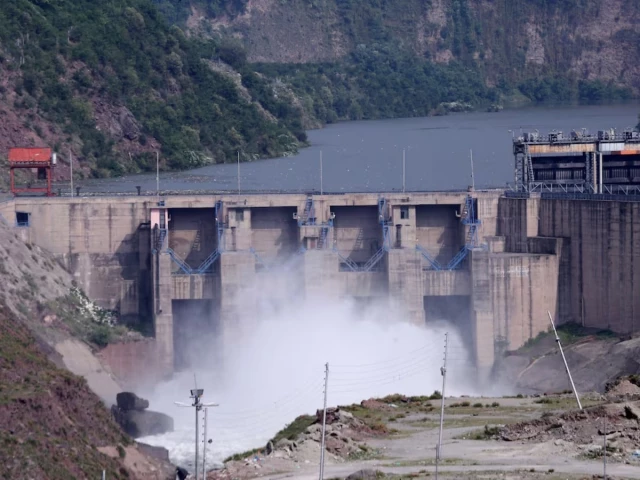
India Rejects Hague Court's Indus Waters Treaty Ruling, Cites No Jurisdiction
India has decisively rejected a ruling by the Hague-based Court of Arbitration concerning the Indus Waters Treaty with Pakistan, asserting the tribunal lacks jurisdiction. New Delhi termed the court "illegally constituted" and maintained its sovereign decision to keep the 1960 treaty in abeyance, stemming from cross-border terrorism concerns. The ruling called for India to uphold the treaty and limit work on the Ratle hydroelectric project.
Key Highlights
- India rejects Hague Court of Arbitration ruling on Indus Waters Treaty.
- New Delhi cites lack of jurisdiction, calls court "illegally constituted".
- India's decision to suspend treaty remains in force due to terror attack.
- Court ordered India to uphold treaty, limit Ratle project construction.
- Dispute involves Ratle and Kishenganga hydroelectric projects.
- India prefers Neutral Expert mechanism over Court of Arbitration.
India has unequivocally rejected the recent ruling by the Hague-based Court of Arbitration concerning the 1960 Indus Waters Treaty (IWT) with Pakistan, asserting that the tribunal is "illegally constituted" and lacks any jurisdiction over India's sovereign decisions. This stance was articulated by the Ministry of External Affairs (MEA) following the Court of Arbitration's pronouncements on August 31, 2026, which held that the IWT remains fully in force and that India had no justification to unilaterally suspend or terminate it.
The dispute intensified after India announced in April 2025 its decision to hold the Indus Waters Treaty "in abeyance" in the wake of a deadly terror attack in Pahalgam, Kashmir, that claimed 26 lives. India attributed the attack to Pakistan-linked assailants and firmly stated its principle that "blood and water cannot flow together". Pakistan, however, has denied any involvement in the attack. India has consistently maintained that its decision to keep the treaty in abeyance remains unchanged and that the Court of Arbitration's pronouncements will have no bearing on India's actions or ongoing projects.
The Court of Arbitration, constituted under the auspices of the World Bank, issued two key decisions on August 31, 2026. Firstly, it issued an 'Award on the Status of the Indus Waters Treaty,' concluding that the treaty has neither been terminated nor suspended and remains fully in force. The tribunal specifically examined various grounds cited publicly by India, including sovereignty, alleged material breach by Pakistan, terrorism, demographic and technological changes, climate change, and armed conflict. It unanimously found that none of these grounds could justify the suspension or termination of the treaty. Consequently, the court asserted that India must continue to observe its obligations under the IWT, including those related to the design and operation of hydroelectric projects on the Western Rivers.
Secondly, the Court issued an 'Order on Interim Measures' specifically concerning India's Ratle Hydro-Electric Plant (RHEP) on the Chenab River in Indian-administered Kashmir. Pakistan had raised objections to certain design features of both the Ratle and Kishenganga hydroelectric projects, arguing they violated the IWT provisions. The Court of Arbitration ordered India to temporarily restrict construction work on the Ratle project, specifically prohibiting the concreting of the dam wall and power intake structure above certain levels. These restrictions are to remain in place until 90 days after a World Bank-appointed Neutral Expert delivers a final decision on the technical design aspects of the project, which is expected by July 2027.
India, however, has steadfastly refused to recognize the legitimacy or legal existence of this Court of Arbitration. New Delhi's position is that the tribunal was constituted by the World Bank in "patent breach" of the terms of the 1960 treaty. India has consistently argued that the IWT provides for a 'Neutral Expert' mechanism to resolve 'differences' related to technical issues, while 'disputes' are referred to a 'Court of Arbitration'. India's contention is that the current proceedings before the Court of Arbitration are running in parallel to, and thus undermining, the treaty-consistent Neutral Expert process which India believes is the appropriate channel for resolving the technical concerns raised by Pakistan regarding the Kishenganga and Ratle projects. The World Bank had initially paused both processes in 2016 due to the differing requests from India and Pakistan but later resumed them, appointing both a Neutral Expert and a Chairman for the Court of Arbitration in October 2022.
India has never appeared before this Court of Arbitration and has consistently refused to acknowledge its pronouncements, reiterating that any awards or decisions from this body are "null and void" and will not affect India's utilization of waters. This ongoing disagreement highlights the deep-seated tensions and differing interpretations of the IWT's dispute settlement mechanisms between the two nuclear-armed neighbours. The treaty, brokered by the World Bank, allocates the waters of the Eastern Rivers (Ravi, Beas, Sutlej) to India and the Western Rivers (Indus, Jhelum, Chenab) primarily to Pakistan, while allowing India limited non-consumptive uses, including hydropower generation, on the Western Rivers, subject to specific design constraints. Pakistan relies heavily on these Western Rivers for its agricultural needs, making adherence to the treaty crucial for its water security. This latest ruling and India's rejection further complicate the already strained bilateral relations and the future of water cooperation in the Indus basin.
Frequently Asked Questions
What is the Indus Waters Treaty (IWT)?
The Indus Waters Treaty is a water-distribution agreement signed in 1960 between India and Pakistan, mediated by the World Bank. It governs the sharing of the six rivers of the Indus River system, allocating the eastern rivers (Ravi, Beas, Sutlej) to India and the western rivers (Indus, Jhelum, Chenab) primarily to Pakistan, while allowing India limited uses on the western rivers for purposes like hydropower generation.
Why did India reject the Hague Court's ruling on the IWT?
India rejected the ruling by the Court of Arbitration, based in The Hague, primarily on grounds of jurisdiction. India maintains that the tribunal was "illegally constituted" in "patent breach" of the IWT's terms and therefore has no authority to pronounce on India's sovereign decisions or projects.
What was the Court of Arbitration's ruling?
The Court of Arbitration ruled that the Indus Waters Treaty remains fully in force, and India had no justification to suspend or terminate it unilaterally. It also issued interim measures, ordering India to limit construction on the Ratle Hydro-Electric Plant in Kashmir until a World Bank-appointed Neutral Expert makes a final decision on its design by July 2027.
Why did India put the Indus Waters Treaty 'in abeyance'?
India announced its decision to put the IWT 'in abeyance' in April 2025, following a terror attack in Pahalgam, Kashmir, that killed 26 people. India blamed Pakistan for the attack and stated that water cooperation could not continue alongside cross-border terrorism, adopting the principle that 'blood and water cannot flow together.'
What are the Kishenganga and Ratle Hydro-Electric Projects and their role in the dispute?
The Kishenganga and Ratle Hydro-Electric Projects are Indian run-of-the-river hydroelectric plants on tributaries of the Jhelum and Chenab rivers (Western Rivers allocated to Pakistan under the IWT). Pakistan has raised technical objections to their design features, arguing they violate the treaty. These projects are central to the ongoing dispute, with India advocating for resolution through a Neutral Expert and Pakistan pursuing arbitration.