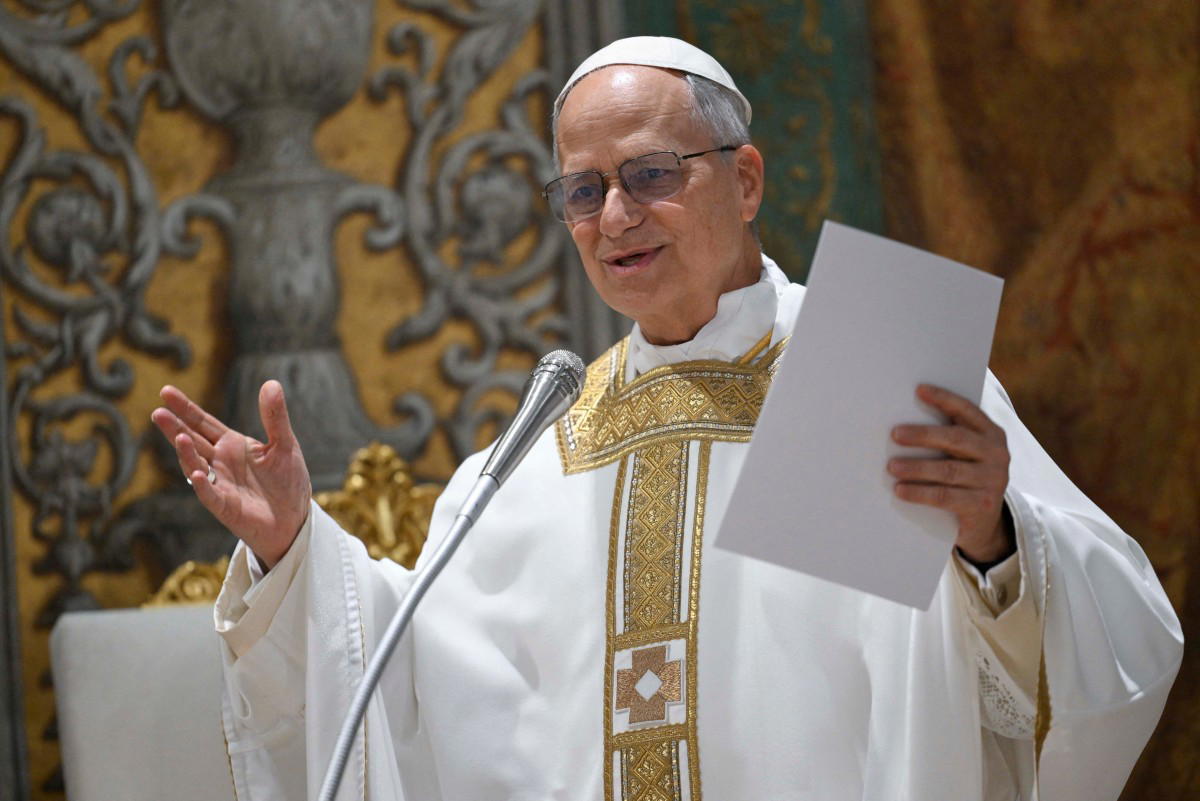
Pope Leo XIV Urges AI 'Disarmament,' Criticizes Trump on Iran War
Pope Leo XIV has issued a landmark encyclical, 'Magnifica Humanitas,' calling for the ethical 'disarming' of Artificial Intelligence. He also implicitly criticized former US President Donald Trump over the Iran war, declaring the 'just war' theory outdated and rejecting the use of religion to justify conflict.
Key Highlights
- Pope Leo XIV released his first encyclical, 'Magnifica Humanitas,' on AI ethics.
- He called for the 'disarming' of AI to prevent its use for domination and exploitation.
- The Pope implicitly criticized Donald Trump's stance on the Iran war.
- Leo XIV declared the 'just war' theory 'outdated' in the age of AI-driven warfare.
- He warned against AI making 'lethal' decisions and fueling geopolitical dominance.
- The encyclical also highlighted AI's environmental impact and worker exploitation.
Pope Leo XIV, the first US-born pontiff, has issued his inaugural encyclical, titled 'Magnifica Humanitas' (Magnificent Humanity), a comprehensive manifesto addressing the ethical and social challenges posed by Artificial Intelligence. The document, presented at the Vatican on May 25, 2026, calls for the 'disarming' of AI, aiming to free it from the mentality of 'armed' competition and prevent its use as an instrument of domination, exclusion, and death.
The Pope warned against a global 'race for ever more powerful algorithms and larger datasets, driven by the desire to secure geopolitical or commercial dominance.' He clarified that 'to disarm does not mean rejecting technology, but preventing it from dominating humanity,' advocating for AI to be 'human-friendly,' accessible to all, and open to public discussion.
A significant portion of the encyclical, and a major point of news coverage, focused on Pope Leo XIV's implicit criticism of former US President Donald Trump regarding the Iran war. Without directly naming Trump, the Pope firmly stated that the traditional 'just war' theory is 'outdated' in an era of AI-directed weaponry and autonomous systems. This comes after previous public clashes between Pope Leo XIV and the Trump administration over the conflict in Iran, with the Pope condemning threats to destroy Iranian civilization as 'truly unacceptable' and against international law. He emphasized that 'no algorithm can make war morally acceptable' and declared it 'not permissible to entrust lethal' decisions to technology, raising alarms about the increasing use of AI in military operations and surveillance.
The 'Magnifica Humanitas' also delves into the often-hidden human costs of AI development. Pope Leo XIV highlighted that 'nothing in the world of AI is immaterial or magical,' pointing to the 'silent work of millions of people' who sustain the industry. This includes content moderators exposed to disturbing material and children involved in mining rare earth elements crucial for computing infrastructure, noting they are 'scarred, injured and worn down so that computational flow may continue uninterruptedly.' He argued that increased efficiency or innovation does not excuse 'a chain of exploitation that remains deliberately hidden' and called for greater efforts to reduce AI's environmental impact.
This encyclical builds upon earlier efforts by the Vatican, including Pope Francis's engagement with AI ethics, such as the 2020 'Rome Call for AI Ethics.' Experts suggest that 'Magnifica Humanitas' could prove as influential as Pope Francis's 2015 climate manifesto, 'Laudato Si,' in shaping global discourse and policy. The Vatican views this document as an extension of its social teachings, aiming to protect individuals in the AI era by promoting human dignity, advocating for robust legal frameworks, independent oversight, and informed users. The Pope's statements underscore the Catholic Church's growing concern over the rapid advancement of AI and its potential to exacerbate inequalities, displace human labor, and concentrate wealth and power in the hands of a few.
This news is of significant relevance to an Indian audience, as India is a major player in the global technology landscape, with a rapidly growing AI sector and a large workforce potentially impacted by AI's transformative effects. The ethical considerations raised by the Pope, particularly concerning exploitation, human dignity, and the use of AI in warfare, resonate globally and demand attention from policymakers, tech developers, and citizens alike. The interaction between religious authority and global political/technological issues offers a unique perspective on contemporary challenges.
Frequently Asked Questions
Who is Pope Leo XIV and when was he elected?
Pope Leo XIV is Robert Prevost, who was elected as the new head of the Catholic Church on May 8, 2025, becoming the first American pontiff.
What is 'Magnifica Humanitas' about?
'Magnifica Humanitas' is Pope Leo XIV's first encyclical, a major teaching document that addresses the ethical and social challenges of Artificial Intelligence, calling for its 'disarming' and emphasizing human dignity.
How did Pope Leo XIV criticize Donald Trump?
While not naming him directly, Pope Leo XIV implicitly criticized Donald Trump by stating that the 'just war' theory is 'outdated' and by condemning the use of religion to justify conflict, specifically in the context of the Iran war during Trump's administration.
What does Pope Leo XIV mean by 'disarming' AI?
By 'disarming' AI, Pope Leo XIV means freeing it from the pursuit of 'armed' competition and preventing it from dominating humanity, instead advocating for AI that is human-friendly, accessible, and developed with ethical considerations to avoid exploitation and warfare.
What are the Pope's main concerns regarding AI?
The Pope's main concerns include the potential for AI to fuel warfare, concentrate wealth, create new forms of exploitation (especially for workers and vulnerable populations), deepen inequalities, and for autonomous systems to make lethal decisions without human oversight.