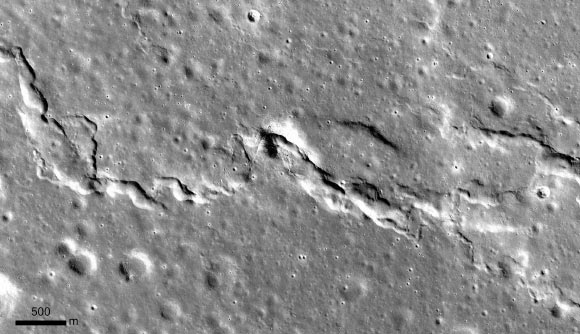
Moon is Geologically Active, Poses Challenges for Lunar Missions
Recent scientific discoveries confirm the Moon is not geologically 'dead' but actively shrinking, leading to tectonic activity and 'moonquakes.' This ongoing process, driven by internal cooling, creates new ridges and faults, presenting potential hazards for NASA's Artemis missions and future lunar settlements.
Key Highlights
- Moon is actively shrinking and deforming, contrary to past beliefs.
- New global map reveals thousands of young small mare ridges (SMRs).
- Tectonic activity causes 'moonquakes' and surface faulting.
- Discoveries have implications for safe landing sites of Artemis missions.
- SMRs and lobate scarps are among the Moon's youngest geological features.
Recent scientific research has definitively established that the Moon is not a geologically 'dead' celestial body, but rather an actively evolving one. This significant paradigm shift comes from a new global map identifying thousands of previously uncataloged tectonic features across its surface, particularly in the vast, dark basalt plains known as maria. The findings, primarily from a study published in The Planetary Science Journal by scientists including Tom Watters and Jaclyn Clark from the Smithsonian Institution and the University of Maryland, reveal that our lunar neighbor is still contracting and reshaping itself.
The core of this discovery lies in the extensive mapping of 'small mare ridges' (SMRs). Researchers have cataloged 1,114 new SMR segments, bringing the total known SMRs across the Moon's maria to 2,634. These low, winding ridges, which resemble faint seams in cooled wax, are now understood to be surprisingly young, with an average age estimated at about 124 million years. This age range, some as young as 50 million years, is considered geologically recent given the Moon's 4.5-billion-year history.
These SMRs, along with previously known lobate scarps found predominantly in the lunar highlands, are formed by the same compressional forces. As the Moon's interior gradually cools and contracts, its brittle outer crust is pushed together, creating thrust faults where one block of material pushes up and over another. This global contraction leads to the Moon shrinking, estimated to have decreased its radius by about 50 meters (164 feet) over the last several hundred million years.
The ongoing tectonic activity is directly linked to 'moonquakes.' While deep moonquakes are known to be caused by Earth's tidal gravitational pull, these shallow moonquakes, originating from the newly identified thrust faults, can register up to a startling 5.5 on the Richter scale and last for over 10 minutes, as recorded by Apollo-era seismometers.
The identification of widespread, young tectonic activity has crucial implications for future lunar exploration, especially for NASA's ambitious Artemis program, which aims to return humans to the Moon's South Pole and establish permanent outposts. The newly mapped SMRs indicate potential 'seismic hotspots' across the lunar maria, an area previously thought to be relatively stable. Understanding where these active fault lines and associated moonquakes might occur is vital for selecting safe landing sites and designing resilient lunar infrastructure.
Scientists emphasize that the Moon's tectonic forces differ from Earth's. Earth's surface is broken into moving plates that collide and spread apart, driving phenomena like mountain ranges and volcanic activity. The Moon, however, lacks plate tectonics; instead, stress builds up within its single, continuous crust. This difference means lunar geological processes, while active, manifest differently.
The discovery completes a more dynamic picture of a contracting Moon, suggesting that the entire lunar body is undergoing global contraction, not just isolated regions. This enriched understanding of lunar tectonism will lead to a greater comprehension of the Moon's internal structure, its thermal and seismic history, and the potential for future moonquakes. It serves as a wake-up call for mission planners, highlighting the need to consider seismic risks when planning long-term human presence on the lunar surface.
Therefore, while the Moneycontrol headline's use of 'alive' is metaphorical, it accurately reflects the scientific consensus that the Moon is far from geologically inert. The research underscores the dynamic nature of our closest celestial neighbor and provides critical data for the safety and success of impending lunar missions.
Frequently Asked Questions
Is the Moon truly 'alive'?
While not biologically alive, the Moon is now understood to be geologically active. Recent discoveries show its interior is cooling and contracting, causing its surface to deform and generate seismic activity, similar to how Earth's tectonic plates move.
What is causing the Moon's tectonic activity?
The Moon's interior is still gradually cooling and contracting. This process causes stresses to build up in its brittle outer crust, leading to the formation of thrust faults and ridges on its surface, and triggering shallow 'moonquakes'.
What are 'small mare ridges' (SMRs) and why are they significant?
Small mare ridges (SMRs) are low, winding geological features found in the Moon's dark plains (maria). They are significant because new research has identified thousands of them as surprisingly young, indicating recent and ongoing tectonic activity, challenging previous beliefs about the Moon's geological inactivity.
How do these discoveries impact future lunar missions like Artemis?
The detection of active tectonic faults and potential moonquake hotspots has critical implications for NASA's Artemis missions. It means that selecting safe landing sites and designing stable lunar bases must now account for seismic risks, as ground shaking could pose hazards to astronauts and infrastructure.
Are 'moonquakes' similar to earthquakes?
While both are seismic events, moonquakes differ from earthquakes. The Moon lacks Earth's moving tectonic plates. Moonquakes result from the Moon's global contraction due to cooling and tidal forces from Earth, causing its single crust to crack and shift, rather than the grinding of continental plates. Shallow moonquakes can be significant, up to 5.5 magnitude.