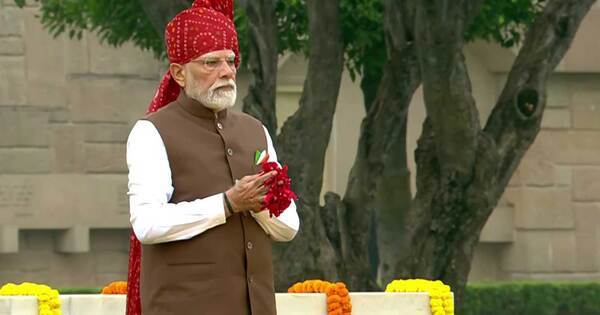
PM Modi urges swift 33% women's reservation in Parliament
Prime Minister Narendra Modi, during the 80th Independence Day address, urged all political parties to expedite the implementation of 33% reservation for women in the Lok Sabha and state assemblies. He highlighted the passage of the Nari Shakti Vandan Adhiniyam, while noting historical political delays in achieving this goal. The call comes amidst ongoing discussions about the practical implementation of the Women's Reservation Bill, which was passed in September 2023 and awaits activation post-delimitation.
Key Highlights
- PM Modi called for swift implementation of women's reservation.
- The appeal was made during the 80th Independence Day address from the Red Fort.
- The Nari Shakti Vandan Adhiniyam aims to reserve 33% of seats for women.
- Historical political games have delayed women's representation, according to the PM.
- The reservation's activation is linked to future census and delimitation processes.
Prime Minister Narendra Modi, in his address on the 80th Independence Day from the Red Fort, made a fervent appeal to all political parties to swiftly ensure the implementation of 33% reservation for women in the Lok Sabha and state legislative assemblies. He emphasized that this step is crucial for women to actively contribute to shaping India's policies and governance. The Prime Minister acknowledged the passage of the Nari Shakti Vandan Adhiniyam in Parliament, which aims to strengthen women's representation, but lamented that the political dream of greater representation for women had been "persistently fallen victim to political games and political battlegrounds" over the last 40 years. He urged parties to "come forward and celebrate the strength and capability of our women" and "step forward in honour of our women" to ensure their representation. Modi also pointed out the significant contributions of women representatives in local governance bodies such as Panchayats, Municipalities, and Municipal Corporations, highlighting their capable leadership in addressing local challenges. The Nari Shakti Vandan Adhiniyam, passed in September 2023, reserves one-third of seats for women in the Lok Sabha, state legislative assemblies, and the Delhi Legislative Assembly. However, the implementation of this reservation is contingent upon a delimitation exercise following the next census. This means the reservation will not be immediately effective and will be implemented after the delimitation process is completed. The call for swift implementation from the Prime Minister reignites the debate surrounding the practical steps and timelines for operationalizing this significant legislation. The related articles indicate a mixed reaction from the opposition, with some criticizing the timing and others questioning the delayed implementation. The historical context of the Women's Reservation Bill shows numerous attempts since 1996 to pass such legislation, with previous versions facing various challenges and lapsing. The 73rd and 74th Constitutional Amendments in 1992 had already mandated 33% reservation for women in local self-governance, which has led to a significant increase in women's participation at the grassroots level. The recent passage of the Nari Shakti Vandan Adhiniyam marks a crucial step towards extending this reservation to the higher legislative bodies. The Prime Minister's appeal seeks to galvanize political consensus and accelerate the process, emphasizing that the time for political maneuvering on this issue has passed. The urgency in his appeal suggests a desire to see this constitutional mandate translated into reality without further delay, ensuring that women have a substantive role in policymaking at the national and state levels. The move is seen as a significant stride towards gender equality and inclusive governance in India, though the practical challenges and timelines for its full implementation remain a subject of ongoing discussion and political attention. The news category is Politics and India. The news is specific to India. The credibility of The Times of India is generally high, with surveys indicating it as one of the most trusted news sources in India. However, Media Bias/Fact Check rates it as Right-Center biased with mixed factual reporting. The credibility of The Hindu is generally high, with high factuality ratings. It is rated as Center by Ad Fontes Media and leans left by Media Bias/Fact Check. NDTV has a mixed factual reporting rating and is rated as Right-Center biased by Media Bias/Fact Check. It has also been rated as Lean Right by Ground News. ThePrint is rated Right-Center biased with Mostly Factual reporting by Media Bias/Fact Check. Ground News also rates its aggregated media bias as Lean Right. The Indian Express is rated Left-Center biased with Mixed factual reporting by Media Bias/Fact Check. Ground News rates its media bias as Lean Left and High factuality. The article is primarily a news report on a political speech. The importance score is 8, as it pertains to a significant policy and political development in India. The urgency is High, as it concerns a major legislative push with implications for a large segment of the population. The news was published on August 15, 2026, at 10:00 AM IST, based on the time of the speech.
Frequently Asked Questions
What did PM Modi ask political parties to do regarding women's reservation?
Prime Minister Narendra Modi urged all political parties to swiftly facilitate and ensure the implementation of 33% reservation for women in the Lok Sabha and state legislative assemblies.
What is the Nari Shakti Vandan Adhiniyam?
The Nari Shakti Vandan Adhiniyam, passed in September 2023, is a law that aims to reserve one-third of all seats in the Lok Sabha, state legislative assemblies, and the Delhi Legislative Assembly for women. Its implementation is linked to future census and delimitation processes.
When will the women's reservation come into effect?
The women's reservation will come into effect after the delimitation exercise is conducted following the next census. It is not immediately applicable and is expected to be implemented after these processes are completed, likely for the 2029 general elections.
What historical context was mentioned regarding women's reservation?
Prime Minister Modi noted that despite efforts over the last 40 years, the dream of greater women's representation had been hampered by political games and delays.