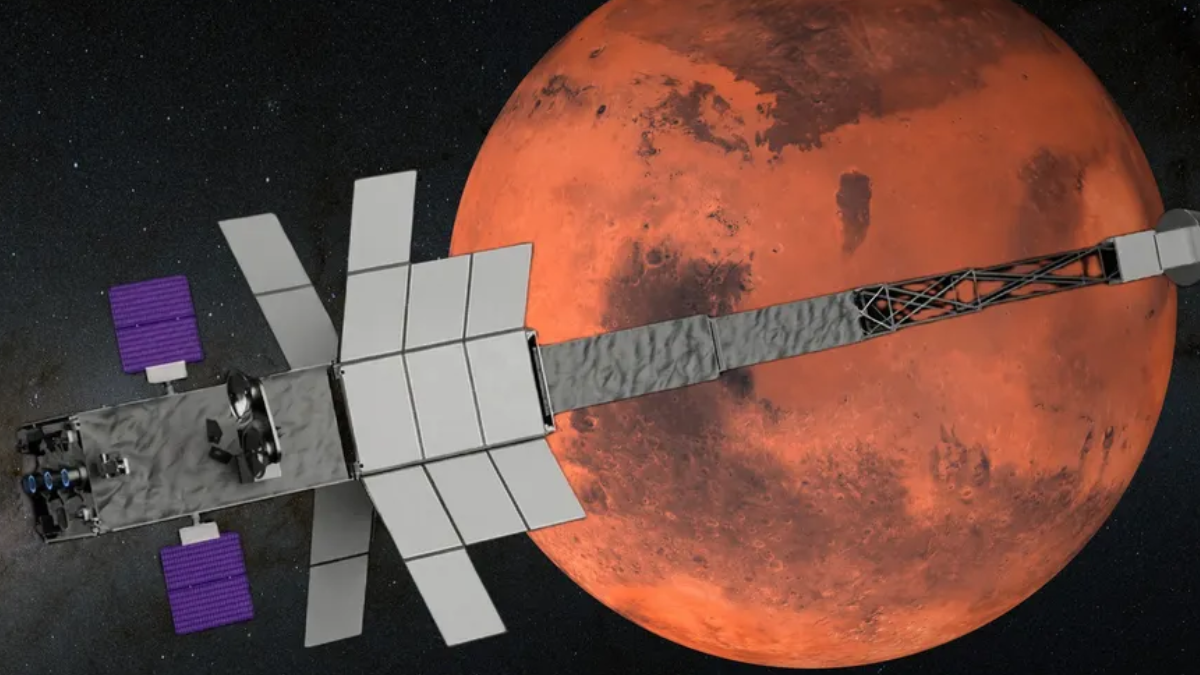
NASA Plans Nuclear-Powered Mars Mission, SR-1 Freedom, by December 2028
NASA is set to launch Space Reactor-1 Freedom (SR-1 Freedom), its first nuclear electric propulsion spacecraft, to Mars by December 2028. This groundbreaking mission will demonstrate advanced nuclear power in deep space and deploy Skyfall helicopters to explore the Red Planet, paving the way for future human exploration and lunar bases.
Key Highlights
- NASA to launch Space Reactor-1 Freedom (SR-1 Freedom) in December 2028.
- Mission utilizes Nuclear Electric Propulsion (NEP) for efficient deep-space travel.
- SR-1 Freedom will deploy Skyfall helicopters to explore Mars.
- Mission aims to establish flight heritage for nuclear hardware and future applications.
- Lunar Gateway's Power and Propulsion Element will be repurposed for this mission.
- This marks a significant step towards human missions to Mars and lunar bases.
NASA is forging ahead with ambitious plans to revolutionize deep-space exploration, announcing the launch of Space Reactor-1 Freedom (SR-1 Freedom), a pioneering nuclear-powered interplanetary spacecraft, to Mars by December 2028. This mission marks a pivotal moment, as it will be the first spacecraft to utilize a nuclear fission reactor for propulsion beyond Earth orbit, a feat unprecedented in 60 years of spaceflight.
The SR-1 Freedom mission is designed to demonstrate advanced Nuclear Electric Propulsion (NEP) in the challenging environment of deep space. Unlike Nuclear Thermal Propulsion (NTP), which heats propellant using a nuclear reactor, NEP converts nuclear energy into electricity to power highly efficient electric thrusters, offering superior propellant efficiency and enabling high-power missions to distant destinations where solar arrays are less effective. This propulsion method is crucial for reducing transit times, thereby mitigating risks to astronaut health from radiation exposure and microgravity during potential future crewed missions to Mars.
Upon its arrival at Mars, expected approximately one year after launch, SR-1 Freedom will deploy a payload named Skyfall. This payload comprises three Ingenuity-class helicopters, similar to the groundbreaking Ingenuity drone that achieved the first powered flight on Mars in 2021. These autonomous rotorcraft will be equipped with cameras, ground-penetrating radar, and radios to conduct crucial scientific investigations. Their primary objectives include surveying potential landing sites for future human missions, mapping and characterizing subsurface water ice deposits, and relaying navigation data.
The initiative is a direct response to a December 2025 executive order emphasizing American space superiority and includes broader mandates such as returning Americans to the Moon by 2028 and establishing lunar outpost elements by 2030. NASA Administrator Jared Isaacman explicitly stated that these announcements align with President Trump's national space policy. To achieve these aggressive timelines, NASA is making strategic adjustments to its exploration roadmap. Notably, the agency is pausing its efforts on the Lunar Gateway, a proposed space station in lunar orbit, and will instead repurpose its Power and Propulsion Element (PPE) for the SR-1 Freedom mission. This strategic shift allows NASA to focus resources and accelerate the development of a permanent Moon base, which will also rely on nuclear power solutions for sustained operations, especially during the long lunar nights.
Historically, the United States has made significant investments in space nuclear programs, dating back to Project Rover in 1955 and the NERVA program (1961-1973). However, only one U.S. flight reactor, SNAP-10A in 1965, has ever made it to space, and it operated for only 43 days before a non-nuclear component failure. SR-1 Freedom aims to break this pattern by limiting its scope to leverage existing technology, with the reactor being the primary new system, thereby prioritizing the 2028 Mars launch window. This mission is intended as a 'pathfinder,' not a 'blueprint,' laying the groundwork, establishing regulatory and launch precedents, and activating the industrial base for future fission power systems across propulsion, surface power, and long-duration missions.
The development of SR-1 Freedom also informs subsequent missions, such as Lunar Reactor-1 (LR-1), planned for 2030, which will be a fission surface-power system crucial for enabling continuous human presence on the Moon. The success of SR-1 Freedom is expected to be a crucial step toward unlocking the capabilities required for sustained exploration beyond the Moon and eventual human journeys to Mars and the outer solar system. The mission underscores a new era of space exploration where nuclear power plays a central role in achieving faster, more efficient, and more ambitious space endeavors.
Frequently Asked Questions
What is Space Reactor-1 Freedom (SR-1 Freedom)?
SR-1 Freedom is NASA's pioneering nuclear electric propulsion (NEP) spacecraft, planned for launch in December 2028. It will be the first spacecraft to use a nuclear fission reactor for propulsion beyond Earth orbit, aiming to demonstrate advanced nuclear power in deep space.
What is the primary mission of SR-1 Freedom?
The primary mission is to travel to Mars using nuclear electric propulsion and deploy a payload of three 'Skyfall' helicopters. These helicopters will explore the Martian surface, search for subsurface water ice, and scout potential landing sites for future human missions.
Why is NASA using nuclear propulsion for this mission?
Nuclear Electric Propulsion (NEP) offers significantly higher propellant efficiency compared to traditional chemical rockets, enabling faster transit times to distant planets like Mars. This reduces mission duration and radiation exposure for potential human crews, while also providing high power for scientific instruments beyond the reach of solar arrays.
How does this mission relate to NASA's other space exploration plans?
The SR-1 Freedom mission is a crucial step in NASA's broader strategy for sustained deep-space exploration. It will establish critical flight heritage for nuclear hardware, which is essential for future human missions to Mars and for powering permanent lunar bases, especially during long lunar nights.
Wasn't another nuclear propulsion project, DRACO, canceled?
Yes, the DARPA-led Demonstration Rocket for Agile Cislunar Operations (DRACO) program, which focused on Nuclear Thermal Propulsion (NTP), was canceled in June 2025. However, the SR-1 Freedom mission uses Nuclear Electric Propulsion (NEP), a distinct technology, and is proceeding as planned.