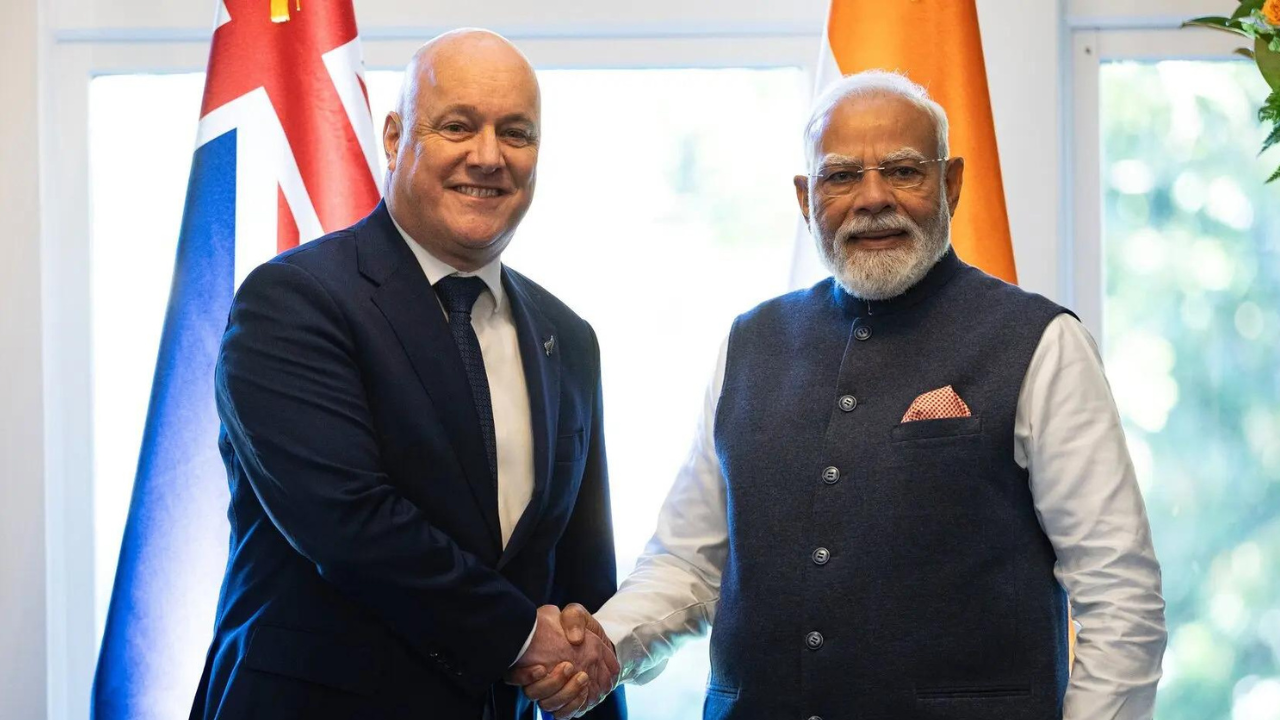
PM Modi's Historic New Zealand Visit: Strategic Partnership, Trade Boost
Prime Minister Narendra Modi undertook a landmark visit to New Zealand from July 10-12, 2026, marking the first visit by an Indian Premier in 40 years. The trip elevated bilateral ties to a Strategic Partnership, aiming to double trade by 2030 and enhancing cooperation across key sectors including defence, technology, and culture.
Key Highlights
- PM Modi's historic visit, first by an Indian PM in four decades.
- India-New Zealand elevate ties to a comprehensive Strategic Partnership.
- Target set to double bilateral trade to ₹35,000 crore by 2030.
- Key agreements signed across defence, technology, sports, and tourism.
- Focus on Indo-Pacific cooperation and strong diaspora engagement.
- New Zealand PM Christopher Luxon hailed visit as 'historic milestone'.
Prime Minister Narendra Modi concluded a significant two-day visit to New Zealand from July 10 to July 12, 2026, an event hailed as historic since it marked the first time an Indian Prime Minister had visited the nation in 40 years. The visit, a final leg of a three-nation tour that included Indonesia and Australia, aimed at significantly bolstering bilateral relations between India and New Zealand.
Upon his arrival in Auckland on Friday, July 10, PM Modi was warmly received by New Zealand Prime Minister Christopher Luxon, who personally welcomed him at the airport. PM Modi himself underscored the historic nature of the trip, expressing his anticipation for comprehensive discussions on the India-New Zealand friendship. The iconic Sky Tower in Auckland was illuminated in the colours of the Indian national flag, symbolising the deepening friendship between the two nations and a special welcome for the Indian leader.
A central outcome of the visit was the elevation of India-New Zealand relations to a comprehensive Strategic Partnership. Both Prime Ministers, Modi and Luxon, agreed to an ambitious plan to deepen cooperation across a wide array of sectors, including trade, defence, education, tourism, culture, sports, science, and people-to-people exchanges. This strategic elevation is expected to provide a robust framework and broader scope for future interactions and collaborations.
Economic cooperation featured prominently in the discussions. The two nations set an ambitious five-year target to double their annual bilateral trade in goods and services to ₹35,000 crore (approximately NZ$7 billion) by 2030. This target is underpinned by the recently signed India-New Zealand Free Trade Agreement (FTA), which both governments are committed to bringing into force swiftly. The FTA is expected to significantly reduce or eliminate tariffs on a substantial portion of New Zealand's exports to India, with many becoming tariff-free immediately upon implementation. During a gala lunch hosted by Prime Minister Luxon, PM Modi also welcomed New Zealand's commitment of US$20 billion in investment in India, foreseeing new opportunities for New Zealand companies to participate in India's growth narrative.
Beyond trade, the leaders discussed strengthening defence cooperation, including potential naval exercises, and enhancing Indo-Pacific maritime cooperation, reflecting shared interests in a free, open, peaceful, and prosperous Indo-Pacific region. This assumes greater importance in the context of evolving geopolitical dynamics and China's increasing assertiveness in the region.
Technological and innovation partnerships, particularly in high-tech dairying, farming, and high-performance sports, were also key areas of focus. New Zealand's expertise in these sectors offers valuable avenues for collaboration with India.
A significant highlight of PM Modi's visit was his address to a large and enthusiastic Indian diaspora event in Auckland, titled 'Kia Ora Modi'. Over ten thousand members of the Indian community gathered at Spark Arena to welcome him. During his address, PM Modi emphasised that the relationship between India and New Zealand is built on shared values, cherished memories, and enduring friendship. He remarked on the "renewed energy" and "renewed resolve" in the bilateral relationship, asserting that the future of both nations is intertwined and that the bilateral trade agreement would accelerate India's journey towards becoming a developed nation. New Zealand Prime Minister Christopher Luxon, speaking at the event, hailed PM Modi's visit as a "historic milestone" and praised India's unprecedented pace of development, its recent achievements like landing a spacecraft on the Moon's South Pole, and its growing global stature as the world's fastest-growing major economy and an upcoming third-largest economy. Luxon also acknowledged the significant contributions of the Indian community to New Zealand's progress.
The visit concluded with PM Modi departing for India on July 12, seen off by Prime Minister Luxon, a special gesture underscoring the warmth of the visit. Both leaders expressed confidence that this visit would open a new chapter in India-New Zealand relations, with PM Modi humorously noting that the next visit by an Indian Prime Minister would not take another 40 years. The Ministry of External Affairs spokesperson confirmed that the three-country tour yielded significant outcomes, advancing cooperation across various sectors including trade, technology, security, education, innovation, and people-to-people exchanges.
While the visit largely focused on positive advancements, discussions also touched upon sensitive issues, including the 'Khalistan' separatist movement, with New Delhi expressing concerns about the presence of its supporters within the Indian diaspora in New Zealand.
Overall, PM Modi's maiden visit to New Zealand in four decades marks a pivotal moment, resetting and significantly enhancing the bilateral relationship, paving the way for deeper strategic, economic, and cultural engagement in the coming years. The visit effectively transformed a cordial but limited relationship into a dynamic strategic partnership with ambitious future goals.
Frequently Asked Questions
When did PM Modi visit New Zealand and why was it significant?
Prime Minister Narendra Modi visited New Zealand from July 10-12, 2026. It was highly significant as it marked the first official visit by an Indian Prime Minister to New Zealand in 40 years, elevating the bilateral relationship to a Strategic Partnership.
What were the key outcomes of PM Modi's visit to New Zealand?
The visit resulted in the elevation of bilateral ties to a Strategic Partnership, a target to double annual bilateral trade to ₹35,000 crore by 2030, and the signing of several agreements across defence, trade, technology, sports, and tourism. Discussions also focused on cooperation in the Indo-Pacific region.
What is the role of the Free Trade Agreement (FTA) in India-New Zealand relations?
A recently signed Free Trade Agreement is central to the economic agenda. Both leaders pledged to expedite its implementation to boost trade, with expectations that it will significantly reduce tariffs and contribute to the goal of doubling bilateral trade by 2030.
How did the Indian diaspora engage with PM Modi during his visit?
PM Modi addressed a large and enthusiastic Indian diaspora event in Auckland, 'Kia Ora Modi', attended by over ten thousand community members. He highlighted the strong bond and shared values between India and New Zealand, and the Sky Tower was lit in Indian flag colours to mark his arrival.
Who is the current Prime Minister of New Zealand and how did he receive PM Modi?
The current Prime Minister of New Zealand is Christopher Luxon. He accorded a warm welcome to PM Modi, meeting him at the airport and hosting him at Government House. Luxon praised India's development and PM Modi's leadership, hailing the visit as a 'historic milestone'.