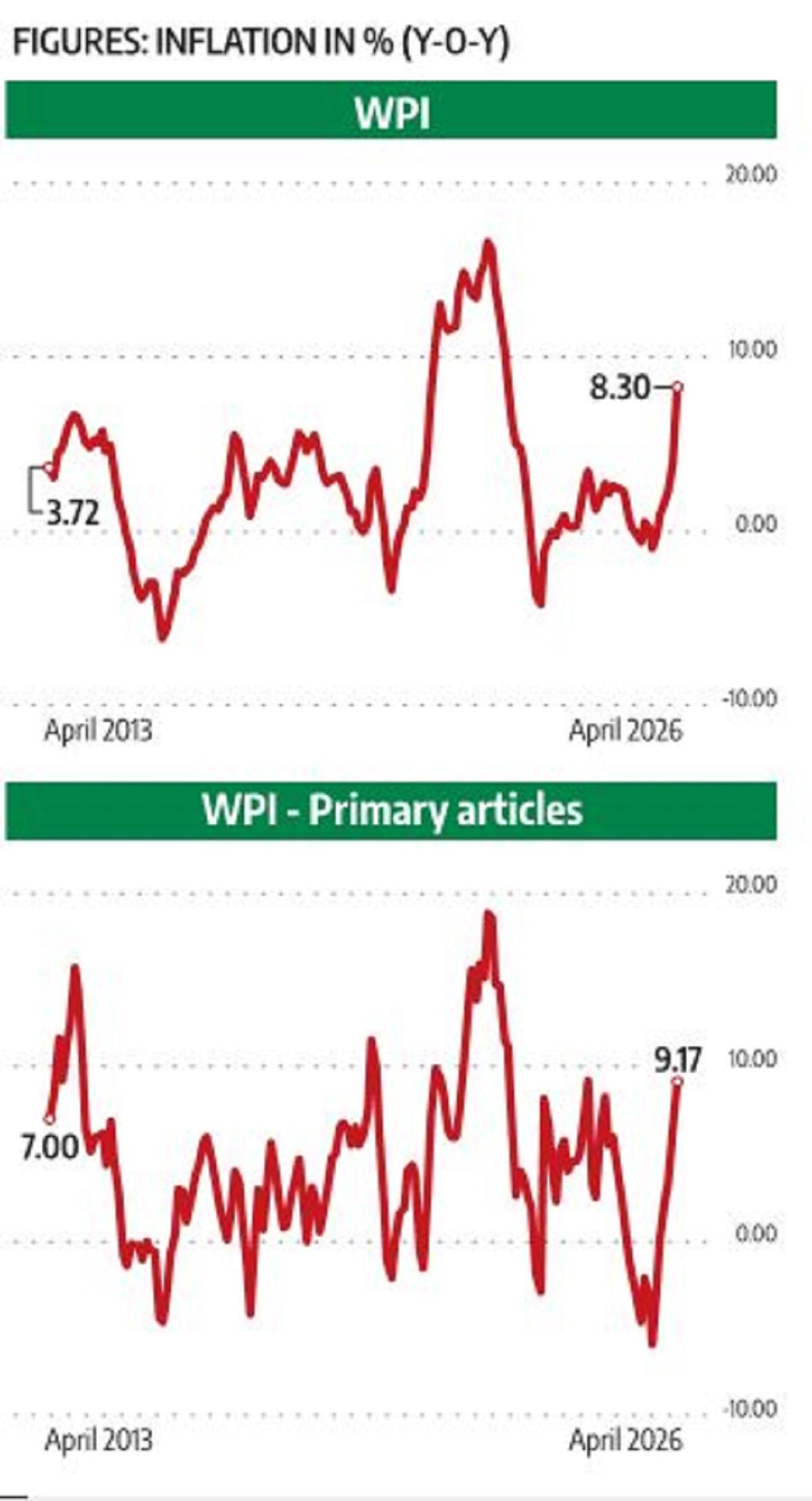
India's WPI Inflation Jumps to 9.68% in May Amid Fuel, Food Price Spikes
India's wholesale price inflation surged to 9.68% in May 2026, driven by significant increases in fuel, food, and manufactured goods prices. This rise, reported by the Commerce and Industry Ministry, follows a revision of the WPI base year to 2022-23. The spike is largely attributed to global crude oil prices and the West Asia crisis.
Key Highlights
- WPI inflation hit 9.68% in May 2026, up from 8.26% in April.
- Fuel and power inflation surged to 30.33%, crude oil prices up 61.51%.
- Manufactured products inflation rose to 7.48% in May.
- WPI Food Index increased to 4.49% due to rising prices.
- New WPI base year revised to 2022-23 for updated measurement.
- West Asia crisis and global crude oil prices cited as key drivers.
India's wholesale price index (WPI) based inflation accelerated significantly to 9.68% in May 2026, marking a substantial increase from 8.26% recorded in April 2026. This surge has been primarily attributed to a sharp rise in the prices of fuel and power, manufactured items, and food articles across the country. The data, released by the Ministry of Commerce and Industry on June 15, 2026, also introduced a major revision in the WPI series, updating the base year from 2011-12 to 2022-23 after more than a decade.
The most significant contributor to the escalated wholesale inflation was the fuel and power segment, which witnessed an inflation rate of 30.33% in May, a notable jump from 24.89% in April. Within this category, crude petroleum and natural gas experienced an even steeper price acceleration, with inflation reaching 61.51% in May compared to 56.31% in the preceding month. Mineral oils also recorded a high inflation rate of 49.82% in May. Experts and government statements have largely linked this sharp rise in energy costs to the ongoing West Asia crisis and the effective blockade of the Strait of Hormuz, a critical chokepoint for global crude oil imports, including a majority of India's crude oil supply. The geopolitical tensions have led to elevated global crude oil prices, which have in turn pushed up domestic fuel prices. This external shock has had a direct pass-through effect on the input costs for various sectors of the Indian economy.
Beyond fuel, the manufactured products segment, which holds the highest weightage in the WPI basket, also registered an upward trend in inflation. Prices in this category rose to 7.48% in May from 6.68% in April. Major drivers within manufactured products included chemicals and chemical products, and basic metals, indicating a broad-based inflationary pressure originating from industrial inputs. The increase in energy costs directly affects manufacturing as industries rely heavily on fuel for production and transportation, leading to higher operational expenses which are then passed on to consumers in the form of increased prices.
Food inflation also contributed to the overall rise in WPI. While specific 'food articles' inflation was reported at 3.60% in May, up from 2.43% in April, the broader WPI Food Index, encompassing both food articles and manufactured food products, increased to 4.49% from 3.11% in the previous month. This indicates a general hardening of food prices, which, combined with the fuel and manufacturing inflation, paints a challenging picture for price stability.
The Ministry of Commerce and Industry's decision to revise the WPI base year to 2022-23 is a significant development. This is the first major revision in over a decade, with the previous base year being 2011-12. The new series includes an expanded basket of 957 items, up from 697, and incorporates new energy sources like solar, wind, and nuclear electricity into the 'Electricity' group. Additionally, 'Crude Petroleum and Natural Gas' has been reclassified from 'Primary Articles' to the 'Fuel and Power' major group, aiming for better alignment with other major fuels. This revision provides a more contemporary and representative measure of wholesale price movements in the Indian economy.
The surge in wholesale inflation is also mirrored in retail or consumer price index (CPI)-based inflation, which climbed to a 16-month high of 3.93% in May, compared to 3.48% in April. While the Reserve Bank of India (RBI) primarily considers CPI for its monetary policy decisions, targeting a headline inflation rate of 4% with a 2% margin on either side, the rising WPI figures could eventually exert upward pressure on retail prices. Earlier in the month, the RBI had already raised its inflation projection for the current fiscal year to 5.1% from an earlier forecast of 4.6%, citing mounting input costs driven by higher global energy prices affecting retail petrol and diesel prices. The rising global crude oil prices had already led to a significant increase of ₹7.50 per litre in petrol and diesel prices during the second half of May.
Economists suggest that while the immediate impact on interest rates might not be seen, the RBI will closely monitor any "second-round impact" of these higher fuel prices on the broader economy. There is some expectation of respite in WPI inflation for June 2026, particularly given reports of a preliminary pact between the US and Iran to end their conflict and reopen the Strait of Hormuz, which could lead to a cooling of global energy and commodity prices. However, the current figures highlight persistent inflationary pressures stemming from both global geopolitical factors and domestic supply chain dynamics. The government and the central bank face the challenge of managing these pressures to ensure economic stability and protect consumer purchasing power. This comprehensive overview underscores the multi-faceted nature of inflation in India, driven by global events impacting commodity prices and domestic economic structures. The revised WPI series offers a more nuanced perspective, but the underlying inflationary trends remain a key concern for policymakers.
Frequently Asked Questions
What is WPI inflation and why is it important for India?
WPI, or Wholesale Price Index, measures the average change in the prices of goods sold in bulk by wholesale businesses to other businesses. It's a key indicator of inflationary pressures in the economy, reflecting input costs for producers and businesses before goods reach consumers. For India, WPI is crucial as it helps policymakers understand the cost pressures on industries and can eventually impact retail prices.
What caused the sharp rise in WPI inflation in May 2026?
The significant increase in WPI inflation to 9.68% in May 2026 was primarily driven by a sharp spike in the prices of fuel and power, manufactured items, and food articles. Geopolitical tensions, particularly the West Asia crisis and its impact on global crude oil prices, as well as the effective blockade of the Strait of Hormuz, played a major role in driving up fuel costs and, subsequently, other input prices.
How does this WPI surge impact the common consumer?
While WPI directly measures wholesale prices, a sustained rise in WPI often translates into higher retail prices for consumers over time. Increased input costs for manufacturers and higher fuel prices for transportation eventually get passed on to the end consumer, leading to higher prices for daily necessities and other goods. It also influences the Reserve Bank of India's monetary policy decisions, which can affect interest rates.
What is the significance of the WPI base year revision to 2022-23?
The revision of the WPI base year to 2022-23 from 2011-12 is significant as it provides a more current and representative reflection of the Indian economy's structure. It updates the basket of commodities, incorporates new energy sources, and reclassifies certain items, ensuring that the index better captures contemporary price movements and structural changes in production and consumption.
What is the outlook for inflation in the coming months?
While the May 2026 WPI data shows a significant increase, some economists anticipate a potential moderation in June. This expectation is partly based on reports of easing geopolitical tensions in West Asia and a preliminary agreement between the US and Iran, which could lead to a cooling of global energy and commodity prices. However, the Reserve Bank of India has already revised its inflation projection upwards for the current fiscal year, indicating continued vigilance over price stability.