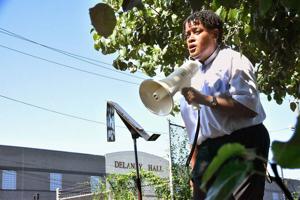
New Jersey State Police Assert Control Amid Violent Migrant Detention Protests
New Jersey State Police took control outside Newark's Delaney Hall migrant detention center in late May 2026, following escalating clashes between protesters and federal immigration agents. The protests erupted over reports of inhumane conditions and a hunger strike by detainees, drawing significant political and public attention to the privately-run facility.
Key Highlights
- New Jersey State Police intervened at Delaney Hall in May 2026.
- Protests sparked by detainee hunger strike over alleged inhumane conditions.
- Clashes between protesters and ICE agents involved pepper spray and batons.
- Governor Sherrill ordered state police to ensure public safety and protest rights.
- Newark Mayor imposed a curfew; congressional members raised human rights concerns.
- Delaney Hall, run by GEO Group for ICE, reopened in 2025.
In late May 2026, New Jersey State Police were ordered to assert control outside the Delaney Hall migrant detention center in Newark, following a week of escalating and often violent clashes between protesters and federal Immigration and Customs Enforcement (ICE) agents. New Jersey Governor Mikie Sherrill, a Democrat, announced the deployment of state police on May 29, 2026, aiming to de-escalate tensions and ensure both public safety and the right to peaceful assembly. This intervention came after days of intense demonstrations fueled by allegations of inhumane conditions and a hunger and labor strike initiated by detainees inside the facility.
Delaney Hall, a 1,000-bed facility operated by the private company GEO Group under a billion-dollar contract with ICE, had reopened in early 2025. The facility quickly became a flashpoint for controversy, including a notable confrontation on May 9, 2025, where Newark Mayor Ras Baraka was arrested for trespassing during an oversight visit with other Democratic politicians. However, the more extensive protests that prompted state police intervention began in late May 2026. Detainees inside Delaney Hall had communicated with relatives and advocacy groups, detailing complaints such as food containing worms and mold, unsanitary bathrooms, lack of air conditioning, overcrowding, and denied medical care for serious conditions.
The hunger strike, reportedly involving about 300 detainees, demanded their release and drew national attention to the facility's conditions. Outside the center, protesters, including immigrant advocacy groups, gathered daily to show solidarity with the detainees and call for the facility's closure. Tensions frequently boiled over, leading to confrontations where ICE agents reportedly used batons and pepper spray against demonstrators. Eyewitness accounts and videos shared on social media showed protesters attempting to block vehicle entrances and exits, using makeshift shields, while law enforcement responded with crowd-control tactics.
One significant incident occurred on May 25, 2026, when protesters clashed with ICE agents while attempting to prevent the transfer of Martin Soto Hernandez, a detainee identified as a key organizer of the hunger strike. DHS officials confirmed the event, stating that approximately 125 "agitators" surrounded the facility, blocked entrances, and damaged an ICE vehicle. Despite the protests, officials managed to transfer Soto Hernandez to another facility.
Political figures also weighed in on the escalating situation. President Donald Trump, during a White House Cabinet meeting, defended Delaney Hall as a "nice facility" and controversially claimed that the protesters were "fake" and being paid, offering no evidence for his assertions. Homeland Security Secretary Markwayne Mullin, who was confirmed to his position on March 23, 2026, also dismissed claims of poor conditions and the hunger strike, stating that detainees were merely refusing to eat because they desired "ethnic food." These statements were widely disputed by detainees' families, advocacy groups, and members of Congress who visited the site.
Conversely, several Democratic members of Congress from New Jersey and New York, including Senator Cory Booker and representatives like LaMonica McIver, Bonnie Watson Coleman, and Rob Menendez, conducted oversight visits. They reported observing dire conditions, corroborating detainees' accounts of medical neglect, small food portions, and instances of mold and maggots in meals. Senator Andy Kim (D-NJ) became a leading voice in advocating for the closure of Delaney Hall, undertaking multiple oversight visits and introducing amendments to ensure accountability, improve medical care, and require de-escalation training for ICE officials. He continued to highlight concerns about detainee deaths and ICE's alleged lack of accountability into August 2026.
In response to the intensifying unrest, Newark Mayor Ras Baraka implemented an overnight curfew around Delaney Hall on May 31, 2026, citing the need to protect public safety and stating that some individuals had been arrested with weapons. The deployment of New Jersey State Police aimed to create designated protest zones and traffic checkpoints, allowing ICE agents to withdraw from the immediate vicinity of the clashes. The situation at Delaney Hall underscores the ongoing national debate in the United States regarding immigration policies, the treatment of detainees, and the role of private companies in federal detention operations.
Frequently Asked Questions
What is Delaney Hall and why did protests erupt there?
Delaney Hall is a privately-run immigrant detention center in Newark, New Jersey, operated by GEO Group under contract with ICE. Protests erupted in late May 2026 due to a hunger and labor strike by detainees, who reported inhumane conditions including moldy food, lack of medical care, and overcrowding.
What was the role of New Jersey State Police in the Delaney Hall situation?
New Jersey Governor Mikie Sherrill ordered state police to assume control outside Delaney Hall on May 29, 2026. Their role was to de-escalate violent clashes between protesters and federal ICE agents, ensure public safety, and protect the right to protest by establishing designated zones.
How did political leaders respond to the events at Delaney Hall?
President Donald Trump and DHS Secretary Markwayne Mullin publicly defended the facility and dismissed claims of poor conditions. In contrast, New Jersey Governor Mikie Sherrill called for the facility's closure, and several Democratic members of Congress, including Senator Andy Kim, conducted oversight visits and advocated for improved conditions and accountability.
What were the alleged conditions inside Delaney Hall that led to the hunger strike?
Detainees alleged receiving food with worms or mold, sleeping on overcrowded floors, being denied medical care for serious conditions, and experiencing abuse from guards. These reports were largely corroborated by visiting congressional members.
Has the situation at Delaney Hall been resolved?
While state police intervention brought some order to the protests in May 2026, the underlying issues regarding detainee welfare and facility conditions remained. Senator Andy Kim continued to raise concerns about medical neglect and detainee deaths at Delaney Hall into August 2026, indicating ongoing problems and advocacy for its closure.