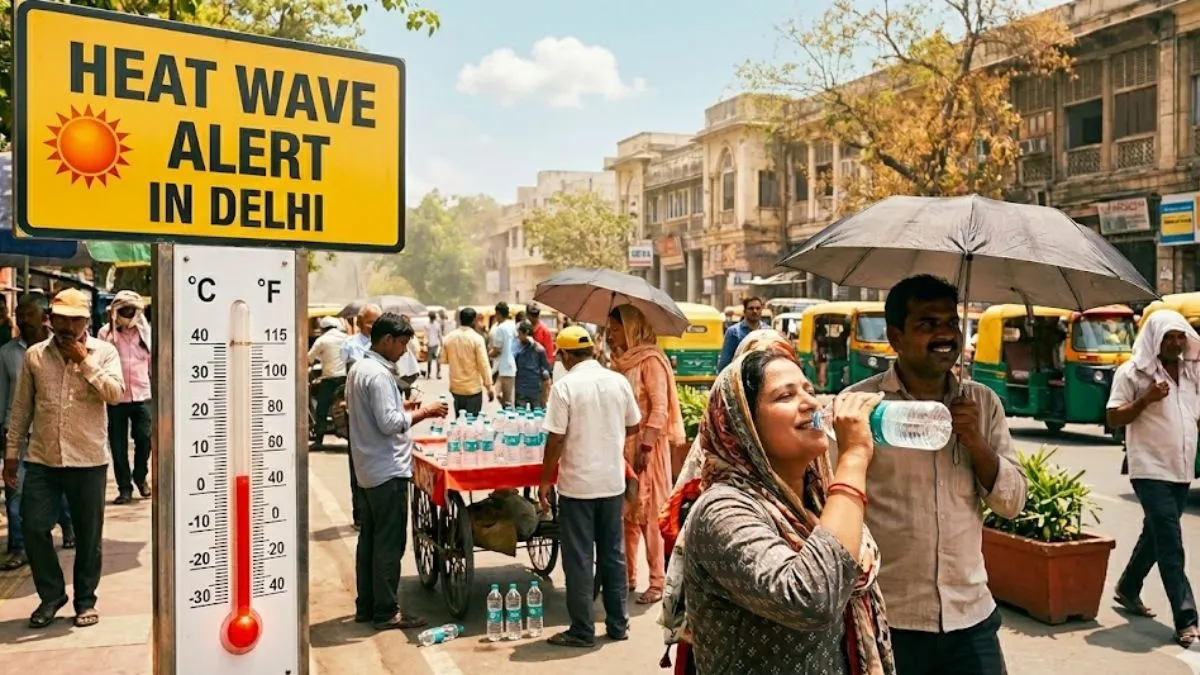
Delhi Heatwave: Orange Alert Issued, Temperatures to Hit 45°C
Delhi is under an 'orange alert' for severe heatwave conditions, with temperatures expected to soar up to 45°C. The India Meteorological Department forecasts these sweltering conditions will persist for the next few days across the capital and other parts of North and Central India. Residents are advised to take precautions against the extreme heat.
Key Highlights
- Delhi under 'Orange Alert' for severe heatwave conditions.
- Maximum temperatures likely to reach 43-45°C in Delhi.
- Heatwave conditions expected to continue until April 27 in Delhi.
- IMD predicts heatwave across North and Central India.
- Potential easing from April 28 with chances of rain.
- Hospitals are preparing for heat-related emergencies.
Delhi is currently grappling with severe heatwave conditions, prompting the India Meteorological Department (IMD) to issue an 'orange alert' for Sunday, April 26, 2026, and a 'yellow alert' for Monday, April 27, 2026. The national capital has experienced its third consecutive day of heatwave conditions on Sunday, with temperatures soaring significantly above seasonal averages. The maximum temperatures in Delhi are forecast to hover between 43°C and 45°C, with some predictions indicating they could even touch 44°C in isolated areas.
The sweltering weather is not confined to Delhi alone, but is widespread across northwest and central India. The IMD had predicted heatwave conditions for the "next 3 days" from Saturday, April 25, covering regions like Punjab, Haryana, Uttar Pradesh, Rajasthan, Madhya Pradesh, Odisha, and Chhattisgarh. This means Delhi's intense heat is expected to continue until at least Monday, April 27.
The Hindustan Times article, published on April 26, 2026, accurately reported the 'orange alert' and the continuation of hot weather. The claim of 'sweltering hot weather conditions to continue for 3 days' is consistent with the IMD's forecast, which indicated heatwave persistence over the broader Northwest and Central India region through April 27. However, some relief might be on the horizon for Delhi. From April 28 onwards, a shift in lower-level easterly winds is anticipated, which could lead to a reduction in maximum temperatures. There is also a possibility of light rain and thunderstorms in some areas towards the afternoon of April 27 and continuing into April 28, which could provide some respite.
On Saturday, April 25, Delhi's Safdarjung station recorded a maximum temperature of 42.8°C, which was 5.1°C above normal and marked the city's hottest day of the year so far. Other weather stations in Delhi, such as Ridge, also reported heatwave conditions with temperatures reaching 43.1°C on Friday, April 24, a departure of 4.7°C from normal. The minimum temperatures in Delhi are expected to remain in the range of 25-27°C, with warm night conditions adding to the discomfort.
Beyond Delhi, other parts of Uttar Pradesh are also experiencing extreme heat. For instance, Prayagraj recorded the country's highest maximum temperature at 45.2°C on Saturday, April 25. While the provided related article mentioned Banda at 47.4°C, this specific reading was not widely corroborated as the highest for the current date range (April 25-26, 2026) in the real-time search, with Prayagraj being cited as the hottest. The IMD has highlighted that heatwave conditions are very likely in isolated pockets across several states during this period, with some regions experiencing 'appreciably above normal' maximum temperatures.
The health implications of such intense heat are significant. The IMD has issued advisories urging people to drink plenty of water, avoid direct sunlight between 12 pm and 4 pm, use hats or umbrellas, and not to leave children or pets in parked vehicles. Hospitals in Delhi are also gearing up for heat-related emergencies, reopening specialized clinics to manage potential heatstroke cases.
AccuWeather's forecast for Delhi in April 2026 indicates daily high temperatures ranging from 98°F to 108°F (36.7°C to 42.2°C), with average highs around 102°F (38.9°C), reinforcing the severity of the current conditions. The early and intense heatwave points towards a challenging summer ahead, prompting authorities and health services to remain on high alert.
In conclusion, the Hindustan Times article's core claims regarding the orange alert for heatwave in Delhi and the continuation of hot conditions are well-supported by real-time IMD forecasts and corroborating reports from other credible news outlets. The severity and widespread nature of the heatwave across North and Central India underscore the importance of public awareness and precautionary measures.
Frequently Asked Questions
What is an 'Orange Alert' for a heatwave?
An 'Orange Alert' issued by the IMD signifies a high probability of severe heatwave conditions, warning the public and authorities to be prepared for adverse impacts and take necessary precautions to mitigate health risks.
How long are the severe heatwave conditions expected to last in Delhi?
Severe heatwave conditions are expected to continue in Delhi until at least Monday, April 27, 2026. Relief might begin from Tuesday, April 28, due to anticipated wind shifts and potential light rainfall.
What temperatures are expected in Delhi during this heatwave?
Maximum temperatures in Delhi are forecast to range between 43°C and 45°C during this period, with some areas potentially reaching 44°C.
Which other regions in India are affected by the current heatwave?
Besides Delhi, heatwave conditions are widespread across Northwest and Central India, including parts of Punjab, Haryana, Uttar Pradesh, Rajasthan, Madhya Pradesh, Odisha, and Chhattisgarh.
What precautions should residents take during a heatwave?
Residents are advised to stay hydrated by drinking plenty of water, avoid direct exposure to sunlight, especially between 12 pm and 4 pm, use hats or umbrellas, and ensure children and pets are not left in parked vehicles.