EarthCARE Radar Reveals Cloud Dynamics in Cold-Air Outbreaks | Quick Digest
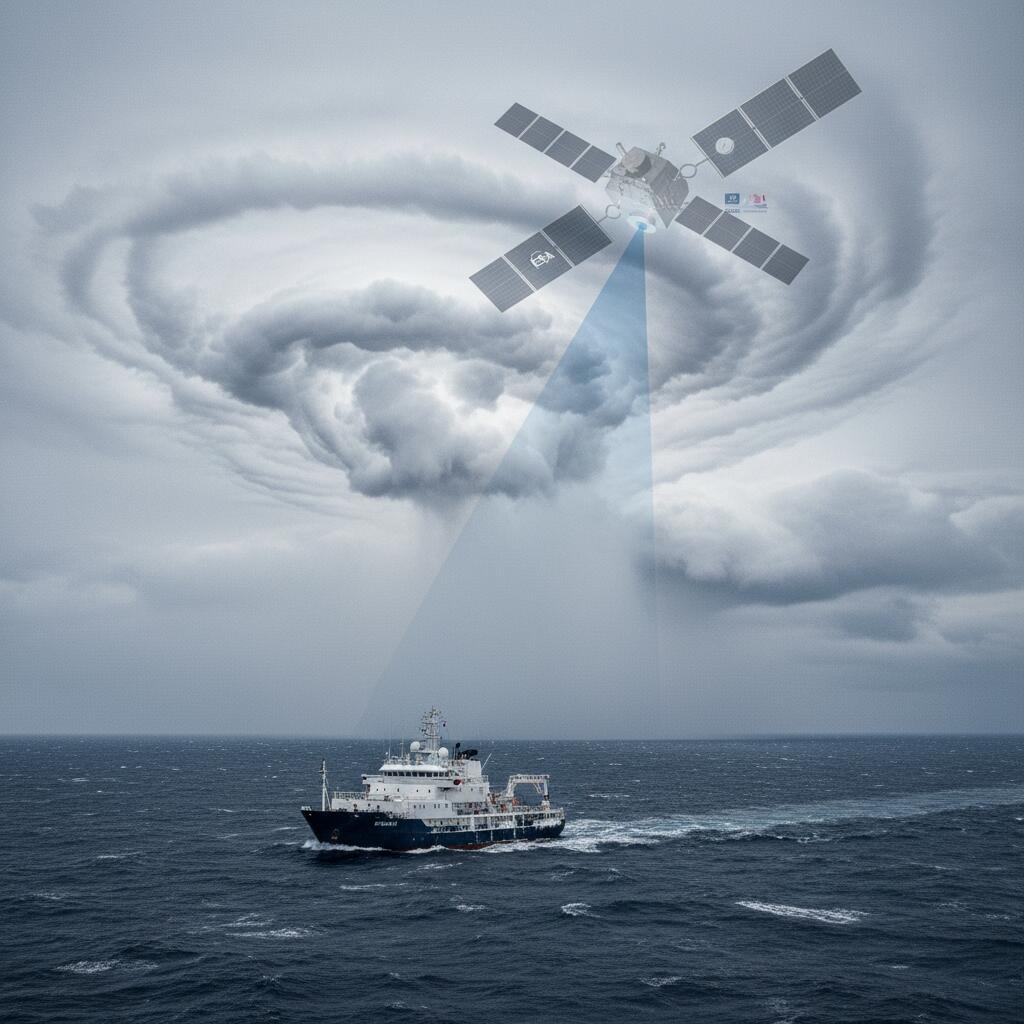
The EarthCARE satellite's Cloud Profiling Radar (CPR) has delivered the first-of-its-kind observations detailing the internal dynamics and microphysics of marine cold-air outbreak clouds. This joint ESA-JAXA mission aims to enhance our understanding of cloud-aerosol-radiation interactions crucial for climate modeling.
EarthCARE mission launched in May 2024, a joint ESA-JAXA venture.
Cloud Profiling Radar (CPR) provides first-ever spaceborne Doppler measurements of cloud vertical motion.
Observations reveal dynamics-microphysics coupling in marine cold-air outbreak clouds.
Data improves understanding of cloud processes vital for climate change models.
ESS Open Archive hosts early scientific findings from EarthCARE data.
The Earth Cloud, Aerosol and Radiation Explorer (EarthCARE) satellite, a collaborative mission between the European Space Agency (ESA) and the Japan Aerospace Exploration Agency (JAXA), was successfully launched in May 2024. Its primary objective is to provide unprecedented insights into the intricate relationship between clouds, aerosols, and radiation, which are critical but poorly understood components of Earth's climate system. The mission carries four advanced instruments, including the Cloud Profiling Radar (CPR), provided by JAXA.
In a significant scientific achievement, the CPR instrument has begun delivering the first spaceborne observations revealing the internal dynamics and vertical motion of clouds. This marks a world-first for a Doppler radar operating in the W-band from space. The reported observations specifically focus on the 'dynamics-microphysics coupling' within marine cold-air outbreak clouds. This phenomenon, occurring when cold air moves over warmer ocean surfaces, leads to distinct cloud formations whose internal processes are crucial for accurate climate and weather predictions.
These initial findings from EarthCARE's CPR, likely presented via the ESS Open Archive as an early release of scientific research, represent a pivotal step in improving climate models. By precisely measuring how cloud particles form, grow, and move, scientists can better quantify the roles clouds play in heating and cooling the atmosphere, ultimately enhancing the accuracy of global warming predictions. The mission's data stream, with Level-1 data available since January 2025 and Level-2 products since March 2025, is poised to significantly advance atmospheric science.
Read the full story on Quick Digest