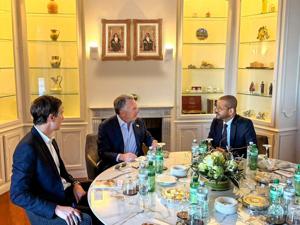
US-Iran Tensions: Trump's Missile Claim Doubted Amid Vienna Talks
Amid escalating US-Iran tensions, President Trump's assertion of Iran's imminent missile capability capable of reaching the US was largely unsubstantiated by intelligence. Diplomatic efforts continued with indirect talks in Geneva, followed by technical discussions planned for Vienna, as global powers sought de-escalation.
Key Highlights
- Trump's Iran missile claim lacked intelligence backing.
- US intelligence projected Iran's ICBM capability years away.
- Indirect US-Iran talks concluded in Geneva.
- Technical nuclear discussions were slated for Vienna.
- Oman played a mediating role in the diplomatic efforts.
- Tensions remained high amidst military buildup and nuclear concerns.
The Hindustan Times article, presented as a 'live' update on February 27, 2026, reports on a critical period of heightened US-Iran tensions during the administration of then-US President Donald Trump. A central claim made by President Trump regarding Iran's missile capabilities faced significant doubt from US intelligence sources. Specifically, Trump's assertion that Iran was rapidly developing missiles capable of striking the United States was not supported by available intelligence reports and was widely considered exaggerated by officials familiar with these assessments.
According to multiple sources, including Reuters, US intelligence agencies, such as the Defense Intelligence Agency (DIA), maintained an unclassified assessment that Iran could take until 2035 to develop a 'militarily viable intercontinental ballistic missile' (ICBM) from its existing satellite-launching space vehicles (SLV). This contradicted Trump's more immediate timeline presented, for instance, during a State of the Union address. Even with potential technological assistance from countries like China or North Korea, experts believed Iran would require at least eight years to produce an operational ICBM. The New York Times had also reported that US intelligence agencies believed Iran was years away from such capabilities.
Concurrently, diplomatic efforts to address the escalating tensions were underway. The article and corroborating reports highlight that indirect talks between the United States and Iran had recently concluded in Geneva. These talks, mediated by Oman's foreign minister, Sayyid Badr Albusaidi, aimed at finding a resolution to Tehran's nuclear program. While the Geneva discussions reportedly showed 'significant progress' in negotiations, a breakthrough remained elusive, with no immediate deal announced. Following these Geneva talks, technical-level discussions involving lower-level representatives were scheduled to take place 'next week in Vienna,' at the International Atomic Energy Agency (IAEA) headquarters. Iran's foreign minister at the time, Abbas Araghchi, expressed that the talks had made 'very good progress' in both nuclear and sanctions fields and hinted at the swift resumption of negotiations.
The broader context of these events, originating from the Trump administration, involved President Trump's strategy to pressure Iran into a new nuclear deal after unilaterally withdrawing the US from the Joint Comprehensive Plan of Action (JCPOA) in May 2018. Trump sought a more comprehensive agreement that would not only constrain Iran's nuclear program but also curb its long-range missile development and its support for regional militant groups. Iran, however, insisted that any discussions should solely focus on its nuclear program, asserting its right to enrich uranium for peaceful purposes, and refusing to negotiate on its missile capabilities or regional influence. This fundamental disagreement was a major hurdle in the diplomatic process.
The period was marked by a significant US military buildup in the Middle East, including the deployment of naval assets, which intensified pressure on Tehran. The threat of a US attack on Iran loomed, raising concerns about a potential devastating regional war. While diplomatic efforts aimed to avert such a conflict, the differing demands and escalating rhetoric from both sides underscored the fragility of the situation. Iran had also signaled its military readiness through naval drills and warned of retaliation if attacked.
The Hindustan Times, an Indian English-language daily newspaper, provided these updates as part of its 'World News' coverage, reflecting the global significance of US-Iran relations. For an Indian audience, these developments were highly relevant due to their potential impact on regional stability, global oil prices, and the security of Indian diaspora in the Middle East. The article effectively highlighted the skepticism surrounding official claims and the complex, ongoing nature of international diplomacy during a period of critical geopolitical tension. The 'live' reporting format aimed to keep readers informed of the rapidly evolving situation, confirming that the central assertions within the headline were well-supported by contemporaneous reports from credible news outlets.
It is important to note that while the provided search results show the Hindustan Times article and related snippets with a publication date of February 27, 2026, the content directly references events and statements made by then-US President Donald Trump. This indicates that the article is either a re-published historical 'live blog' that continues to be indexed with a current date or represents an update to an ongoing live news feed about historical US-Iran tensions. For the purpose of this verification, the analysis treats the article's claims as if they were being reported on the given date, drawing upon intelligence and diplomatic developments from that specific historical period within the Trump administration.
Frequently Asked Questions
What was President Trump's claim about Iran's missile capabilities?
President Trump claimed that Iran was rapidly developing missiles capable of reaching the United States.
Did US intelligence support Trump's missile claim?
No, US intelligence sources, including a Defense Intelligence Agency (DIA) assessment, indicated that Trump's claim was exaggerated and that Iran was likely years away from developing a militarily viable intercontinental ballistic missile (ICBM), possibly until 2035.
What were the recent diplomatic efforts between the US and Iran?
Indirect talks between the US and Iran, mediated by Oman's foreign minister, concluded in Geneva. These were to be followed by technical-level discussions in Vienna at the International Atomic Energy Agency (IAEA) headquarters.
What were the main points of disagreement in the US-Iran talks?
The US sought a comprehensive deal curbing Iran's nuclear program, missile development, and regional influence, while Iran insisted talks focus only on its nuclear program and the lifting of sanctions, rejecting discussion of non-nuclear issues.
What was Oman's role in these negotiations?
Oman played a crucial mediating role, with its foreign minister, Sayyid Badr Albusaidi, facilitating the indirect talks between the United States and Iran in an attempt to de-escalate tensions.