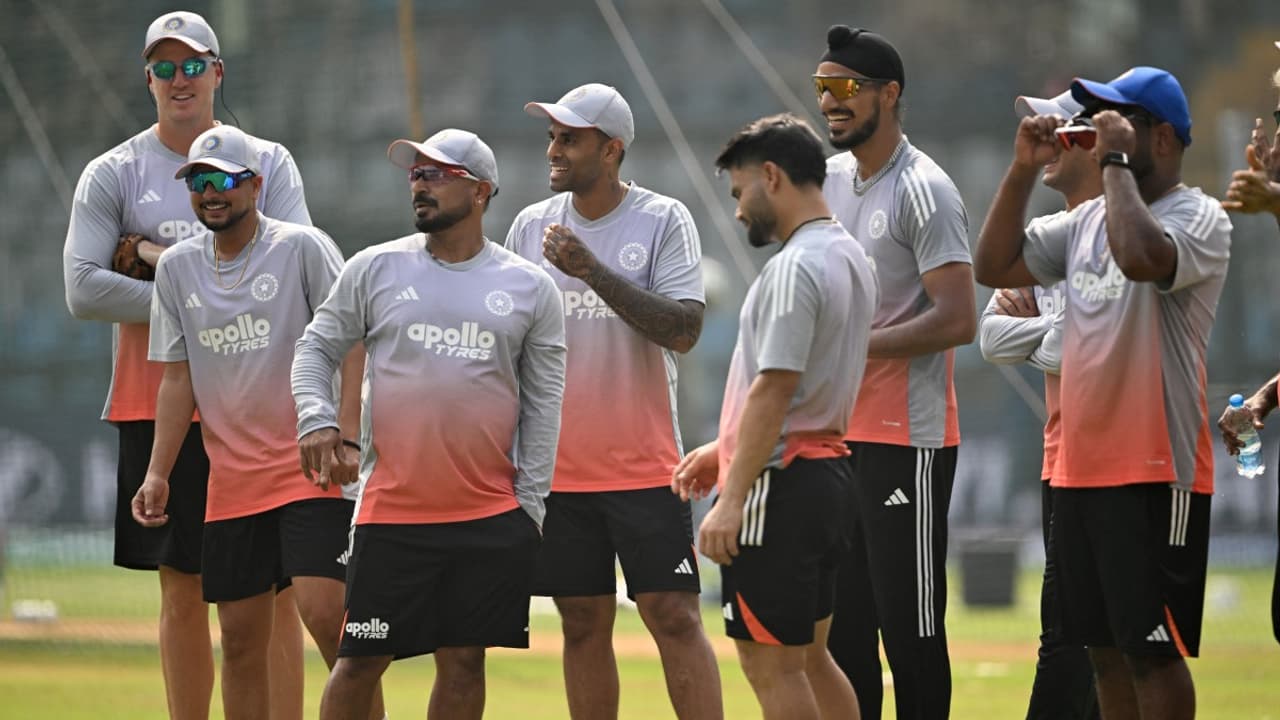
India's Aggressive Batting Tested at T20 World Cup 2026
As the 2026 T20 World Cup begins, India's "hit first, ask questions later" batting strategy faces its ultimate test. Led by top-ranked Abhishek Sharma, this aggressive approach, emphasizing high strike rates and specialist T20 batters, marks a significant shift post their 2024 World Cup triumph.
Key Highlights
- India adopts 'hit first' aggressive batting for T20 World Cup.
- Abhishek Sharma spearheads India's high-octane batting strategy.
- 2026 T20 World Cup in India-Sri Lanka is the proving ground.
- Team aims for high strike rates and minimal settling-in time.
- Strategy shifts from traditional approach of previous eras.
- Focus on specialist T20 batters over multi-format players.
India's cricketing landscape has undergone a profound transformation, particularly in the shortest format of the game, Twenty20 (T20) cricket. The article from the Times of India, published on February 7, 2026, highlights this radical shift, articulating a 'hit first, ask questions later' philosophy that defines India's current batting approach as they embark on their campaign to defend the ICC Men's T20 World Cup title in 2026. Co-hosted by India and Sri Lanka, this tournament is poised to be a critical referendum on this new, ultra-aggressive batting strategy.
This aggressive mindset is a deliberate evolution following India's triumph in the 2024 T20 World Cup. That victory, which ended an 11-year drought for an ICC trophy, saw a fundamental change in team composition and tactics. Under the captaincy of Suryakumar Yadav and with stalwarts like Rohit Sharma, Virat Kohli, and Ravindra Jadeja having retired from the format post-2024, a new generation of specialist T20 batters has emerged. The current Indian squad is built on the principle of 'acceleration,' emphasizing high base strike-rates, minimal settling-in time, and a collective intent to score aggressively from the very first ball to the last.
At the forefront of this new-age batting is Abhishek Sharma, who has rapidly ascended to become the world's No. 1 ranked T20I batter. Sharma, having debuted in mid-2024, embodies this fearless approach with his explosive starts and remarkable strike rate, which has consistently been above 190 in T20 Internationals. His performance, including a staggering 182 runs against New Zealand at a strike rate of 249.31 and 859 runs in 2025 at nearly 200 strike rate, exemplifies the team's commitment to maximizing scoring opportunities, especially during the crucial Powerplay overs.
The shift is not merely about individual brilliance but a systemic change. The Indian team is for the first time fielding a top six almost entirely composed of specialist T20 batters, rather than multi-format players adapting their game. This ensures that every player is geared towards maintaining a high tempo throughout the innings. This contrasts sharply with traditional batting philosophies, which often prioritized preserving wickets and building an innings. The new strategy aims for early dominance, targeting 75 or more runs in the Powerplay, a significant increase from the historical benchmark of 50 runs.
Other related articles provide further context and corroboration for India's evolving T20 strategy. 'India's Aggressive Batting Strategy Tested at T20 World Cup' (The CSR Journal) and 'India's All-Out Assault: The New T20 Blueprint' (Revsportz) both echo the sentiment of a transformed Indian batting lineup ready for high-risk cricket. The article 'Abhishek Sharma, Babar Azam, and why we need new measures for T20 hitting' (ESPN India) implicitly highlights the difference between this modern, aggressive hitting style and more traditional approaches, often associated with players like Babar Azam, whose strike rate in T20 World Cups has been a point of criticism, contrasting sharply with the rapidly accelerating strike rates of contemporary T20 batters.
Furthermore, the 'reinvention of spin' in Powerplays is another tactical adjustment in modern T20 cricket, as noted by Hindustan Times. Spinners, once primarily deployed in middle overs, are now proving economical and effective with the new ball, adding another layer to the strategic complexities of the format. Captains are increasingly utilizing spinners in the Powerplay to disrupt aggressive batting, with players like Varun Chakaravarthy becoming key components of India's bowling attack alongside Jasprit Bumrah and Arshdeep Singh.
India's success since the 2024 World Cup under this new approach is evident. They have won 33 out of 41 T20Is since June 29, 2024, losing only six, and sit comfortably atop the ICC rankings. The team's post-2024 phase has seen the highest run rate of 9.9 and an impressive 4.4 balls per boundary, amassing over 13 scores of 200 or more. These statistics underscore the effectiveness of their 'Dandam Dashagunam' (attacking with full force) mantra.
However, challenges remain. While the batting strategy seems clear, the bowling combination, particularly the balance between pacers and spinners, is still under discussion. The T20 World Cup 2026, with its high stakes and global competition, will be the ultimate proving ground for India's bold and aggressive blueprint, determining if 'hitting first and asking questions later' can lead them to consecutive titles.
Frequently Asked Questions
What is India's 'new-age batting' strategy for the 2026 T20 World Cup?
India's new-age batting strategy, dubbed 'hit first, ask questions later,' emphasizes aggressive, high-strike-rate scoring from the outset of the innings. It focuses on maximizing runs in the Powerplay and throughout, moving away from a more cautious, adaptive approach.
Who are the key players embodying India's aggressive T20 batting approach?
Abhishek Sharma is identified as the spearhead of this aggressive batting philosophy, currently ranked as the world's No. 1 T20I batter. Other specialist T20 batters form a top-six committed to maintaining a high scoring tempo.
What was the outcome of the 2024 T20 World Cup for India?
India won the 2024 ICC Men's T20 World Cup, marking their second title and ending an 11-year ICC trophy drought. They were undefeated throughout the tournament.
How has spin bowling evolved in T20 Powerplays?
Spinners are increasingly being used in the Powerplay overs in T20 cricket, a departure from traditional norms. This tactical shift has shown spinners to be economical and effective, challenging aggressive batting strategies.
Where and when is the 2026 T20 World Cup being held?
The ICC Men's T20 World Cup 2026 is co-hosted by India and Sri Lanka, and it is set to get underway on February 7, 2026.